- 24 September, 2026

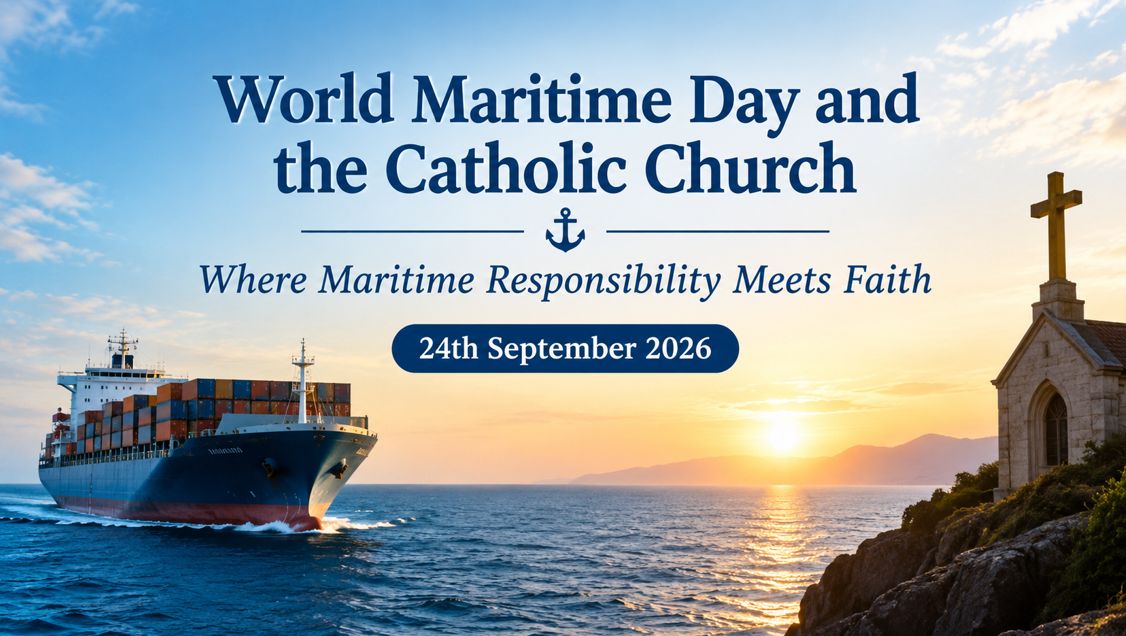
September 24, 2026: World Maritime Day, observed annually on the final Thursday of September, falls on 24 September in 2026. This year’s International Maritime Organization (IMO) theme is “From Policy to Practice: Powering Maritime Excellence”, focusing on turning international maritime rules into practical measures that make shipping safer, more secure, resilient and environmentally responsible.

World Maritime Day is not a Catholic observance. Yet its concern for seafarers, human dignity, safety, responsible work and care for the oceans has several important points of contact with Catholic teaching.
The most direct connection is Stella Maris, the Catholic Church’s maritime apostolate. In his 1997 Apostolic Letter Stella Maris, St John Paul II described the Church’s particular pastoral responsibility towards people who live and work in the maritime world, including seafarers, fishers, port workers and their families.
This mission is not merely symbolic. Stella Maris provides pastoral, spiritual and practical assistance to people whose work often separates them from their homes for long periods.

In 2025, Pope Leo XIV formally established the Apostleship of the Sea as a coordinating body with public canonical status, reaffirming the Church’s continuing commitment to the pastoral care of the “people of the sea”.
(CLICK HERE to follow Catholic Connect and to stay updated with Catholic News & Content)
World Maritime Day therefore provides a natural opportunity to recognise the people whom the Church already accompanies.
The 2026 theme has a striking connection with Catholic Social Teaching. The Church teaches that economic and technological systems must ultimately serve the human person rather than treat people merely as instruments of production.
St John Paul II's Laborem Exercens emphasises that the dignity of work comes principally from the dignity of the person who performs it. The Church therefore has a moral interest in working conditions, just remuneration, workers’ rights and protection from exploitation.
This is particularly relevant to seafarers. A maritime policy has little value if safety standards are not implemented aboard ships, if workers' rights are neglected, or if people are treated simply as replaceable components of a global economic system.
The Catholic principle is simple: maritime excellence must never come at the expense of human dignity.
The sea also has a distinctive place in the Gospels. Several of Jesus’ Apostles were fishermen, and some of Christ’s ministry took place around the Sea of Galilee.
Jesus enters boats, teaches fishermen, calls them to discipleship and famously calms a storm. The imagery offers Christians a powerful way of understanding maritime life: the sea can be a place of work and livelihood, but also a place of uncertainty, danger and dependence upon others.
The Catholic tradition remembers several saints connected with the sea and maritime life.
St. Nicholas of Myra, patron of sailors, is traditionally associated with protection during dangerous voyages.
St. Brendan the Navigator is remembered for his legendary sea journeys.
St. Peter, a fisherman of Galilee, has a special connection with the sea through the Gospels.
St. Elmo is also traditionally invoked by sailors facing storms.
Pope Francis noted this connection when addressing Stella Maris, recalling both the importance of seafarers and fishermen to the world and the hardships they can face, including isolation, exploitation, trafficking and abandonment.
A World Maritime Day observance with a Catholic dimension could naturally turn to Mary, Star of the Sea (Stella Maris).
The title expresses an ancient Christian image of Mary as a guide and intercessor for people travelling upon the waters. It also gives its name to the Church's maritime apostolate.
The symbolism is especially appropriate: just as a star helps a navigator keep a course, Christians look to Mary as one who points towards Christ. The Church's maritime ministry therefore combines practical accompaniment with spiritual care.
World Maritime Day also addresses environmental responsibility. The IMO's 2026–27 theme includes protection of the marine environment alongside safety, security, digitalisation and decarbonisation.
Catholic teaching likewise calls Christians to exercise responsible stewardship of creation. The ocean is not simply an economic resource; it is part of the created world entrusted to humanity.
This gives Catholic communities an opportunity to connect maritime responsibility with the Christian vocation to care for our common home, while recognising the livelihoods that depend upon healthy seas.
A Catholic World Maritime Day observance could therefore include prayer for seafarers and their families, a blessing for maritime workers, reflection on the dignity of work, prayers for those who have died at sea, or support for a local Stella Maris ministry.
The 2026 theme carries a message that resonates strongly with Catholic social thought. From policy to practice means ensuring that principles become real protection for people.
And for the Church, every seafarer is more than a worker moving cargo across the world's oceans. He or she is a person created in the image of God, deserving of dignity, solidarity, pastoral care and hope.
On World Maritime Day, the Catholic response can therefore be beautifully summed up by the Church's own maritime tradition: Stella Maris — Star of the Sea, pray for all who work upon the waters and guide them safely towards Christ.
By Catholic Connect Reporter




© 2026 CATHOLIC CONNECT POWERED BY ATCONLINE LLP