
- 09 May, 2026

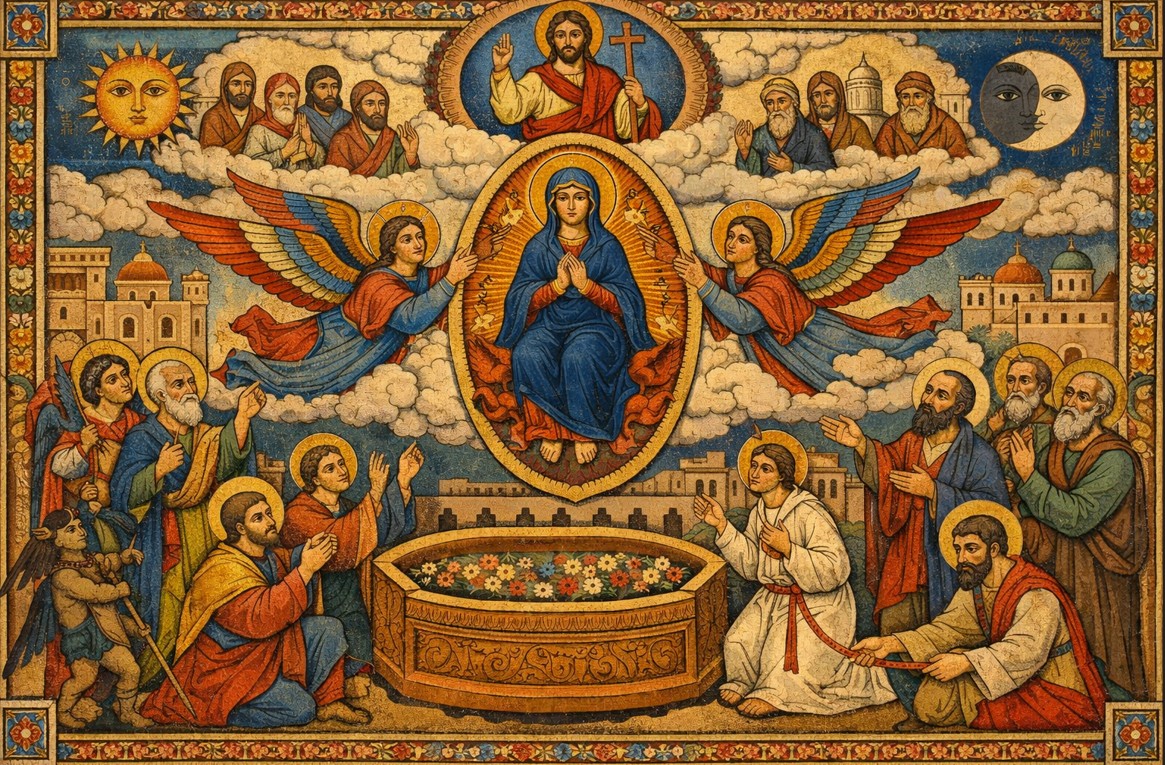
May 9, 2026: For centuries, Catholics around the world have celebrated one of the Church’s most beautiful and mysterious beliefs: the Assumption of the Blessed Virgin Mary. But in an age driven by science, skepticism and endless debate, many still ask the same question — why do Catholics believe Mary was assumed into Heaven body and soul?


The answer lies in a powerful mix of Scripture, sacred tradition and centuries of Christian belief.
The Assumption of Mary refers to the belief that at the end of her earthly life, Mary was taken up into Heaven — body and soul — by God. Unlike Jesus Christ’s Ascension, where Christ rose to Heaven by His own divine power, Mary’s Assumption was entirely God’s gift to her.
The doctrine was officially declared by Pope Pius XII in 1950 through the apostolic constitution Munificentissimus Deus, but the belief itself is far older than modern Catholicism. Early Christians across the East and West had long celebrated Mary’s entrance into Heaven, with writings and liturgical feasts dedicated to the Assumption appearing as early as the fifth and sixth centuries.


One of the strongest reasons Catholics believe in the Assumption is the unique role Mary holds in salvation history.
Catholics see Mary not simply as the mother of Jesus, but as the “New Eve.” Just as Eve played a role in humanity’s fall, Mary participated in humanity’s redemption through her obedience to God. Since death and bodily corruption entered the world through sin, many theologians argued it was fitting that Mary — preserved from original sin through the Immaculate Conception — would not undergo bodily decay after death.
(CLICK HERE to follow Catholic Connect for regular Catholic Content)
Another reason comes from the striking silence surrounding Mary’s earthly remains.
Throughout Christian history, relics of saints became treasured objects of devotion. Yet no Church ever claimed to possess the body of Mary. Historians note that if Mary’s tomb or relics existed, they would almost certainly have become one of Christianity’s most sacred pilgrimage sites. Instead, early Christians consistently taught that Mary had been taken into heavenly glory.
While the Bible does not directly describe the Assumption, Catholics point to several scriptural passages that they believe foreshadow it. In Revelation 12, John describes a “woman clothed with the sun” appearing in Heaven, a passage many theologians connect symbolically to Mary. Psalm 132 also speaks of the Ark of the Covenant entering God’s resting place — and Catholic tradition often sees Mary as the “New Ark,” because she carried Christ within her.
Beyond theology, the Assumption carries a deeply human message of hope.
In a world marked by suffering, death and uncertainty, the Assumption reminds believers that Heaven is not an abstract idea, but a promised destiny. Mary’s Assumption is viewed as a preview of the resurrection Christians hope for at the end of time — the belief that both body and soul are destined for eternal life with God.
That hope explains why the Feast of the Assumption, celebrated every year on August 15, remains one of the most important Marian feasts in the Catholic Church. Across countries like Italy, Spain, the Philippines, India and Latin America, processions, Masses and public celebrations honour Mary’s heavenly entrance.
Even today, devotion to the Assumption continues to grow, especially among younger Catholics rediscovering ancient traditions through social media, podcasts and online faith communities.
More than 2,000 years after Mary’s life, the mystery of the Assumption still captures the imagination of millions — not simply because of what Catholics believe happened to Mary, but because of what it promises for humanity itself: that death is not the end, and glory awaits beyond the grave.
By Catholic Connect Reporter

© 2026 CATHOLIC CONNECT POWERED BY ATCONLINE LLP