

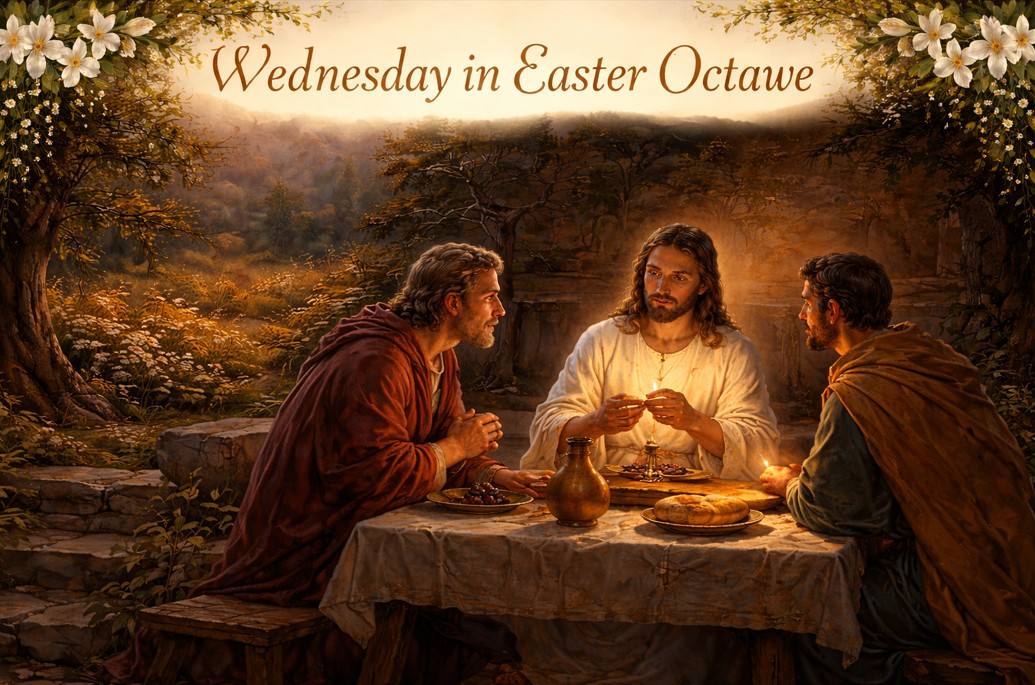
Vatican City, April 8, 2026: Wednesday in the Easter Octave reveals a profound and intimate truth of the Resurrection—Jesus Christ is alive and walking among His people, even when they do not immediately recognize Him. As the Church continues its joyful eight-day celebration of Easter, this day highlights transformation through encounter, Scripture, and the breaking of bread.

Significance of Wednesday in the Easter Octave
This day emphasizes recognizing Christ in unexpected moments.
- It reflects the continuing celebration of Easter as a prolonged feast of resurrection joy.
- The focus is on spiritual insight, recognition, and faith awakening.
- It teaches that Christ is present even when not immediately seen or understood.
- In Catholic teaching, it highlights the importance of encountering Christ through Scripture and the Eucharist.
Historical Origins of Wednesday in the Easter Octave
The observance is deeply rooted in early Christian liturgical tradition.

- It forms part of the Easter Octave, established by the early Church to extend Easter celebrations.
- By the 4th century, each day of the octave was treated as a solemn continuation of Easter Sunday.
- Specific Gospel readings were assigned to reflect different resurrection encounters.
- The structure remains unchanged in the Catholic liturgical calendar today.
Relevance in the Catholic Church Today
Wednesday in the Easter Octave continues to guide believers in their faith journey.
- It encourages Catholics to recognize Christ’s presence in daily life.
- The liturgy invites reflection on how faith grows through understanding and experience.
- It strengthens belief in the living presence of Christ beyond the empty tomb.
- It calls the faithful to move from doubt to deeper conviction.
Interesting Stories and Biblical Events
This day centers on one of the most meaningful Resurrection narratives.
- The Gospel recounts the journey of two disciples traveling to Emmaus.
- Jesus walks with them, explaining Scripture, yet they fail to recognize Him at first.
- They finally recognize Him in the breaking of the bread, a powerful Eucharistic moment.
- In the first reading, Peter heals a crippled man in Jesus’ name, showing the power of the Resurrection at work in the Church.
Insight: Faith often grows gradually—what begins as confusion can become clarity when Christ reveals Himself.
When It Became Part of the Catholic Church
This day developed alongside the Church’s earliest Easter traditions.
- The Resurrection was celebrated from apostolic times as the foundation of faith.
- By the 4th century, the octave system was firmly established.
- Each day, including Wednesday, received unique readings and prayers.
- It remains part of the Church’s highest-ranking liturgical celebrations.
Other Interesting Facts About Wednesday in the Easter Octave
- It is celebrated as a solemn continuation of Easter Sunday.
- The “Alleluia” remains central in all liturgical prayers.
- The Emmaus story is one of the most detailed Resurrection appearances.
- The day highlights both Eucharistic recognition and scriptural understanding.
- It is not a Holy Day of Obligation but holds great spiritual importance.
Wednesday in the Easter Octave reminds believers that Christ is often closest when least expected. It calls the faithful to open their hearts, listen to His Word, and recognize Him in the breaking of the bread—transforming ordinary moments into encounters with the risen Lord.
By Catholic Connect Reporter
________________________
Reflective Keywords : Wednesday in Easter Octave Catholic meaning, Emmaus story explained Catholic, recognizing Jesus in the Eucharist, Easter Octave significance Catholic Church, Resurrection appearances Bible, Catholic Easter reflection week, breaking of bread meaning Catholic