- 14 September, 2026
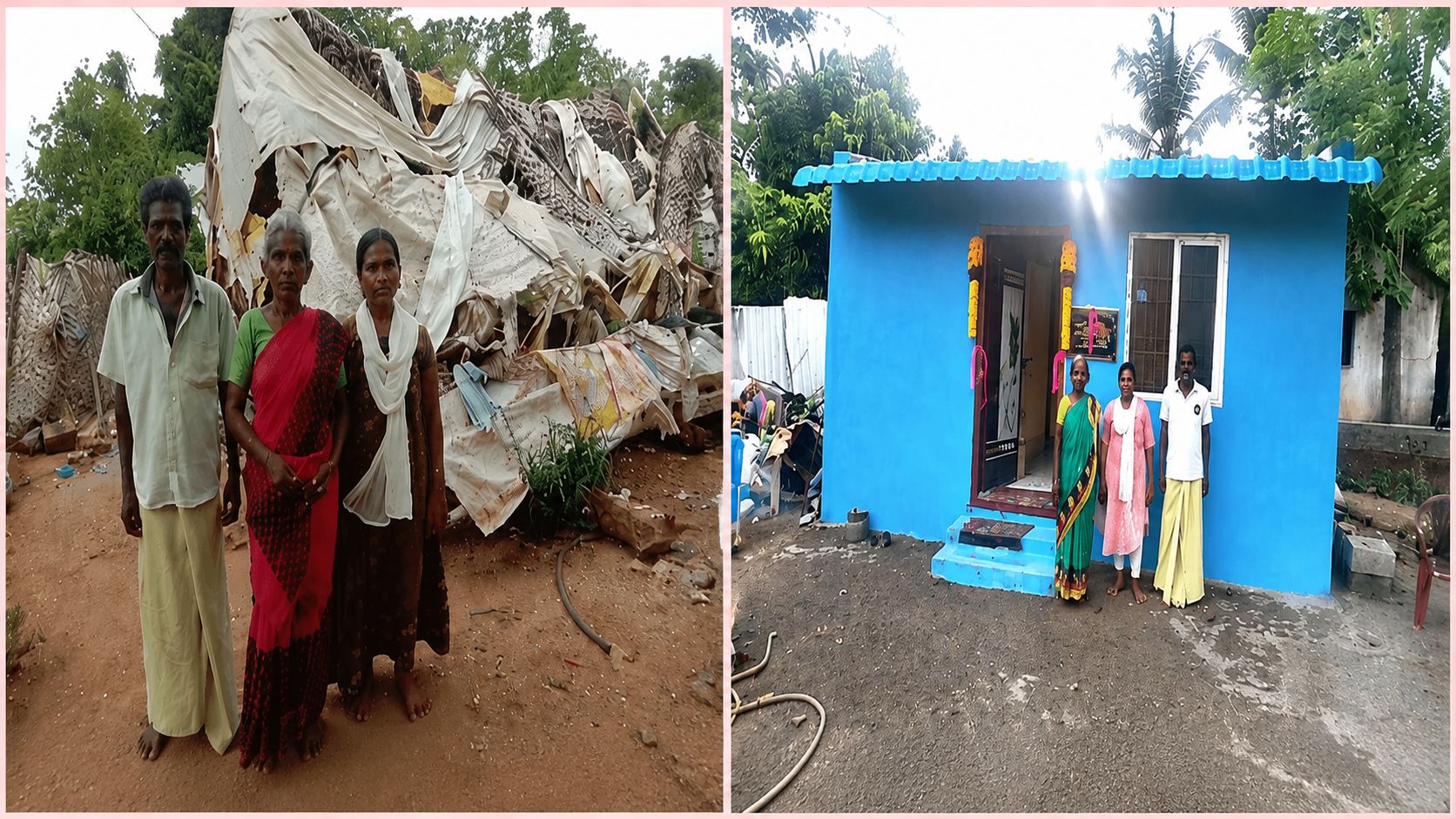
TAMIL NADU, June 11, 2026: In some of Tamil Nadu's most isolated Dalit and Tribal settlements, where families struggle to survive in makeshift shelters of plastic sheets and crumbling walls, a Church-led housing initiative is restoring not only homes but also human dignity.

The Tamil Nadu Bishops' Council's Commission for Scheduled Castes and Scheduled Tribes has launched an ambitious project to construct 60 houses for some of the state's most vulnerable families. Supported by CHARIS Singapore and inspired by the Gospel theme, “The Last, First” (Matthew 20:16), the initiative aims to build three houses in each diocese across Tamil Nadu. Twelve houses have already been completed, while construction of the remaining 48 is underway.
For Capuchin Fr. Nithiya Sagayam, Secretary of the Commission and the driving force behind the project, the initiative is far more than a housing programme.

“Many people think this is just housing,” he said. “In reality, it is giving life to lifeless people.”
Reaching Communities Left Behind
Through his ministry among Dalit and Tribal communities, Fr. Nithiya has witnessed firsthand the harsh realities faced by many Dalit Catholics in Tamil Nadu.
“Our Commission is meant for tribal and Dalit people. Many Dalit Christians lose all their benefits. Tribal people have some privileges, but Dalit Christians lose them,” he explained.
Many of these communities live in remote settlements with little or no access to basic infrastructure. Roads, drinking water facilities, toilets, schools and healthcare services are often absent, leaving residents socially and economically isolated.
“Their poverty is acute—very acute,” Fr. Nithiya said. “The possibility of development is extremely limited.”
He also pointed to caste discrimination as one of the factors contributing to the continued marginalisation of these communities.
“In Tamil Nadu, casteism is very strong. People may ask where you are from, but what they often want to know is which caste you belong to,” he said.
According to him, this mentality has sometimes found its way into Church structures as well.
“Sixty-five percent of Christians in Tamil Nadu come from Dalit communities, but their welfare is often not adequately addressed,” he noted.
Searching for the Poorest
One of the most distinctive aspects of the project is its beneficiary selection process. Rather than waiting for applications, the Commission actively seeks out families living in extreme poverty.
“The poorest people do not come asking for help,” Fr. Nithiya said. “They are poorest because they do not even know where to get help.”
He instructs his team to identify families whose living conditions evoke a deep sense of compassion. “I told my staff, ‘When you see a house and tears come to your eyes, that is the house we must build,’” he recalled.
Priority is given to widows, families with girl children, persons with disabilities and households facing exceptional hardships. The eligibility criteria are deliberately strict.
“If somebody has a cement wall, we reject them immediately. If somebody has tiles on the roof, we reject them. There are still worse-off people out there,” he explained.
The Commission's goal, he said, is to reach those who have been overlooked by everyone else.
“We are not helping people who simply have less money. We are helping people who cannot afford even one rupee. We demand nothing from them. It is purely a gift.”
Stories Behind the Houses
Behind every completed house lies a story of suffering, resilience and hope.
One family that deeply moved Fr. Nithiya lived in a fragile hut while facing overwhelming challenges. The father suffered from tuberculosis, the mother was blind and the grandmother was bedridden. Despite these hardships, the family worked tirelessly to educate their children.
Their eldest daughter excelled academically and gained admission to Anna University to study Artificial Intelligence. Tragically, she later died due to a heart condition.
“Their house was in a very pathetic state,” Fr. Nithiya recalled. When he visited them, the family did not ask for financial assistance. Instead, they requested a toilet.
“All our four ladies are there. Where will they go during the day? Where will they go at night?” they asked. The Commission provided both a toilet and a new home. Shortly afterwards, the father also passed away.
“Not a single person from the village came for the funeral,” Fr. Nithiya said. “They are nobody. They are the poorest.”
Such stories, he added, reveal the true purpose of the project.
“The beneficiaries never dreamt of having a house. They cannot even plan for the future. These are people who are simply trying to survive.”
Building in the Peripheries
Constructing houses in some of Tamil Nadu's most inaccessible regions presents significant challenges.
“This is not just building houses,” Fr. Nithiya explained. “If all twelve houses were in one place, we could complete them within a month.”
Instead, each construction site presents unique logistical difficulties. Many settlements lack proper roads, requiring building materials to be transported over long distances using small vehicles. Water shortages and transportation costs further complicate the work.
Before construction begins, the Commission undertakes a thorough verification process. “The whole village should know that there is nobody poorer than them,” Fr. Nithiya said. “The local parish priest and villagers must confirm it.”
Yet he sees these challenges as an integral part of the mission.
A Call to the Church
Fr. Nithiya believes the project also serves as a challenge to the wider Church. “Unfortunately, we are often helping people who are already able to manage,” he observed.
He stressed that the Church's mission must intentionally focus on those who remain invisible to society. “It is unfortunate that some of us have become building-centred, business-centred and money-centred,” he said.
Instead, he argues, Christians are called to seek out those whom society has forgotten. “We are people meant for the lost sheep, the lost coin and the lost son. This is our spirituality.”
CLICK HERE to follow Catholic Connect for regular News and Content!
‘The Last Should Become the First’
The project's guiding principle comes directly from the Gospel: “The Last, First.” For Fr. Nithiya, it is not merely a slogan but a mandate for Christian discipleship.
“The one who is most wounded should be cared for first,” he said.
Echoing the vision of Pope Francis to reach the peripheries, he believes the Church must place the forgotten at the centre of its mission.
“They have the right to live. They have the right to basic decent living and decent housing,” he said.
Despite the scale of the undertaking, Fr. Nithiya remains confident that providence will sustain the mission.
“I never imagined that support would come from Singapore,” he reflected. “I do not know where the money will come from, but God works miracles.”
As work continues on the remaining 48 homes, he remains convinced that the initiative represents something far deeper than social service.
“This initiative of building houses is not economic work,” he said. “It is spirituality.”
By Catholic Connect Reporter

© 2026 CATHOLIC CONNECT POWERED BY ATCONLINE LLP