- 19 November, 2026

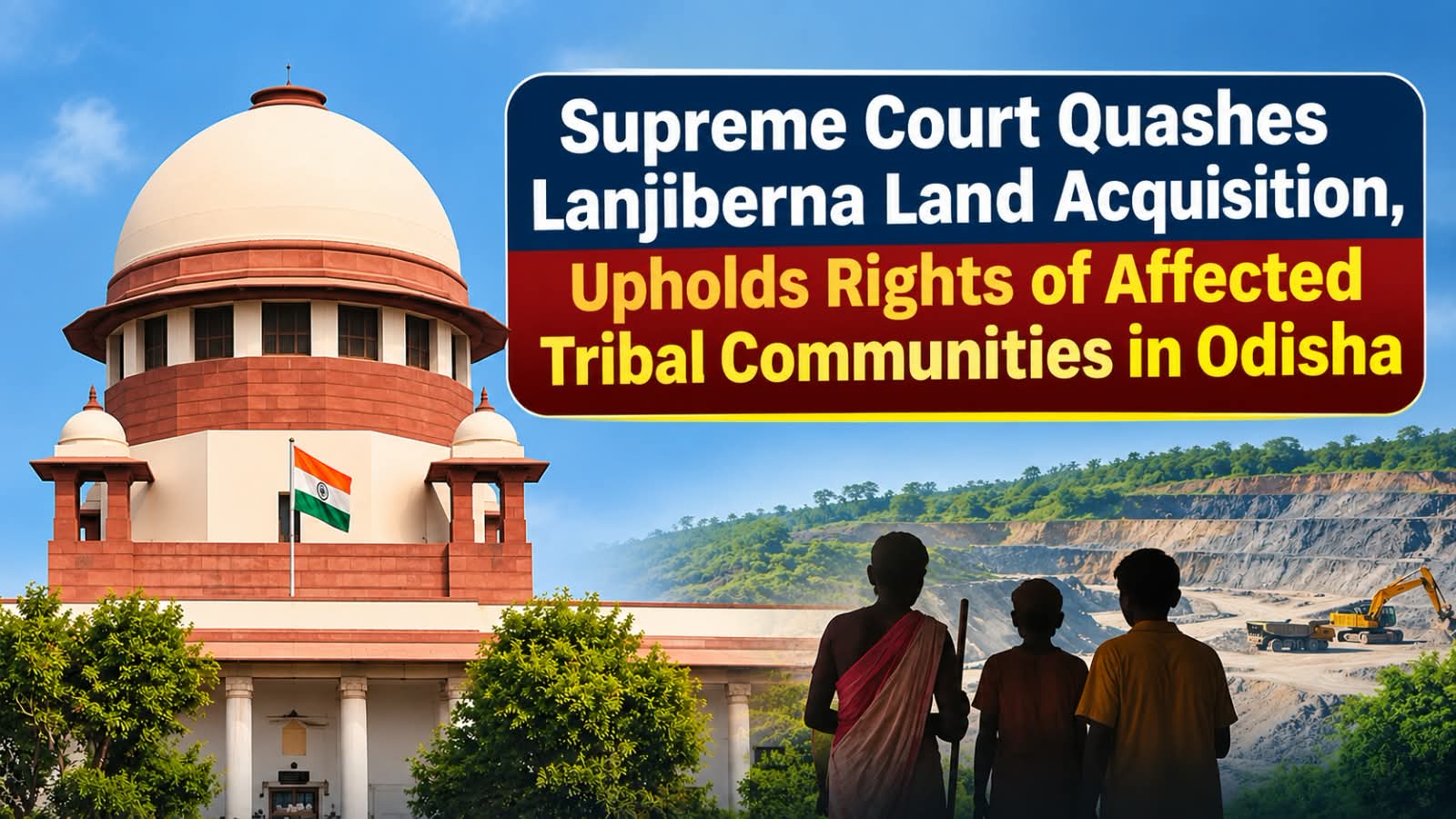
NEW DELHI, November 19, 2026: The Supreme Court of India has quashed the land acquisition proceedings initiated for mining operations by Dalmia Cement Bharat Limited in Odisha’s Sundargarh district, delivering a major victory to residents of three affected villages after years of legal struggle.


Setting aside the Orissa High Court judgment that had upheld the acquisition, the Supreme Court ruled in favour of the affected people of Kukuda, Bihabandha and Lanjiberna villages. The judgment reinforces the legal safeguards governing land acquisition in Scheduled Areas, particularly the requirement of prior consent from Gram Sabhas and affected families.
In its judgment in Bibol Toppo and Others vs State of Odisha and Others (Civil Appeal No. 8294 of 2026), delivered on November 19, a Bench comprising Justice Satish Chandra Sharma and Justice Deepankar Datta held that the acquisition process violated several mandatory provisions of the Right to Fair Compensation and Transparency in Land Acquisition, Rehabilitation and Resettlement Act, 2013.
The dispute concerned the proposed acquisition of 273.57 acres of agricultural land to enable Dalmia Cement to exercise surface rights for mining operations. Although the company already held mining rights over the area, the land continued to belong to its respective owners.
The Court found that the acquisition was unlawful on several grounds. It held that the government had failed to obtain the mandatory prior consent of at least 80 per cent of affected families, as required under Section 2(2)(b) of the 2013 Act, before examining the acquisition proposal.
It also ruled that the land fell within a Scheduled Area and that prior consent of the concerned Gram Sabhas was mandatory under Section 41(3) of the Act. The Court noted that the Gram Sabhas had rejected the acquisition proposal through resolutions passed on January 26, 2020, but the authorities proceeded with the acquisition despite their opposition.
The judgment further identified serious procedural violations, including the absence of a public hearing on the Social Impact Assessment report and the inclusion of a person connected with Dalmia Cement in the Expert Group responsible for independently evaluating the assessment.
Emphasising the importance of community participation and tribal land rights, the Supreme Court observed that the requirement of Gram Sabha consent could not be reduced to a mere formality.
The Court allowed the appeal, quashed the acquisition proceedings and all related notifications and orders, and set aside the Orissa High Court judgment dated September 6, 2024. However, it clarified that the authorities could initiate a fresh land acquisition process in accordance with the law and the findings of the Supreme Court.
Six-year struggle ends in victory
Reacting to the verdict, Fr Ashok, who supported the affected communities throughout their legal struggle, described the judgment as a victory for justice after six years of sustained efforts.
"After six years of struggle, we have finally received the fruits of our efforts. The entire land acquisition has been quashed and the High Court judgment has been set aside," he said.
Recalling his association with the villagers, Fr Ashok said he had stood with them from the beginning of the struggle until the final judgment.
"My legal journey with the people was really beautiful. I had to face many challenges, including threats and allegations. Today, justice has won," he said, thanking all those who supported the struggle.
The ruling is significant for communities living in Scheduled Areas, reaffirming that the statutory protections for tribal land, livelihoods and Gram Sabha participation must be respected in land acquisition proceedings, including those undertaken for private mining projects.
By Catholic Connect Reporter


© 2026 CATHOLIC CONNECT POWERED BY ATCONLINE LLP