- 20 June, 2026
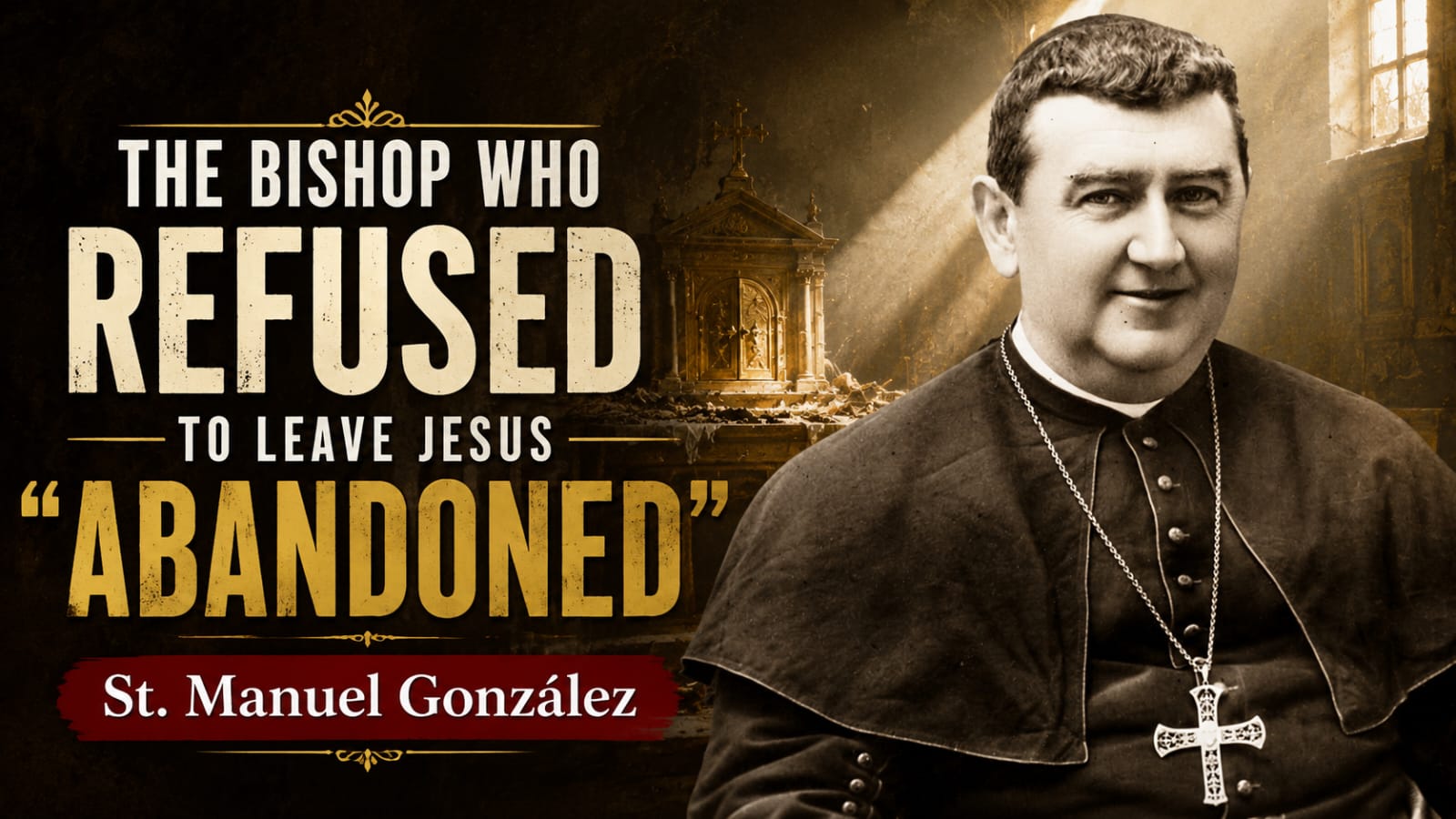
Born in Seville, Spain, on February 25, 1877, Manuel González García grew up in a humble family where his father worked as a carpenter. As a boy, he became one of the Seises — the traditional choirboys who performed a sacred dance before the Blessed Sacrament in the Cathedral of Seville during major feasts.


That experience deeply shaped his lifelong devotion to the Eucharist. At just 12 years old, he secretly took the seminary entrance exam because he was determined to become a priest.
The Church That Changed His Life
Soon after his ordination in 1901, Father Manuel was sent to preach in the town of Palomares del Río, where faith had almost disappeared.


Inside the church, he found dust, cobwebs, torn altar linens, and signs of complete neglect. Kneeling before the abandoned tabernacle, he experienced a profound spiritual realization that changed his life forever.
Later, he wrote:
“My faith was looking at Jesus through the door of that tabernacle, so silent, so patient, so good, gazing right back at me... I found myself to be a priest of a town that didn't love Jesus, and I would have to love him in the name of everybody.”
From that day onward, he dedicated his life to “repairing” this abandonment through prayer and presence.
(CLICK HERE to follow Catholic Connect for regular News and Content)
Prayer That Led to Action
Father Manuel’s spirituality did not separate him from society. Instead, it pushed him toward the poor and marginalized.
In 1905, while serving in Huelva, he established schools for disadvantaged children and helped struggling families. During the harsh winter of 1913, he provided food for the children of striking miners.
He also founded several organizations, including the Eucharistic Missionaries of Nazareth and the Disciples of Saint John. To spread his message further, he launched the magazine El Granito de Arena (“The Grain of Sand”).
A Bishop During Turbulent Times
Pope Benedict XV appointed him Auxiliary Bishop of Málaga in 1915, and he became its residential Bishop in 1920.
When people expected a grand celebration for his appointment, Bishop Manuel instead hosted a banquet for 3,000 poor children, served by priests and seminarians.
During the anti-clerical violence of the 1931 republican era in Spain, an angry mob burned his episcopal palace. Forced into exile for safety, he governed his diocese from Gibraltar and later Madrid.
Yet he responded without bitterness, seeing the destruction of churches as another form of the “abandoned tabernacle” that had shaped his mission.
His Final Wish
In 1935, he became Bishop of Palencia, where he spent his final years. He died on January 4, 1940.
Before his death, he asked to be buried near the tabernacle in the Cathedral of Palencia. His epitaph reflected the mission that defined his entire life:
“I ask to be buried next to a tabernacle, so that my bones, after death, as my tongue and my pen in life, are saying to those who pass: There is Jesus! There he is! Do not leave him abandoned!”
Pope John Paul II beatified him in 2001, and Pope Francis canonized him on October 16, 2016.
Even today, St. Manuel González García remains remembered as a saint whose deep prayer life inspired concrete acts of service, compassion, and care for the abandoned.
By Catholic Connect Reporter
© 2026 CATHOLIC CONNECT POWERED BY ATCONLINE LLP