- 06 October, 2026

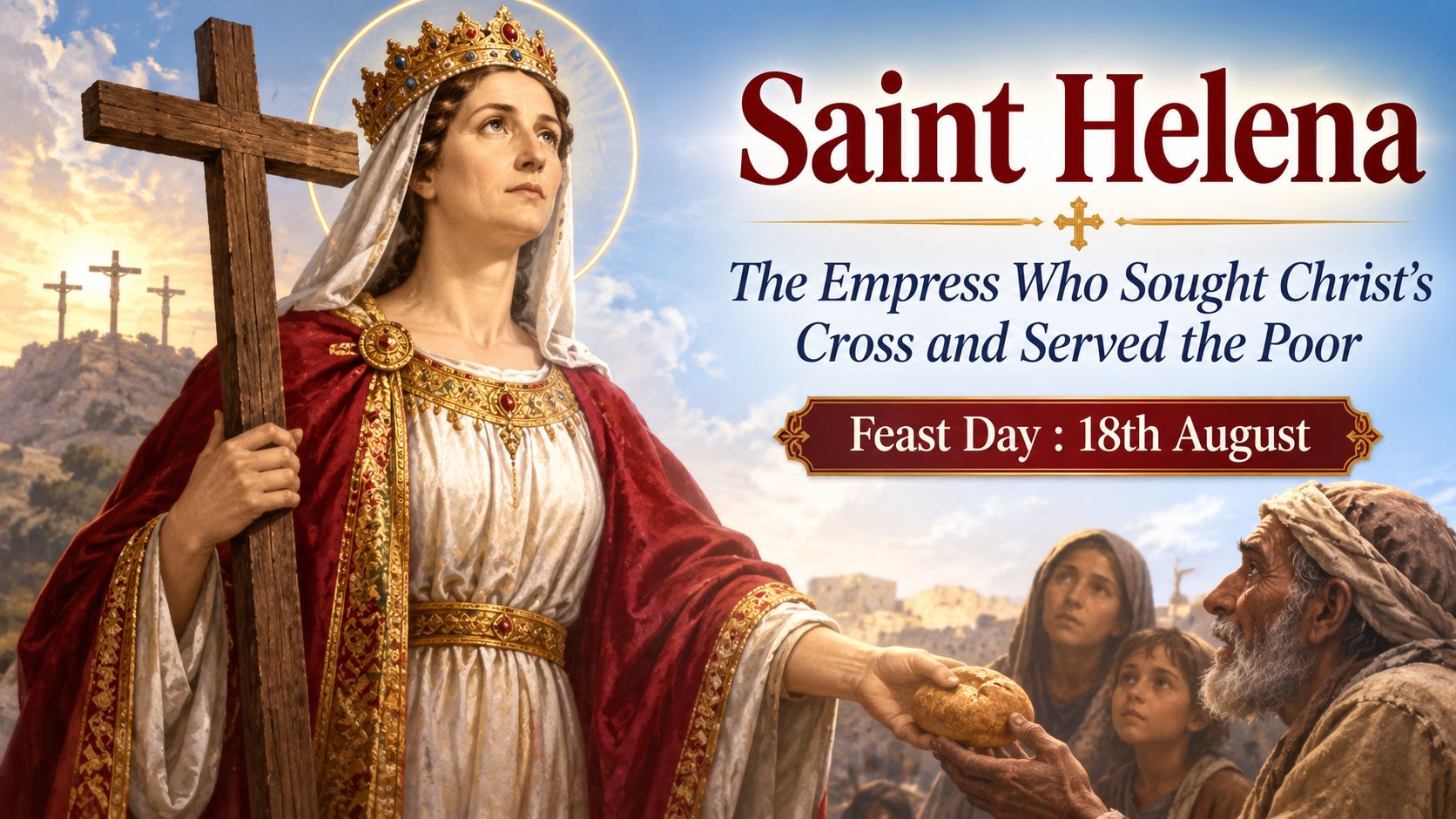
August 18, 2026: Why is Saint Helena remembered as one of the most important women in the early history of Christianity? Discover the remarkable story of the mother of Emperor Constantine the Great, whose conversion to Christianity transformed her life and whose pilgrimage to the Holy Land became closely associated with the discovery and veneration of the True Cross.


Feast Day: 18 August
Born: c. 250–257
Died: c. 329–330
Known For: Mother of Constantine the Great, Christian devotion, pilgrimage to the Holy Land, and tradition of discovering the True Cross
Title: Empress and Saint
Patron of: Archaeologists, converts, difficult marriages, and the Holy Places
Saint Helena lived during one of the most important periods in Christian history.
She was the mother of Constantine the Great, the Roman emperor whose reign brought Christianity from persecution toward public freedom. Helena herself embraced Christianity and became known for her deep faith, generosity, and devotion to the places associated with the life, Passion, Death, and Resurrection of Jesus Christ.
(CLICK HERE to follow Catholic Connect and to stay updated with Catholic News & Content)
Her life reminds Christians that greatness is not measured by worldly status, but by how faithfully one uses one's position to serve God and others.
Helena was born of humble origins and later became the wife of Constantius Chlorus. Their son Constantine was born around 274. After Constantius separated from Helena for political reasons, Constantine remained devoted to his mother.
When Constantine became emperor, he honoured Helena with the title Augusta.
Yet Helena's greatest honour would not come from the imperial court.
It would come from her Christian faith.
Following Constantine's victory and the growing freedom of Christianity, Helena became deeply devoted to Christ.
She used her wealth and influence to support Christian communities and works of charity. Tradition and contemporary accounts connect her with the construction of churches and charitable works in several places.
Her faith was not merely a private belief.
She put it into action.
Despite her advanced age, Helena travelled to Palestine around 326.
Her pilgrimage was an extraordinary act of devotion. She visited the places associated with Christ and supported the construction of churches at sacred sites. According to Eusebius, churches were established at Bethlehem and on the Mount of Olives.
Her pilgrimage helped strengthen Christian devotion to the Holy Land.
Saint Helena is traditionally associated with the discovery of the True Cross in Jerusalem.
According to Christian tradition, excavations near Calvary uncovered three crosses. The Cross of Christ was identified through a miraculous healing.
The historical tradition concerning the discovery developed over time, and ancient sources differ in their details. Nevertheless, the veneration of the Cross became firmly established in Christian tradition, with Saint Helena playing a central role in that story.
Helena's mission did not end with the discovery of sacred relics.
She helped promote the building of churches at locations associated with Christ's life.
Her devotion contributed to the preservation and honouring of the Holy Places, allowing generations of Christians to encounter the geography of the Gospel in prayer and pilgrimage.
Saint Helena's faith was also expressed through humility and generosity.
Vatican tradition recalls that she dressed simply and personally helped feed the poor.
This aspect of her life is especially meaningful.
Although she lived surrounded by imperial power, she chose to identify herself with those in need.
Helena died around 329–330, after a life that had carried her from humble beginnings to the imperial court and finally to the Holy Land. Her body was brought to Rome, where she was buried in a mausoleum on the Via Labicana.
Her devotion spread throughout both East and West, and her feast is celebrated in the Western Church on 18 August.
Saint Helena teaches that faith should lead to action.
She reminds Christians to seek Christ with perseverance, honour sacred places, care for the poor, and remain humble even when surrounded by privilege.
Her journey to Jerusalem also reminds Catholics that the Cross is not merely an object of devotion.
It is the sign of Christ's sacrificial love.
Saint Helena remains an extraordinary witness to the power of conversion.
She became a Christian during a turning point in history and used her influence to honour Christ and serve others.
Her name became permanently connected with the Cross—the central symbol of Christian faith.
Saint Helena's message remains powerful: seek Christ faithfully, serve the poor generously, treasure the Cross, and use every blessing and responsibility to glorify God.
To know about more saints please visit the spiritual section.
By Catholic Connect Reporter
Saint Helena, Saint Helena feast day, Saint Helena August 18, Saint Helena Empress, Saint Helena mother of Constantine, Saint Helena biography, True Cross, Discovery of the True Cross, Holy Land, Christian saints, Catholic saints, Constantine the Great, Empress Helena, saints of Rome, pilgrimage to Jerusalem, Christian history, Holy Cross, Helena and Constantine, Catholic feast days, saints of August


© 2026 CATHOLIC CONNECT POWERED BY ATCONLINE LLP