- 08 May, 2026

Vatican, May 8, 2026: During the first year of his pontificate, Pope Leo XIV repeatedly called for a reconciliation that is “unarmed and disarming,” while urging the “lords of war” to listen to “a melody greater than ourselves.”


“Unarmed and disarming”
With these words, spoken at sunset on 8 May 2025—the beginning of his pontificate—Pope Leo XIV presented his vision of peace.


On Christmas morning, he clarified that peace is not merely the silence of weapons achieved through a ceasefire, distinguishing his understanding from the fragile arrangements often seen in international geopolitics.
Such arrangements, he warned, risk making every appeal for reconciliation appear disarming in a negative way: weakening people’s ability to react, respond or resist. He described this as a “great weariness” that threatens to enter hearts and drain words of their meaning.
During the Urbi et Orbi Blessing on 25 December, the Pope reflected on the idea of a “wild peace,” inspired by the poet Yehuda Amichai. He described it as a reconciliation that emerges “suddenly,” like wild “flowers” that continue to grow through cracks in concrete with persistent simplicity. “May it come,” Pope Leo said of that harmony, “because the field needs it.”
More than 400 mentions of “peace”
The word “peace” has appeared more than 400 times in the addresses delivered by the Bishop of Rome during the first year of his pontificate. He has used the term in various contexts, beginning with his first meeting with members of the press in the Paul VI Hall.
“You are on the front lines” in reporting wars and uncovering aspirations for reconciliation, the Pope told journalists, encouraging them to promote communication “capable of leading us out of the ‘Tower of Babel’ in which we sometimes find ourselves, out of the confusion of loveless languages, often ideological or partisan.”
The Pope stressed that peace does not exist beneath banners and is not naïve. He said it is pointless for “the lords of war” to act “not to know that it takes only a moment to destroy, but often not even a lifetime is enough to rebuild.” Likewise, he said they should not pretend “not to see that billions of dollars are needed to kill and devastate, while the resources needed to heal, educate and lift people up cannot be found.”
He added that “people are beginning to realize the amount of money that ends up in the pockets of merchants of death,” during his meeting with participants in the plenary assembly of the Reunion of Aid Agencies for the Oriental Churches (ROACO).
Highlighting the contradiction, the Pope said: “Money that could be used to build new hospitals and schools is instead being used to destroy those that already exist!”
The consequences of war
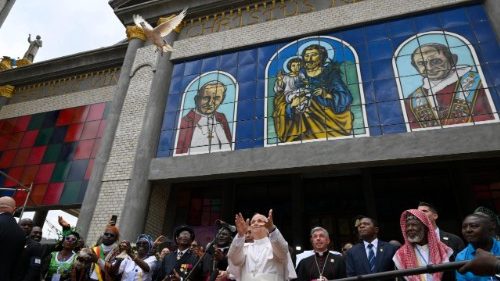
From his first appeals for peace in the Vatican to his more recent remarks in Bamenda, Cameroon, during a meeting in St. Joseph’s Cathedral aimed at promoting reconciliation with the local community, Pope Leo’s message of communion has extended across different regions and situations.
The harmony envisioned by the Pope reaches beyond the halls where the “lords of war” make “actions of death,” and instead focuses on the suffering of those who “feed only on despair, tears and misery.”
These words were also heard at the headquarters of the FAO, the United Nations Food and Agriculture Organisation, where the Pope highlighted hunger as one of the many devastating consequences of conflict.
The Pope’s message also reflected closeness and service, symbolised in the homily for the Mass in Coena Domini on Holy Thursday, where he described the image of a God who is almighty through service.
The idols that fuel conflicts
Holy Week marked one of the most significant moments in the Pope’s appeals for peace.
On Palm Sunday morning, he insisted that no one can justify war in the name of God, saying that God “does not listen to the prayer of those who wage war, and rejects it, saying: ‘Even though you multiply your prayers, I will not listen; your hands are full of blood.’”
As Successor of Peter, Pope Leo reflected on the wounds caused by war. He spoke of those who are “enslaved to death” because they have turned “their backs on the living God in order to make themselves and their own power a mute, blind and deaf idol.”
The Pope also addressed the various forces that fuel conflicts today. If not the thirst for power, he said, it is often the pursuit of money, as he noted during his visit to the Principality of Monaco.
The lightness of reconciliation
The Pope’s reflections during Holy Week following the Rosary for peace carried both gravity and hope, presenting reconciliation as something marked not only by suffering but also by lightness.
Speaking in Lebanon, he described harmony as something that moves gently, “like an interior movement that flows outward, enabling us to let ourselves be guided by a melody greater than ourselves, the melody of divine love.”
He offered reassurance to the people of a country deeply affected by war.
Peace, he suggested, is both a journey and a destination, one that humanity continues to move towards. In this context, the theme chosen for the 59th World Day of Peace—“toward” a peace that is “unarmed and disarming”—takes on greater meaning.
The audacity of disarmament
The Pope’s appeals have also addressed the practical realities of conflict, including the global arms race.
He noted that worldwide military spending increased by 9.4% in 2024, continuing a ten-year trend and reaching 2.718 trillion dollars, or 2.5% of global GDP.
“Lay down your sword!” the Pope urged world leaders during the Marian Vigil for peace in October 2025, encouraging them to embrace “the audacity of disarmament.”
He observed that modern warfare has shifted from swords to drones, which can make conflict appear like “the scenario of a video game.” Yet, he warned that war remains a tragic reality to which people must never become accustomed, repeating this appeal strongly at the conclusion of the General Audience on 18 June 2025.
Sport and culture: instruments of reconciliation
The Pope also encouraged creative ways to overcome “indifference toward the law.” In a letter reflecting on the value of sport, he said that competition—and life itself—teaches that “a fall is never the final word.”
At the General Audience of 3 September 2025, Pope Leo said Christians do not defeat evil through force, “but by fully accepting the weakness of love.”
He further emphasised the importance of contemplation and study, urging the Italian bishops to promote “paths of education in nonviolence.”
Speaking about peace, the Pope highlighted the need for “a realignment of policies” related to education, encouraging a “culture of memory” that preserves “the awareness gained in the twentieth century” and remembers its millions of victims.
“After centuries of history, how can anyone believe that acts of war bring about peace and not backfire on those who commit them?” he asked while again addressing ROACO.
The Pope acknowledged that everything can be forgotten, even “the light.” Yet he once again invoked the image of “wild peace”: a persistent flower growing through concrete with a disarming beauty.
Courtesy: Vatican News
© 2026 CATHOLIC CONNECT POWERED BY ATCONLINE LLP