- 27 May, 2026

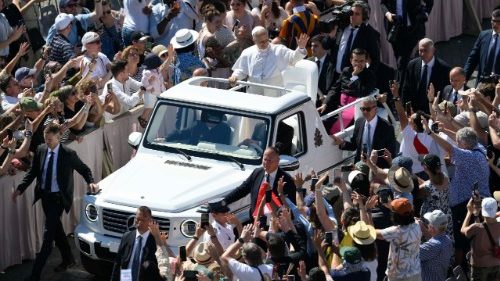
Vatican, May 27, 2026: Pope Leo XIV said during the Wednesday General Audience in St. Peter’s Square on May 27 that renewing the liturgy and enabling it to develop, while safeguarding tradition, helps the Church to grow, remain united and continue her mission of proclaiming the Gospel to all.


Continuing his catechesis series on the Documents of the Second Vatican Council, Pope Leo XIV reflected on the 1963 Constitution on the Sacred Liturgy, Sacrosanctum Concilium, focusing particularly on liturgy from the perspective of tradition and development.
Sacrosanctum Concilium was the first document promulgated during the Second Vatican Council and introduced significant liturgical reforms, including permitting the liturgy to be celebrated in vernacular languages and encouraging greater participation of the faithful.


During his address, the Pope noted that the liturgy has “been, for centuries, a driving force for evangelization."
“Today, this energy must be renewed in continuity with the authentic and living Catholic tradition, that is, in accordance with a dynamic aimed at introducing believers to the fullness of the truth.”
In this regard, the Pope especially called on priests “who exercise the ministry of liturgical presidency, to always uphold that respect for the texts and regulations of the liturgy which springs from an inner attitude of openness and trust in God, manifesting humility before His greatness and sincere fidelity to ecclesial communion.”
The close bond between liturgical renewal and the Church’s renewal
Pope Leo XIV began his catechesis by quoting his predecessor Venerable Pius XII, who described the Church as “a living organism” that – including in relation to the liturgy – “grows, matures, develops, adapts and accommodates herself to temporal needs”.
The Pope observed that, following this principle, Sacrosanctum Concilium acknowledged in its introduction the need to reform the liturgy in order to respond to the needs of the times and “impart an ever increasing vigour to the Christian life of the faithful.”
“At that moment in history, there was a strong sense of the need for a renewal of the ritual forms through which, for centuries, the Church had glorified God and sanctified the Christian people,” the Pope explained.
Referring to the Liturgical Movement, which promoted this renewal, the Pope said the understanding gradually developed that “a very close and organic bond exists between the renewal of the liturgy and the renewal of the whole life of the Church. The Church not only acts but also expresses herself in the liturgy, lives by the liturgy and draws from the liturgy the strength for her life,” citing his predecessor Pope John Paul II.
A progress rooted in Tradition
Pope Leo XIV explained that Sacrosanctum Concilium also provided guidance for liturgical renewal, stating that while efforts should be made to encourage the faithful’s access to the richness of the liturgy, sound tradition must be preserved and developments should remain open to legitimate progress.
To further explain this, the Pope cited his predecessor Pope Benedict XVI, who noted that “tradition and progress are often clumsily opposed”, whereas “actually, the two concepts merge: tradition is a living reality, which therefore includes in itself the principle of development, of progress.”
“The Council affirms the legitimacy of this progress, rooted in authentic Tradition, distinguishing within the liturgy ‘immutable elements, divinely instituted’,” from others that can be subject to change, the Pope stressed.
He further explained that such changes have continually taken place throughout the centuries in order to help the faithful participate fully in the liturgy and consequently in “the Paschal Mystery of Christ,” which is the foundation of the Christian faith.
“The Church’s worship has thus been ‘embodied’ in the cultural forms of each age and has been able to influence them and even transform them,” and therefore has served as a force for evangelisation, Pope Leo said.
A progress that fosters communion
The Pope explained that the Council Fathers also stressed that the revision of the rites “must be carried out taking care that ‘any new forms adopted should in some way grow organically from forms already existing’” and that, for the good of the Church, every reform should “always be preceded by careful ‘theological, historical and pastoral’ investigation.”
The Council Magisterium therefore calls for avoiding confusion among the faithful, “discouraging anyone from adding, removing or altering anything in liturgical matters on their own initiative,” the Pope continued.
“The progress evoked in the Conciliar Constitution in no way compromises ecclesial communion: rather, it seeks to confirm and foster it,” he concluded.
Courtesy: Vatican News
© 2026 CATHOLIC CONNECT POWERED BY ATCONLINE LLP