
- 11 June, 2026

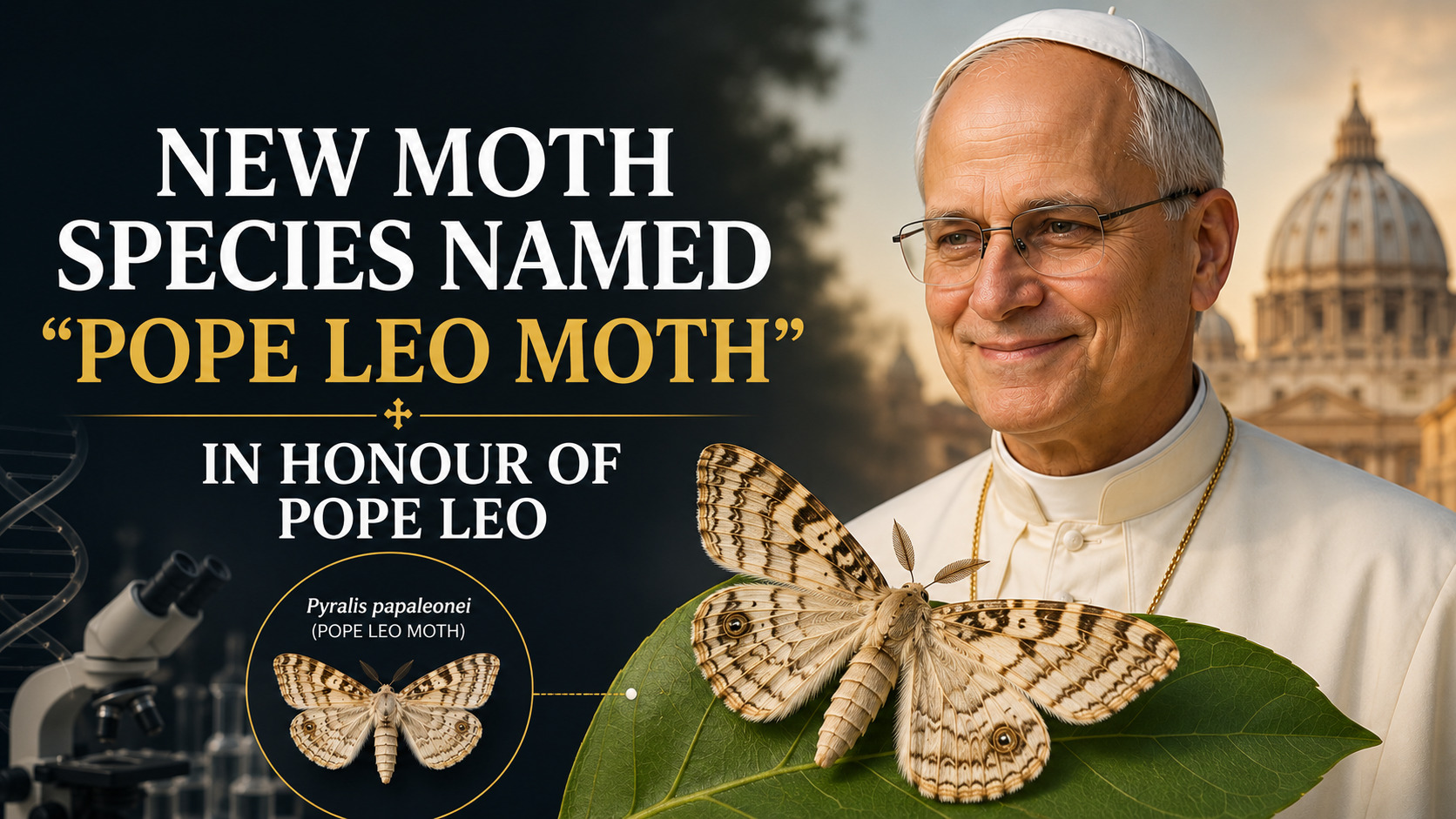
May 11, 2026: A newly discovered moth species found on the Mediterranean island of Crete has been named “Pyralis papaleonei,” or the “Pope Leo moth,” in honour of Pope Leo XIV, recognising his advocacy for climate and environmental protection.


“The new species is dedicated to the head of the Catholic Church, Pope Leo XIV,” authors Peter Huemer, Lauri Kaila, and Andreas H. Segerer wrote in a research article published in the journal Nota Lepidopterologica. “The pontiff is a strong advocate of climate and environmental protection, and we hope that his voice may serve as an example for humanity.”
According to the entomologists, the medium-sized species has a wingspan of about two centimetres and is distinguished by gold spots and prominent white bands.
The researchers also noted that the moth’s appearance places it within a group of Pyralidae species whose names are associated with high secular or ecclesiastical offices.


“Furthermore, due to its distinctive coloration and overall appearance, the new species belongs to a group of Pyralidae whose species names refer to high secular or ecclesiastical offices including Pyralis regalis, Pyralis imperialis, Pyralis princeps, and Pyralis cardinalis,” they wrote.
A press release from Tiroler Landesmuseum Ferdinandeum, also known as the Tyrolean State Museum in Innsbruck, Austria, explained that butterflies and moths are often named after external characteristics, geographical locations, or distinguished individuals.
Within the Pyralis genus, the naming tradition dates back to 1775 when Austrian naturalists and Jesuits Michael Denis and Ignaz Schiffermüller described the first species of the group as Pyralis regalis, meaning “royal,” because of its coloration.
The museum stated that this inspired later names such as Pyralis princeps and Pyralis cardinalis, which belong to the Pyraloidea superfamily comprising around 16,000 described species worldwide.
Referencing the Book of Genesis, the museum also highlighted the deeper historical roots of taxonomy, the science of naming and classifying organisms. According to the museum, Adam’s task of naming animals in Genesis 2 has often led taxonomy to be regarded “in the biblical sense, the oldest task of humankind.”
The naming of Pyralis papaleonei now adds a modern and symbolic chapter to that centuries-old scientific tradition, linking environmental advocacy with the enduring practice of classifying the natural world.
News Credits: Catholic News Agency
© 2026 CATHOLIC CONNECT POWERED BY ATCONLINE LLP