
- 19 October, 2026

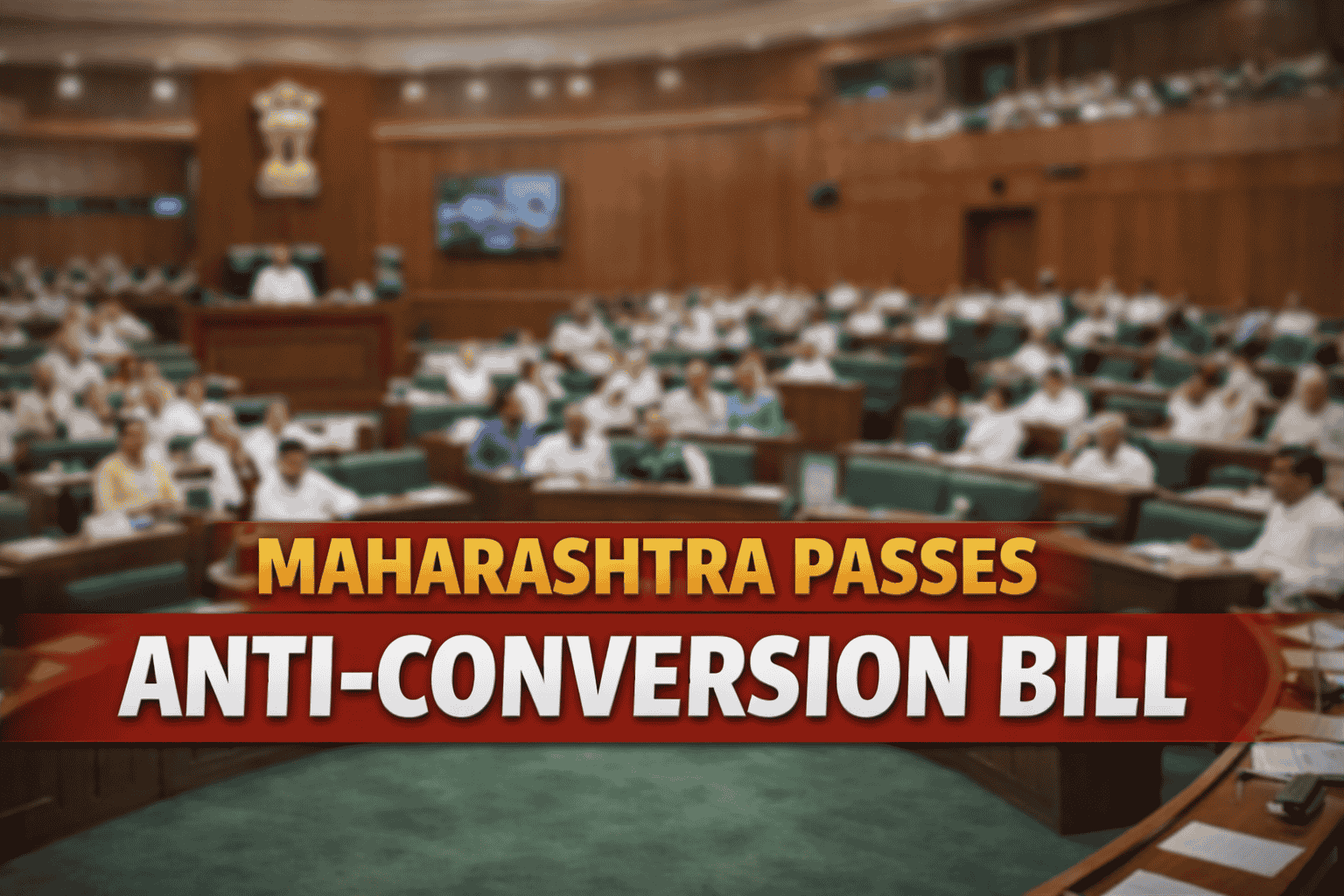
Maharashtra, Mar 17, 2026: The Maharashtra Legislative Assembly on Monday night approved the Freedom of Religion Bill 2026 by voice vote, introducing strict measures to curb religious conversions carried out through coercion, fraud, inducement or marriage.



Key provisions and penalties
Under the provisions of the bill, individuals found involved in unlawful conversions under the pretext of marriage will face imprisonment of seven years along with a fine of Rs 1 lakh.
Offences involving a minor, a person of unsound mind, a woman, or a person belonging to the Scheduled Castes or Scheduled Tribes will attract a punishment of seven years’ imprisonment and a fine of Rs 5 lakh.
The bill also prescribes a jail term of seven years and a fine of Rs 5 lakh for mass conversions. Repeat offenders may face imprisonment of up to 10 years along with a fine of Rs 5 lakh.
"The proposed anti-conversion law in Maharashtra is not directed against any particular religion, and it aims only to prevent religious conversions carried out through force, fraud or inducement, Chief Minister Devendra Fadnavis told the assembly.
He noted that several states, including Odisha, Gujarat, Uttar Pradesh, Madhya Pradesh, Haryana, Karnataka and Jharkhand, have already enacted similar laws.
"This bill does not restrict a person's right to follow a religion as guaranteed under Article 25 of the Constitution. The right to religion does not include the right to convert another person through coercion, misrepresentation, fraud or allurement," Fadnavis said and cited rulings of the Supreme Court.
Earlier in the day, Fadnavis told reporters that several women had been lured into relationships, married, and later abandoned, stating that the bill seeks to address such issues and prevent fraudulent religious conversions.
"The Opposition parties are politicising the issue for vote-bank gains, but once they read the bill carefully, they will have no objections," he added.
Government defends provisions of the bill
Addressing the Assembly, Fadnavis, who also holds the Home portfolio, said complaints could be filed by the affected individual or close relatives, while the police may also take action in certain cases.
Seeking support for the passage of the bill, the chief minister said it is intended to protect citizens from unlawful conversions and maintain law and order.
Minister of State for Home Pankaj Bhoyar said the proposed law aims to prevent conversions carried out through fraud, coercion or inducement while safeguarding constitutional rights.
Replying to the debate in the House, Bhoyar said the bill seeks to ensure that religious conversions take place voluntarily and transparently.
Some members had objected to the provision requiring a person intending to convert to another religion to give a 60-day prior notice to the district magistrate, calling it unjust and against constitutional guarantees, he said.
"The objective of this provision is only to verify that the conversion is taking place out of free will and not through fraud, force or inducement," Bhoyar said.
The minister also addressed concerns over the requirement to inform authorities within 21 days after the conversion, failing which the conversion could be treated as invalid.
He said the requirement was meant for administrative record-keeping and to prevent potential legal and social disputes in the future.
Responding to criticism that relatives or other persons could file complaints regarding forced conversions, Bhoyar said victims may not always be able to approach the police themselves.
"The provision allowing others to lodge complaints is intended to ensure protection where fraud, pressure or threats are suspected," he said.
Bhoyar stated that the law does not deny adults the right to change their religion, noting that the Constitution guarantees the freedom to profess, practice and propagate religion.
He added that special care would be taken during implementation to ensure the protection of women's rights and to safeguard women, Scheduled Castes, Scheduled Tribes and minors from forced or fraudulent conversions.
Bhoyar further said that if a marriage takes place on the basis of an illegal conversion and a child is born, the child would be considered to follow the mother's original religion prior to conversion, as per the bill.
Opposition reactions and debate
The opposition Shiv Sena–Uddhav Balasaheb Thackeray faction also supported the bill.
Sena-UBT MLA Bhaskar Jadhav said the bill aims to protect the right to religious freedom and prevent illegal religious conversions.
"It is comprehensive and does not target any specific religion, despite rumours or misconceptions. The objective is to curb unethical practices and misuse of religion that harm individuals or communities," Jadhav said, adding that reports of the bill targeting a particular religion are incorrect.
He said the bill applies to all religions equally and is intended to prevent coercion or inducement in religious conversions, citing Dr B.R. Ambedkar's conversion in 1956 as voluntary and without coercion.
However, several Opposition MLAs demanded that the bill be referred to a joint select committee of the legislature for discussions.
BJP MLA Atul Bhatkalkar warned against attempts to alter Maharashtra's demography through religious conversion, saying such efforts would not succeed.
Opposition MLAs including Nitin Raut raised concerns over possible "vigilantism".
Congress MLA Aslam Shaikh said the objective and essence of the bill appear to impact the Constitution and the right to privacy.
Samajwadi Party MLAs Abu Asim Azmi and Rais Shaikh also opposed the bill, with Shaikh stating that it violates Articles 14, 15 and 21 of the Constitution.
"Maharashtra is a progressive state which has always set an example for the rest of the country. This bill curtails the Constitutional right to freedom of religion," he said.
After the discussion, presiding officer Sanjay Kelkar declared the bill passed.
Courtesy: Rediff.com





© 2026 CATHOLIC CONNECT POWERED BY ATCONLINE LLP