- 16 June, 2026

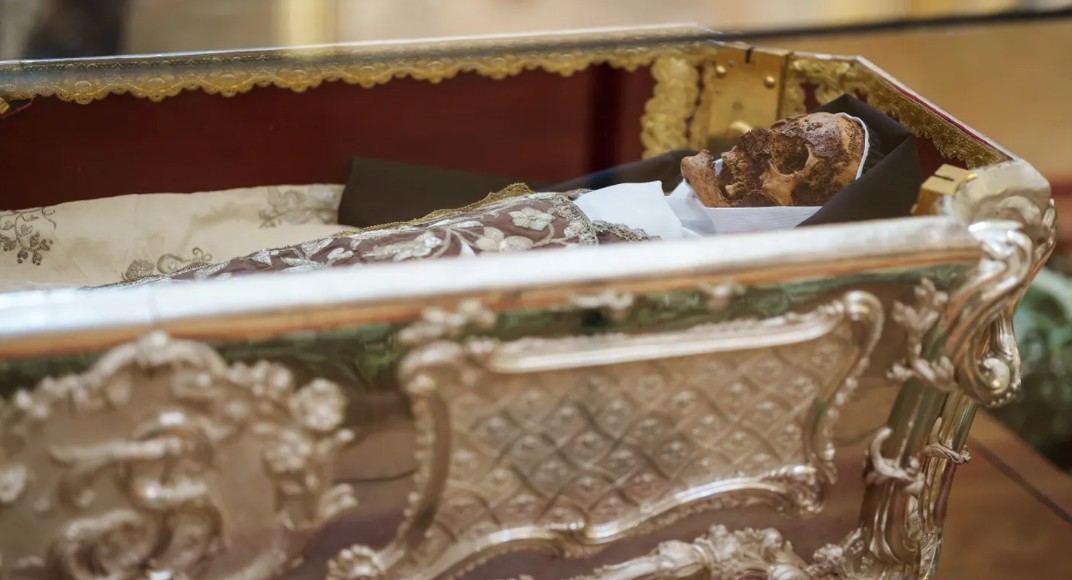
Spain, May 14, 2026: When scientists opened the tomb of St. Teresa of Ávila in 2024, they expected bones, dust, and fragments of history.


Instead, they found skin, hair, facial features. And a mystery no one can fully explain.
More than 440 years after her death in 1582, the Catholic saint’s body stunned researchers with what many believers call incorruptibility — a phenomenon where a body resists natural decomposition far beyond what science expects.
For the faithful, it is a sign of heaven. For scientists, it is a forensic puzzle.
And for everyone else, it raises an uncomfortable question: What happens when science reaches the edge of explanation?


In August 2024, researchers reopened the tomb of St. Teresa of Ávila for the first time since 1914.
The tomb lies beneath the basilica in the small Spanish town of Alba de Tormes — a cold, humid burial chamber where decomposition should have long erased any trace of human tissue.
But according to investigators, parts of her body remained astonishingly preserved.
Anthropologist Luigi Capasso described her remains as “perfectly preserved” in several areas. Reports noted intact skin, preserved muscles, strands of brown hair, and even visible facial structures including one eyelid and part of the iris.
The imprint of her 16th-century Carmelite veil was reportedly still visible on her forehead.
For a woman dead since the 1500s, the findings sounded almost impossible. And yet, scientists insist there could be explanations.
(CLICK HERE to follow Catholic Connect and to stay connected with the Church)
For centuries, the Catholic Church has documented cases of so-called “incorrupt saints” — holy men and women whose bodies decayed unusually slowly after death.
But science approaches the phenomenon differently.
Researchers investigating St. Teresa of Ávila are examining whether specific environmental and biological factors may have naturally preserved her remains.
Some of the leading theories include:
Low oxygen can dramatically slow bacterial activity, reducing decomposition.
Sometimes called “grave wax,” this occurs when body fat transforms into a soap-like substance that protects tissue from decay.
Scientists suspect diet, illness, fasting habits, and even gut bacteria may influence how a body decomposes after death.
Certain tomb environments can preserve bodies similarly to ancient mummies — though usually with brittle skin and skeletal remains.
But here’s where things become strange.
Many incorrupt saints reportedly remain flexible rather than stiff and brittle.
Some were found without evidence of embalming.
Others began decaying rapidly only after being removed from sealed tombs, suggesting the environment itself played a critical role.
Science can explain parts of the mystery. But not always the whole thing.
For Catholics, incorruptibility is not officially required for sainthood.
But throughout history, it has often been viewed as a possible sign of divine favor — a visible reminder of resurrection and eternal life.
The Church has long approached such cases cautiously. Investigators typically examine whether chemicals, preservation techniques, or environmental manipulation could explain the condition of a body.
In the case of St. Bernadette Soubirous, examinations reportedly found no evidence of artificial embalming.
That tension between investigation and belief is exactly what makes these stories so compelling.
The Church invites science into the tomb.
Science studies the evidence. And sometimes, even experts walk away unsettled.
Stories like this are often framed as a war between religion and reason.
But history tells a more complicated story.
The same Church that venerates incorrupt saints also founded universities, preserved scientific texts, and supported astronomers, geneticists, and physicists throughout history.
And in cases like St. Teresa of Ávila, science is not being rejected.
It is being invited in. Researchers are scanning tissues. Anthropologists are documenting preservation patterns.
Medical experts are studying bone disease and historical health conditions.
Faith asks why.
Science asks how.
And somewhere between the microscope and the miracle, the mystery survives.
In May 2025, pilgrims were allowed to publicly venerate the body of St. Teresa of Ávila for only the third recorded time in history.
The first was in 1760. The second in 1914.
And now, more than four centuries after her death, thousands still travel to see a body that seemingly refuses to vanish.
Maybe future science will explain every detail. Maybe it won’t.
But for now, one thing is undeniable: A woman who died in the 1500s is still forcing the modern world to confront the limits of what it understands about death, decay, and the possibility that there may be more to human existence than biology alone.
By Catholic Connect Reporter
Sources :
Times of India – “This 400-year-old Catholic saint’s body has amazed scientists”
Fox News – “Experts reveal details about a 16th-century Catholic saint found ‘perfectly preserved’”
The Atlantic – “The (Not Really So Very) Incorrupt Corpses”
Picture Courtesy : CESAR MANSO/AFP via Getty Images
© 2026 CATHOLIC CONNECT POWERED BY ATCONLINE LLP