- 01 May, 2026

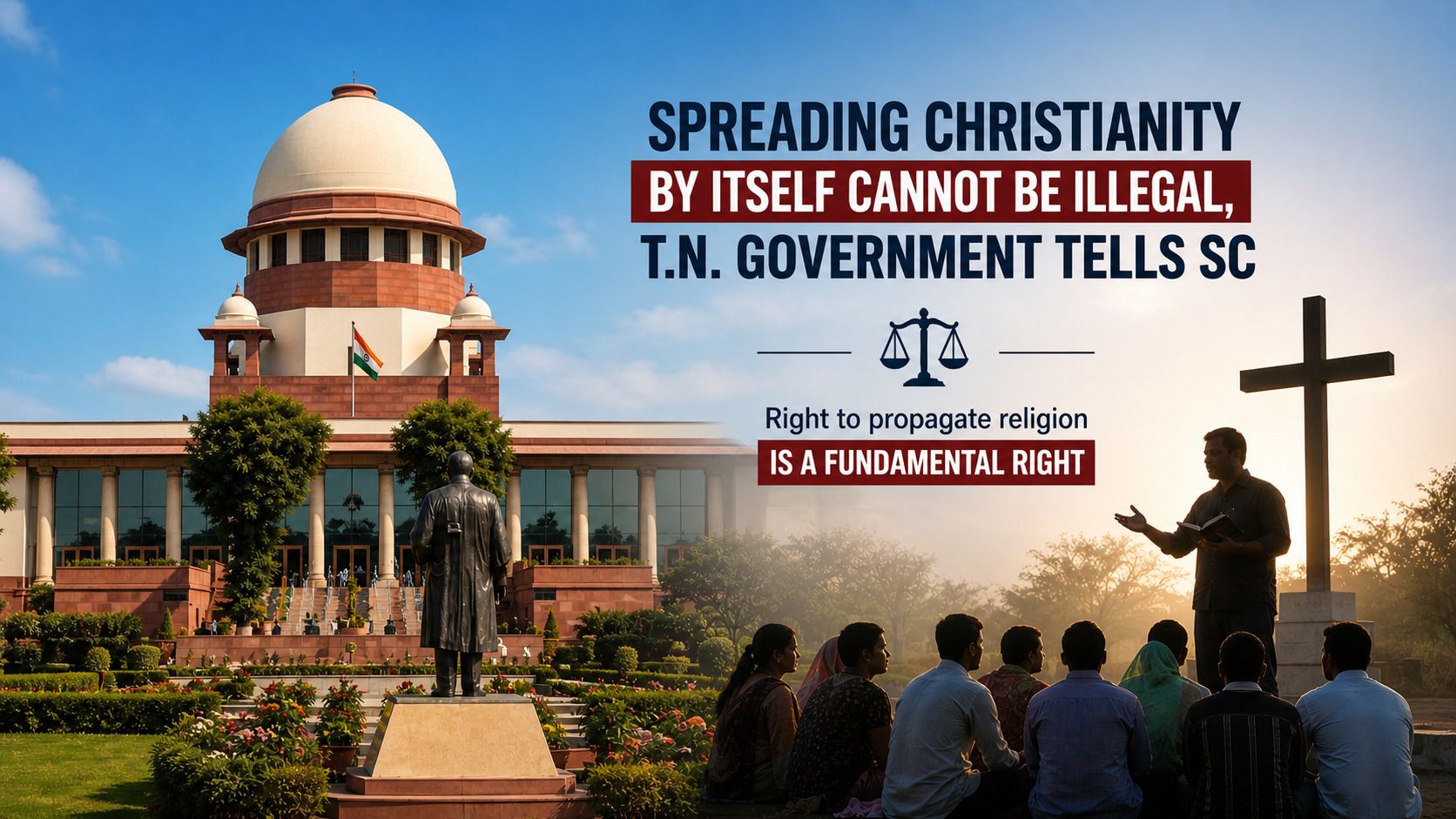
New Delhi, May 1, 2026: The Tamil Nadu government has informed the Supreme Court that the acts of missionaries to spread Christianity, by themselves, cannot be regarded as illegal.

The Tamil Nadu government has told the Supreme Court that the acts of missionaries to spread Christianity by themselves cannot be viewed as unlawful.
“Article 25 (freedom of religion) of the Constitution guarantees every citizen the right to propagate his religion. Therefore, the acts of missionaries spreading Christianity by themselves cannot be seen as something against the law. But if their act of spreading their religion is against public order, morality and health and to other provisions of Part III of the Constitution, it has to be viewed seriously,” the State said.


The State further stated that any individual has the right to propagate and preach their belief system to others without using intimidation, threats, deceit, allurement, superstition or black magic.
Represented by senior advocate P. Wilson, Tamil Nadu noted that while a person does not have a fundamental right to convert another individual to their religion, every person has the right to propagate their faith.
The State also said that the Constitution does not prohibit any person from converting to a religion of their choice.
It added that individuals have the freedom to change their beliefs and may also return to their original religious denominations.
“The citizens of the country should be allowed freely to choose their religion. It would not be appropriate for the government to put spokes in their personal beliefs and privacy,” Tamil Nadu stressed.
The State said that the right to profess faith in a particular religion can be linked to Article 21 (right to a dignified life) of the Constitution.
“It is an inviolable right,” the affidavit said.
The State was responding to a petition filed by advocate Ashwini Kumar Upadhyay, who has sought an NIA/CBI investigation into the “root cause” of the death of a 17-year-old girl in Tamil Nadu amid allegations that she had been forced to convert to Christianity. The petition argued that forcible or deceitful conversion violates fundamental rights.
The State underscored that forcible or deceitful religious conversion does not take place in Tamil Nadu.
“Conversion of poor people to other religions by intimidation, threats, deceit, allurement through gifts, black magic or superstition are not reported in Tamil Nadu,” the affidavit submitted.
Courtesy: The Hindu
© 2026 CATHOLIC CONNECT POWERED BY ATCONLINE LLP