
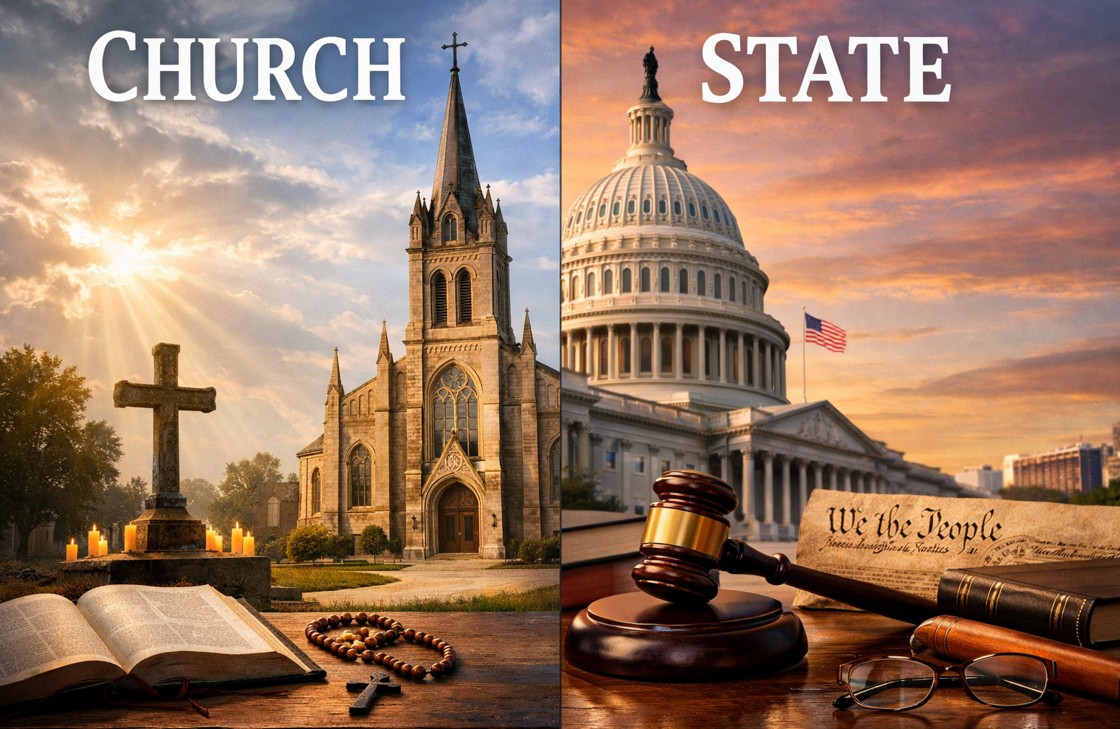
Vatican, April 14, 2026: In April 2026, a sharp and highly public disagreement emerged between Donald Trump and Pope Leo XIV. The exchange, centered on issues of war, global responsibility, and moral leadership, quickly escalated into personal criticism. While the tone of the dispute has drawn attention, the underlying dynamic is deeply rooted in history. For centuries, political leaders have challenged the authority of the papacy whenever moral teachings appeared to conflict with state interests.

The Immediate Conflict: 2026
The current dispute arose in the context of rising global tensions and military conflict involving Iran. Pope Leo XIV called for restraint, warning against what he described as a dangerous overconfidence in the use of force and urging world leaders to prioritize peace and human dignity.
President Trump responded critically, portraying the Pope’s stance as politically biased and incompatible with national security priorities. His remarks, which included personal criticism of the pontiff’s leadership and worldview, marked a rare instance in modern times of a head of state directly and publicly rebuking a pope in such strong terms.
This moment, however, is best understood not as an anomaly but as part of a long continuum of interactions between secular and religious authority.

Historical Precedents of Conflict Between Rulers and the Papacy
Medieval Power Struggles (11th–14th Centuries)
Henry IV and Pope Gregory VII (1075–1122)
- The Investiture Controversy was one of the most significant struggles between Church and State in medieval Europe. Henry IV insisted on his traditional right to appoint bishops, while Pope Gregory VII asserted that only the Church held that authority. The conflict escalated dramatically: Henry declared the Pope deposed in 1076, and Gregory excommunicated Henry in return.
- This confrontation highlighted how ecclesiastical appointments were not merely religious decisions but instruments of political control.
Philip IV of France and Pope Boniface VIII (1296–1303)
- Philip IV sought to tax the clergy to fund his wars, while Pope Boniface VIII opposed secular interference in Church finances. The dispute culminated in the Anagni Incident, when agents of the French king physically assaulted the Pope.
- This episode demonstrated the increasing willingness of monarchs to assert dominance over religious authority.
Reformation Era Conflicts (16th Century)
Henry VIII and Pope Clement VII (1527–1534)
- Henry VIII’s request for an annulment of his marriage to Catherine of Aragon was denied by the Pope. In response, Henry severed ties with Rome and established the Church of England in 1534.
- This break was not only a personal matter but also a political assertion of independence from papal authority.
Martin Luther and Pope Leo X (1517–1521)
- Martin Luther’s criticism of Church practices, particularly the sale of indulgences, evolved into a broader theological challenge to papal authority. His writings included harsh denunciations of the Pope, whom he described in deeply critical terms.
- The result was the Protestant Reformation, a movement that permanently divided Western Christianity.
Early Modern and Enlightenment Period (19th Century)
Napoleon Bonaparte and Pope Pius VII (1801–1814)
- Initially cooperating through the Concordat of 1801, Napoleon later sought to dominate the Church in France. When tensions rose, he imprisoned Pope Pius VII from 1809 to 1814 and annexed papal territories.
- This conflict reflected the growing power of centralized states over religious institutions.
Modern Political Confrontations (19th–20th Centuries)
Otto von Bismarck and Pope Pius IX (1871–1878)
- Bismarck’s Kulturkampf aimed to reduce the influence of the Catholic Church in the newly unified Germany. Laws were enacted to control clergy and limit Church authority.
- The conflict reflected concerns that religious loyalty might compete with allegiance to the state.
Benito Mussolini and Pope Pius XI (1922–1939)
- Mussolini initially reached an agreement with the Church through the Lateran Treaty of 1929, recognizing Vatican sovereignty. However, tensions later emerged as the fascist regime sought to dominate civil society, including Catholic organizations.
Adolf Hitler and Pope Pius XI (1933–1939)
- The Vatican condemned Nazi ideology, particularly its racial doctrines, in the 1937 encyclical Mit brennender Sorge. In response, the Nazi regime suppressed Catholic institutions and harassed clergy.
- This confrontation illustrated a profound moral conflict between religious teaching and totalitarian ideology.
Contemporary Disagreements (21st Century)
Donald Trump and Pope Francis (2016–2020s)
- Disagreements over immigration policy and the construction of border walls highlighted differing perspectives on human dignity, security, and national responsibility.
Recep Tayyip Erdoğan and Pope Francis (2015–present)
- Tensions have arisen over the recognition of the Armenian genocide, reflecting the intersection of historical memory, national identity, and religious diplomacy.
Understanding the Pattern
Across these cases, several consistent themes emerge:
- The struggle for authority between spiritual and political leadership
- Conflicts over economic control and institutional independence
- Deep theological disagreements
- Assertions of national sovereignty
- Diverging views on moral and social issues in the modern world
These recurring patterns suggest that such conflicts are not isolated incidents but structural features of the relationship between Church and State.
Conclusion: Toward Resolution
The conflict between Donald Trump and Pope Leo XIV, like many before it, reflects a deeper tension between two forms of leadership: one grounded in moral guidance and the other in political responsibility. History shows that when these forces collide without dialogue, the result is often division, misunderstanding, and lasting consequences.
Yet history also offers a quieter lesson. Periods of greatest stability have come not when one side silenced the other, but when both recognized their distinct roles. Political leaders govern nations; religious leaders shape conscience. Neither can fully replace the other, but each can enrich the other when approached with humility.
A meaningful resolution, then, does not lie in victory or defeat, but in mutual respect. It begins when criticism gives way to listening, when authority is tempered with compassion, and when both sides acknowledge a shared concern for human dignity and peace.
In a world already strained by conflict, the image of two powerful voices choosing understanding over confrontation would carry immense weight. It would remind humanity that even in disagreement, there remains the possibility of grace, reconciliation, and a common path forward.
By Catholic Connect Reporter