- 31 May, 2026
Vatican, April 30, 2026: It sounds like the setup to a mystery—but the truth is far more fascinating than any conspiracy. “Why does the Catholic Church run an astronomical observatory?”


High above the noise of modern debates about faith and science, the Vatican Observatory quietly continues a centuries-long mission: exploring the universe not in spite of faith, but because of it.
The idea that religion and science are at odds is a modern myth. For the Catholic Church, studying the cosmos has long been a way of appreciating creation itself.
The Vatican Observatory—also known as the Specola Vaticana—is one of the oldest active astronomical institutions in the world. Its purpose isn’t secrecy or symbolism. It’s research. Real, peer-reviewed, cutting-edge science.
At its core, the mission is simple:


to show that faith and science can coexist—and even enrich each other.
The Church’s involvement in astronomy isn’t new—it goes back centuries.
In 1582, Pope Gregory XIII commissioned astronomers to fix inaccuracies in the calendar. The result? The Gregorian calendar still used globally today.
Fast forward to 1891, when Pope Leo XIII officially re-established the observatory. His goal was clear: counter the growing belief that the Church was anti-science and demonstrate its commitment to intellectual inquiry.
Since then, the Vatican Observatory has stood as a visible reminder that the Church doesn’t fear science—it funds it.
Today, the Vatican Observatory is anything but outdated.
While its historic headquarters remain in Castel Gandolfo, its most powerful instrument operates across the world in Arizona: the Vatican Advanced Technology Telescope (VATT) on Mount Graham.
There, Jesuit priests and brothers—trained astronomers from across the globe—study:
These are not hobbyists in robes. They are scientists contributing to the same global research community as NASA or ESA.
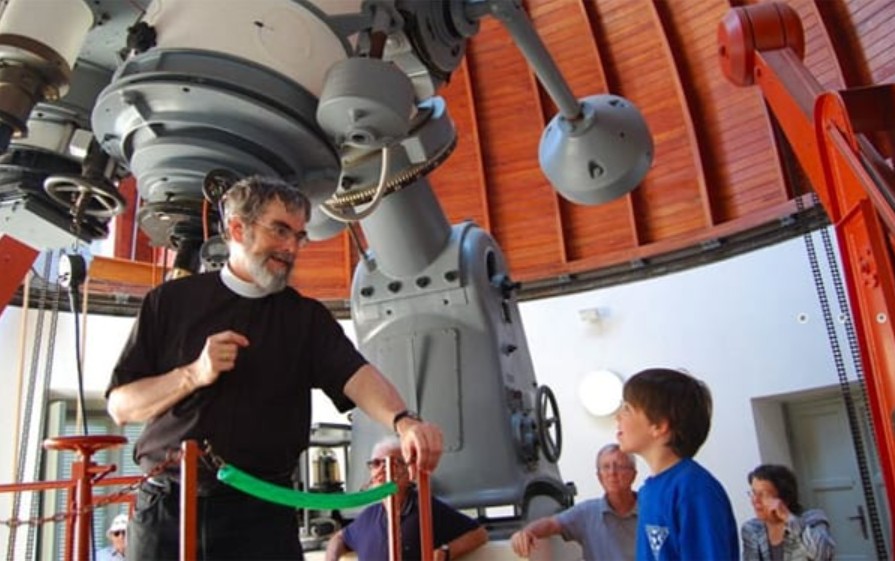
At the center of this work is Br Guy Consolmagno SJ, a Jesuit brother and planetary scientist often called “the Pope’s astronomer.”
Before entering religious life, he earned a PhD from MIT and worked at Harvard. Today, he studies meteorites—ancient space rocks that hold clues to how our solar system formed.
But Consolmagno is more than a researcher. He’s a bridge-builder.
He frequently speaks about how science and faith are not rivals, but partners. In his view, studying the universe is an act of reverence—an attempt to understand creation more deeply.
In 2014, his work in making science accessible earned him the prestigious Carl Sagan Medal.
The Vatican Observatory’s contributions go far beyond symbolism. Its impact on science is real and lasting:
So why does the Church study the stars?
Not to compete with science. Not to control it.
But to participate in it—with a unique perspective.
For the Vatican Observatory, the universe isn’t just a collection of data points. It’s something meaningful. Something worth studying not only with instruments, but with wonder.
In a world that often frames faith and science as opposites, the Church’s astronomers offer a quieter message:
You can believe—and still explore.
You can have faith—and still ask questions.
You can look up at the stars—and see both science and something more.
By Catholic Connect Reporter
Picture Courtesy Jesuits Mid West

© 2026 CATHOLIC CONNECT POWERED BY ATCONLINE LLP