
English
Key Verse to Meditate: "I have bought a piece of land, and I must go out and see it; please accept my regrets" (Lk 14:18).
Dear Brothers and Sisters in the Lord,
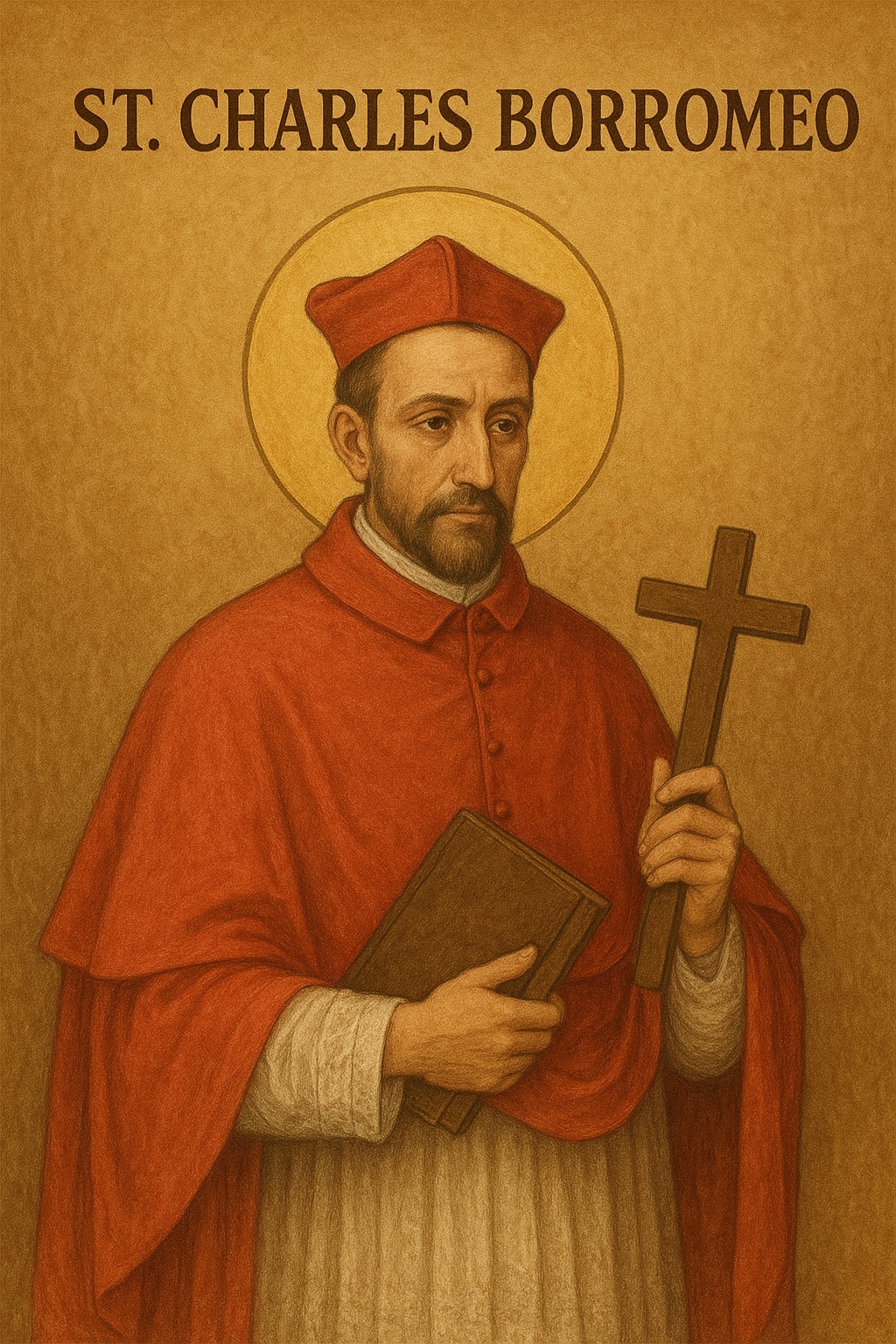
Today, the Church joyfully celebrates the feast of Saint Charles Borromeo, a true shepherd after the Heart of Christ and a luminous example of pastoral zeal, holiness, and reform. Born in 1538 into a noble family in Arona, Italy, Charles renounced wealth and privilege to serve God and His people. After his uncle, Pope Pius IV, appointed him as Cardinal and later Archbishop of Milan, Charles devoted his life to implementing the decrees of the Council of Trent, which sought to renew the Church in faith and discipline after the Reformation.
He became a tireless reformer—reviving seminaries for the proper formation of priests, restoring liturgical discipline, and encouraging holiness of life among clergy and laity alike. During the plague that struck Milan in 1576, while many fled the city, Charles stayed behind, personally tending to the sick, feeding the hungry, and comforting the dying. His deep compassion and fearless charity made him a living image of Christ, the Good Shepherd who lays down His life for His sheep (cf. Jn 10:11).
Saint Charles was also a man of intense prayer, fasting, and penance. His ascetic life was not born of pride but of love—love for the crucified Lord, whom he sought to imitate in all things. He lived what he preached: a faith rooted in conversion and expressed in humble service. His motto, “Humilitas” (humility), became the foundation of his sanctity and leadership. Indeed, he was a man of the Gospel—faithful to prayer, devoted to the Eucharist, and compassionate toward the poor. May his life and example inspire us to renew our love for God and zeal for souls.
The Gospel Reading
The parable of the great banquet in today’s Gospel (Lk 14:15–24) beautifully echoes the mission and spirituality of Saint Charles Borromeo. This parable parallels Matthew’s version (Mt 22:1–14), though Luke places it in a different context—during a meal in the house of a Pharisee. When a guest exclaims, “Blessed is anyone who will eat bread in the kingdom of God!” (Lk 14:15), Jesus responds with a story that challenges complacency and pride.
In the parable, a man prepares a great banquet and invites many guests. When everything is ready, he sends his servant to announce: “Come, for everything is now ready.” The servant symbolizes Jesus Himself, who brings God’s invitation to His people. Yet, those invited make excuses—some are preoccupied with business, others with possessions or family ties (Lk 14:18–20). Their refusal reveals misplaced priorities and a lack of openness to God’s grace.
In righteous anger, the master sends his servant to gather “the poor, the crippled, the blind, and the lame” (Lk 14:21). These represent those whom society overlooks—but whom God welcomes first. When there is still room, the servant is told to go out again, compelling others from the highways and hedgerows to come in. This is the radical inclusivity of God’s kingdom—an open invitation to all, especially the humble and contrite of heart.
Through this parable, Jesus teaches that God’s invitation to the heavenly banquet is universal, but it requires a response. The chosen people’s refusal symbolizes those who reject God’s Word; the new guests symbolize those who accept it with gratitude—the poor in spirit, the repentant, the Gentiles, and all who heed the call of grace. In heaven’s banquet, there is room for everyone because God’s mercy knows no bounds.
Saint Charles lived this Gospel in his ministry. He recognized that the Church’s renewal begins with accepting God’s invitation—to conversion, holiness, and service. Like the master’s servant in the parable, he went out tirelessly to invite others into the banquet of faith. Through catechesis, reform, and personal witness, he brought countless souls to Christ. His life reminds us that holiness is not an abstract ideal but a concrete response to God’s invitation each day.
Points for Personal Reflection
1) Do I take lightly God’s daily invitation—the call to conversion, love, and deeper communion with Him?
2) What excuses keep me from responding wholeheartedly to His grace—comfort, busyness, or fear of change?
3) Am I willing, like Saint Charles Borromeo, to bring others into the banquet of God’s love, especially those who feel excluded or unworthy?
Excuses prevent us from embracing the fullness of life that God offers. Let us pray that, through the intercession of Saint Charles Borromeo, we may accept His invitation with open hearts, welcome His grace, and find true life in Him. May we be renewed in our faith, strengthened in service, and ever ready to lead others to the feast of God’s kingdom.
© 2026 CATHOLIC CONNECT POWERED BY ATCONLINE LLP