
English
Mass Readings: Hab 1:2-3; 2:2-4 | Ps 94 | 2 Tim 1:6-8, 13-14 | Lk 17:5-10
Key Verse for Meditation: “The apostles said to the Lord, ‘Increase our faith!’” (Lk 17:5)
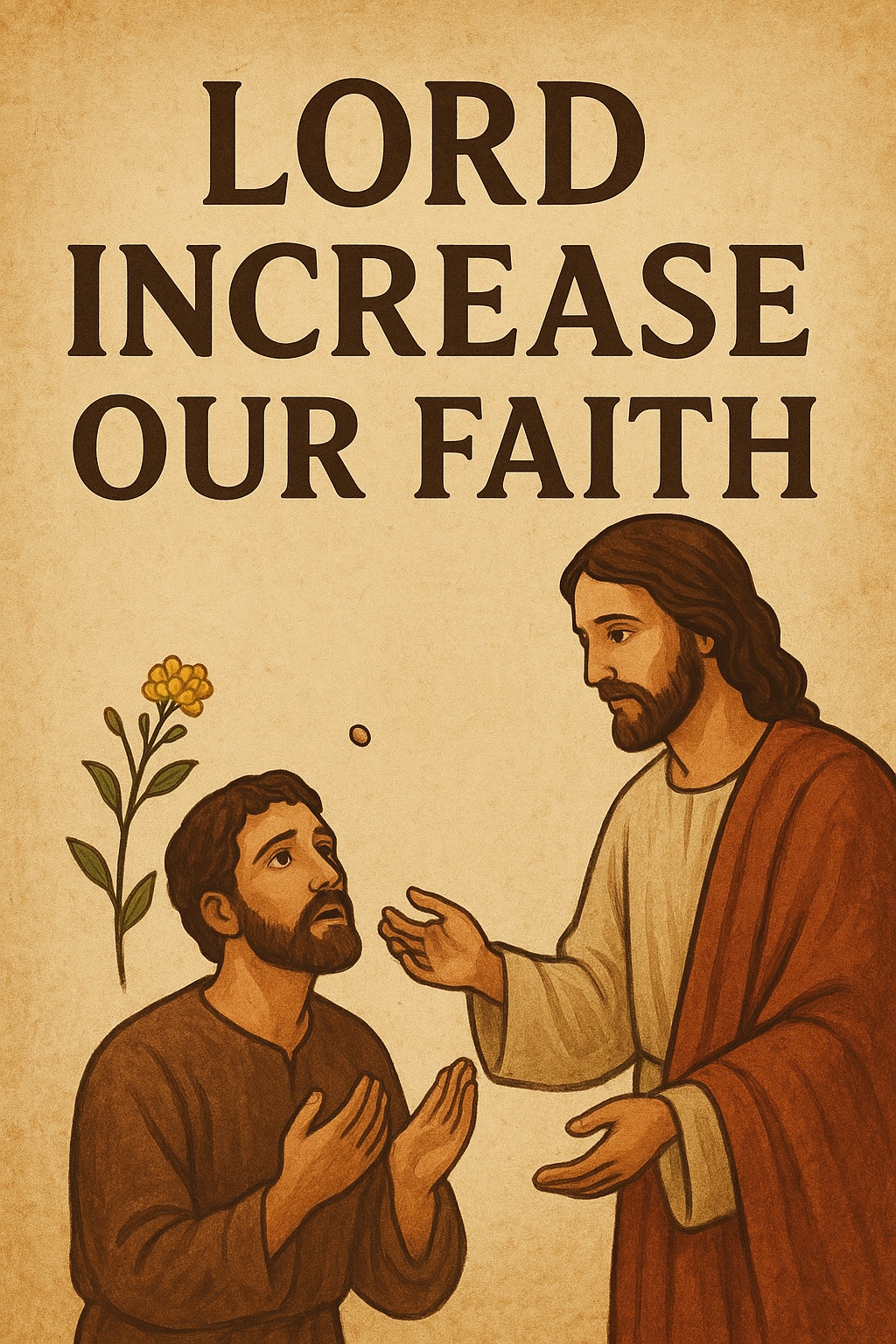
Dear brothers and sisters in Christ, The Liturgy of the Word of God on this twenty-Seventh Sunday in ordinary time presents the central theme of faith. In the Gospel, the apostles approach Jesus with a heartfelt plea: “Increase our faith!” (Lk 17:5; cf. Is 26:15). Their request is simple, yet profound. They had walked with Jesus, witnessed His miracles, listened to His teachings, and yet they realized that the life of discipleship demanded a stronger, deeper faith than they currently possessed. Jesus responds with a striking image: “If you had faith the size of a mustard seed, you could say to this mulberry tree, ‘Be uprooted and planted in the sea,’ and it would obey you” (Lk 17:6). The Lord is teaching them—and us—that even a little genuine faith can accomplish great things, not because of human strength, but because of God’s power working in us. May this Eucharist strengthen our faith, deepen our trust, and inspire us to live boldly as disciples of Christ.
The First Reading
The first reading presents to us the oracle that the prophet Habakkuk received in a vision. This passage unfolds in two parts: the first contains the prophet’s lamentation expressed as a prayer, and the second conveys the Lord’s response. What we encounter here is a profound dialogue between the prophet and God. Habakkuk brings before the Lord a heartfelt complaint about domestic oppression, the perversion of justice, and the rampant violence in society. For the prophet, injustice is seen in the way the wicked circumvent and overpower the righteous.
Habakkuk 2:4 and St. Paul
In the second part of today’s first reading (Hab 2:2–4), the Lord instructs the prophet to write down the vision plainly on tablets so that it may be read and remembered by all. This message is meant to strengthen and encourage the people, especially the Jews living in exile, assuring them that “the righteous shall live by faith” (Hab 2:4). This divine assurance calls the faithful to patient endurance, rooted in trust in God’s unwavering faithfulness.
When Habakkuk declared, “The righteous shall live by his faith,” he was echoing a timeless truth first exemplified in the life of Abraham: “Abraham believed the Lord, and He counted it to him as righteousness” (Gen 15:6). The righteous man “lives” in the sense that he is spared from God’s judgment and, through faith, receives the gift of eternal life. By contrast, the Babylonians, proud and arrogant—“puffed up”—stand condemned, destined for God’s judgment. The righteous, however, remain humble before God and secure in His favor.
The phrase “the righteous shall live by faith” (Hab 2:4) became foundational for St. Paul’s doctrine of justification by faith. Paul cites this verse three times in the New Testament. In Romans 1:17, he affirms that righteousness by faith is offered to both Jews and Gentiles alike: “For in the gospel the righteousness of God is revealed from faith to faith, as it is written, ‘The righteous will live by faith.’” In Galatians 3:11, Paul underscores that justification cannot come through the law: “Now it is evident that no one is justified before God by the law, for ‘The righteous shall live by faith.’” As Habakkuk had already proclaimed, salvation has always been by faith, not by works of the law.
Habakkuk 2:4 is also referenced in Hebrews 10:38, highlighting the perseverance of faith. Paul further insists that only through faith in Christ are we made righteous: “By the obedience of one man, many will be made righteous” (Rom 5:19). He elaborates on this truth in Galatians 2:16, teaching that justification comes not through works of the law, but by faith in Jesus Christ.
Thus, Habakkuk’s prophetic oracle, while rooted in the struggles of his own time, anticipates the heart of the New Testament message: a life of righteousness is a life of faith—a faith fulfilled in Christ.
The Second Reading
In continuity with the first reading, St. Paul, in today’s second reading, also emphasizes that faith is both a gift and a task. He exhorts Timothy: “Rekindle the gift of God that is within you” (2 Tim 1:6). Faith, though received as a divine gift, must be stirred into flame, nurtured, and carefully preserved. It is not a spirit of fear or timidity, but rather a spirit of “power, love, and self-discipline” (2 Tim 1:7).
Faith empowers us to trust in God during moments of trial, to remain steadfast on the path of righteousness, and to hold firmly to the truths of the Gospel. As St. Paul reminds us elsewhere: “Faith comes from hearing, and hearing through the word of Christ” (Rom 10:17). By listening attentively to God’s Word, we allow our faith to mature and deepen.
The apostles themselves had faith, but it was often insufficient for the great mission entrusted to them. Jesus frequently challenged their lack of trust: “Why are you afraid, O you of little faith?” (Mt 8:26). Yet, He never abandoned them in their weakness. Instead, He patiently strengthened them—through His presence, His Word, and His unfailing love.
The Gospel Reading: “Lord, increase our faith!”
Why did the apostles ask Jesus to increase their faith? This request follows immediately after the Lord had spoken of two difficult demands of discipleship: to remain vigilant against temptation and to forgive a brother who sins repeatedly (Lk 17:1–4). Understandably, the apostles felt overwhelmed. To resist temptation and to forgive without limit seemed humanly impossible. Hence, they turned to the Lord for help.
This prayer for greater faith echoes other moments in Scripture. In Mark’s Gospel, the father of a possessed boy cries out to Jesus: “I believe; help my unbelief!” (Mk 9:24). Likewise, when the disciples were astonished at Jesus’ teaching about the difficulty for the rich to enter the Kingdom of God, He reassured them: “For mortals it is impossible, but for God all things are possible” (Mt 19:26). Faith, therefore, is not something we generate on our own; it is first and foremost a gift of God. As St. Paul teaches, faith is a gift of the Spirit (1 Cor 12:9), received at baptism and nurtured throughout our lives.
“Be uprooted and planted in the sea” – A Story
There once lived an elderly woman whose house stood just across from her parish church. She was a devout soul who, when younger, attended Mass regularly and received Holy Communion every Sunday. With age, however, she became too weak to go often, and so she contented herself with praying at home, gazing at the church’s tabernacle through her window. But there was one problem: a large tamarind tree blocked her view of the Blessed Sacrament.
One day she read Jesus’ words: “If you had faith the size of a mustard seed, you could say to this mulberry tree, ‘Be uprooted and planted in the sea,’ and it would obey you” (Lk 17:6). Taking these words to heart, she prayed fervently before going to bed, commanding the tree to be uprooted and cast into the sea. The next morning, full of expectation, she rushed to the window—only to find the tree still standing firmly in place. Disappointed, she muttered to herself: “Ah, I knew it wouldn’t work.” Like this woman, we sometimes pray with lips that doubt even as they ask. Jesus, however, calls us to a faith that trusts deeply, however small it may seem.
Faith Like a Mustard Seed
In response to the apostles’ plea, Jesus says: “If you had faith the size of a mustard seed, you could say to this mulberry tree, ‘Be uprooted and planted in the sea,’ and it would obey you” (Lk 17:6). Why speak of such an impossible task as transplanting a tree into the sea? Jesus is not inviting us to become magicians. Rather, He emphasizes the power of genuine faith. Even the smallest seed of authentic trust in God can accomplish the seemingly impossible.
Elsewhere, Jesus compares the mustard seed to the Kingdom of God: though the tiniest of seeds, it grows into a large shrub where birds build their nests (Mt 13:31–32; Mk 4:30–32; Lk 13:18–19). By contrast, the black mulberry tree, which could live up to six centuries, had an immense and firmly-rooted system. Thus, the image highlights that even faith as small as a mustard seed has the power to uproot what seems unshakable.
Faith, then, is not about spectacular feats, but about trusting God with steadfast simplicity. Just as Jesus used the image of a camel passing through the eye of a needle (Mt 19:24), here too He paints a picture of the extraordinary power of faith when rooted in God.
The Power of Humble Service
The second part of today’s Gospel reminds us that faith must be accompanied by humble service. Jesus presents the example of a servant (doulos) returning from the fields. Even after a day’s labor, the servant does not expect rest or thanks but continues to serve his master (Lk 17:7–9). The point is clear: discipleship is not about earning merit or putting God in our debt. Our service is our duty, freely offered in love.
This teaching directly challenges the Pharisaic mentality that believed good works entitled one to a reward from God. Jesus rejects this claim, as seen again in the parable of the Pharisee and the tax collector (Lk 18:9–14). No one can put God under obligation. As the Scripture scholar Klostermann notes, disciples are not to seek thanks, but rather to give thanks. Indeed, God does reward generously, as seen in Luke 12:35–37, where the vigilant servant is astonishingly served by the Master Himself. But such reward is pure grace, never earned wages.
Thus, Jesus concludes: “When you have done all you were commanded, say, ‘We are unworthy servants; we have done only what we ought to have done’” (Lk 17:10). This truth humbles us: our prayers, sacrifices, and works are not bargaining chips with God. Rather, they are expressions of our love, made possible only by His grace working within us.
Living the Gospel
In this Gospel, Jesus teaches us two inseparable lessons:
True discipleship, then, is marked not by power or recognition but by trusting faith and humble service. As Jesus Himself testified: “The Son of Man came not to be served but to serve, and to give His life as a ransom for many” (Mt 20:28).
May we too live with such faith and such humility, offering our lives in loving service to God and to one another.
Points for Personal Reflection
Conclusion
Dear brothers and sisters in the Lord, faith is God’s gift, and even the smallest seed of faith, when entrusted to Him, can move mountains. Let us pray with sincerity: “Lord, increase our faith.” May He strengthen us in moments of trial, make us forgiving in times of hurt, and keep us humble in our service. Let us live each day with the conviction that our lives are sustained not by sight, but by faith. And may this faith lead us ever closer to Christ, who is the source and fulfilment of our hope.
© 2026 CATHOLIC CONNECT POWERED BY ATCONLINE LLP