English
Mass Readings: Wis 9:13-18 Ps 90 Philemon 1:9-10. 12-17 Lk 14:25-33
Key Verse to Meditate: So therefore, no one of you can be My disciple who does not give up all his own possessions (Lk 14:33).
My dear Brothers and Sisters in the Lord,
The Twenty-Third Sunday in Ordinary Time presents to us, the disciples of the Lord, the clear and uncompromising conditions of true discipleship. Jesus gives us a clarion call to examine seriously our vocation as His followers and to live it out in concrete, practical ways. The four Gospels highlight different dimensions of discipleship. For Matthew, discipleship is learning from the Master (Mt 11:29). For Mark, it is suffering with the Master. For Luke, it is walking with the Master, while John emphasizes that a disciple is totally committed to Jesus the Master.
The First Reading: The Need for Divine Wisdom: In the Book of Wisdom, the author reflects on how human reason alone is insufficient to grasp the plan and will of God. He notes that “the deliberations of mortals are timid, and unsure are our plans” (Wis 9:14). Our mortal bodies weigh down our souls, and the limitations of earthly life make it difficult to comprehend God’s ways. Without divine wisdom, our philosophies can mislead us. True understanding of God’s plan comes only through His Spirit, who guides us beyond human limitations.
The Second Reading: Brotherly Love Above Social Boundaries: In the Letter to Philemon, St. Paul goes beyond addressing the slavery of his time. His concern is the deeper matter of brotherly love. Paul appeals to Philemon to welcome back Onesimus, a runaway slave, not as a servant but as a brother in Christ. Paul even urges Philemon to receive Onesimus as he would receive Paul himself. Philemon is no longer to act as a master but to embrace Onesimus as a fellow member of the Body of Christ. In Christ, every human relationship is transformed.
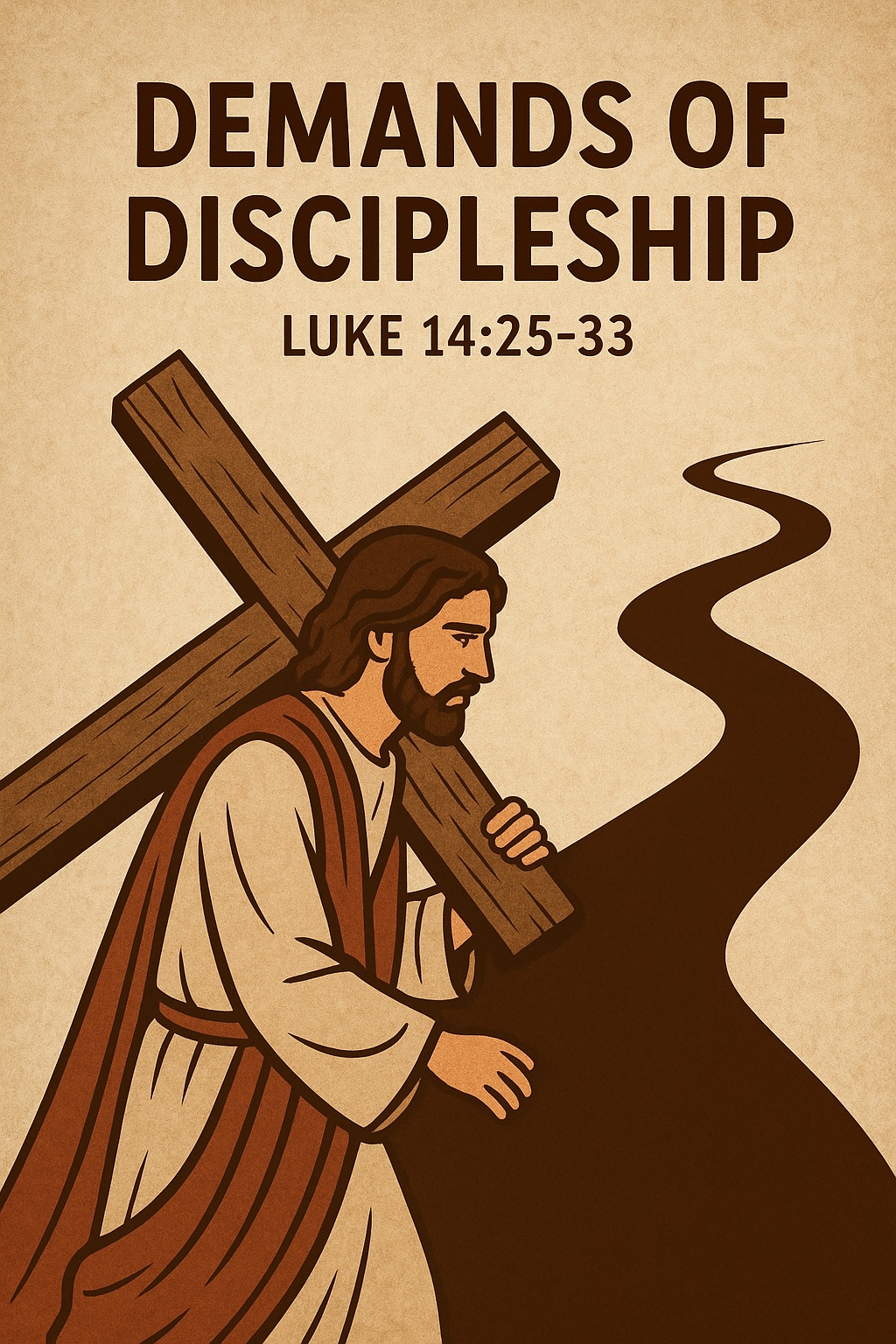
The Gospel Reading: The Demands of Discipleship
We are in the “Journey Section” of Luke’s Gospel. While addressing large crowds, Jesus now turns his attention to his disciples. In this passage—unique to Luke—Jesus issues both a warning and a rebuke about the demands of discipleship. But what does following Jesus really require? Twice, He insists that a person cannot be His disciple unless he or she “hates” even family, self, and is willing to carry the daily cross (Lk 14:26–27; cf. Mt 10:37–38). True discipleship, therefore, is inseparable from bearing the cross and placing Jesus above all else. At its heart, discipleship is about fidelity: what truly occupies the first place in one’s heart?
Discipleship in Christ is not casual—it is demanding. Jesus says, “Whoever comes to me and does not hate father and mother, wife and children, brothers and sisters—yes, even life itself—cannot be my disciple” (Lk 14:26). At first, this may sound harsh. But Jesus is not calling us to despise our loved ones. Rather, He insists that our love and attachment to them must never hinder our commitment to God’s kingdom. Peter once said, “Lord, we have left everything and followed you,” and Jesus assured him that anyone who sacrifices home, family, or possessions for the sake of the Kingdom will receive far more—in this life and in the life to come (Lk 18:29–30).
Successful Discipleship: Jesus teaches that following Him and being part of God’s Kingdom must become the highest priority of life. Disciples must “count the cost” of following Jesus, because success in discipleship does not come easily. From the very beginning of His preaching, Jesus did not soften the demands of the journey. He clearly asked for the first place in a disciple’s heart. This is what successful discipleship requires.
Total Loyalty: When Jesus says that a disciple must “hate” father, mother, spouse, children, siblings—even one’s own life—He does not speak of literal hatred. The word is used figuratively, expressing the absolute priority of one’s relationship with Christ. Successful discipleship requires complete adherence to Him. Loyalty to Jesus must outweigh every other attachment.
Jesus First: For a disciple, Jesus must come first—above family, possessions, comfort, or even self-preservation. A disciple is, by definition, a learner, and the true Teacher is Jesus alone. Without this, discipleship is impossible. This saying becomes especially challenging for priests and religious, who must continually choose Christ over natural family ties. If attachment to family outweighs attachment to Jesus, then under the pressures of persecution or division, a disciple risks choosing against Christ. This is the meaning behind Jesus’ hard saying: discipleship cannot exist unless He is the first and ultimate teacher.
Walking the Path of the Master: To be a disciple is to walk the same path Jesus walked: rejection from leaders, misunderstanding from people, loneliness, pain, and ultimately the cross. A true disciple must learn from Jesus and imitate His radical renunciation—even His abandonment of family ties—in total surrender to God’s will. If one is not prepared to embrace this path, it is better not to begin the journey at all. Discipleship is not a half-hearted endeavour but a life of total allegiance to Christ.
The Two Parables
To illustrate His teaching, Jesus presents two parables (Lk 14:28–30; 31–32).
The first parable describes a man building a watchtower for his vineyard. Such a project requires careful planning; otherwise, if he cannot complete it, all who see the half-finished tower will ridicule him. Jesus asks: “Which of you, desiring to build a tower, does not first sit down and estimate the cost to see if he has enough to complete it?” (Lk 14:28). How sad it is to begin something and not bring it to completion! Likewise, embarking on the journey of discipleship demands serious reflection on what it will take to persevere until the end.
The second parable carries a similar lesson (Lk 14:31–32). Here the image is of a king preparing for battle. When he realizes his forces are outnumbered, he wisely considers the cost of destruction and chooses instead to seek terms of peace. Only a foolish king would march into battle against a stronger opponent, knowing he is doomed to fail. This parable teaches that in the life of discipleship, it is far better to reconcile with God than to resist Him. Wisdom lies in counting the cost of standing against the Almighty.
Discipleship: To Give up Everything: In conclusion, Jesus declares: “In the same way, any of you who does not give up everything he has cannot be my disciple” (Lk 14:33). True discipleship requires putting Jesus first above all else. Those who oppose God’s will must carefully consider the cost, for His terms of peace are both gracious and demanding. They call for humility, surrender, and the recognition that He alone is the source of life and spiritual well-being.
Discipleship is no casual matter. To be a disciple and finish the task, one must count the cost, accept God’s terms of peace, and make Him the first and final priority. Successful discipleship begins with humble surrender and is sustained by unwavering fidelity to Christ.
Points for Personal Reflection
1. Am I willing to place Christ above every other relationship and attachment in my life?
2. How do I carry my daily crosses with faith and perseverance in following Jesus?
3. In what ways do I strive to think, speak, and act as Christ did?
4. Is Jesus truly at the center of my life, guiding all my choices and priorities?
The Lifestyle of Jesus: Priests and religious, like all disciples, can be deeply attached to family. Yet Jesus warns: “Whoever loves father or mother more than me is not worthy of me” (Mt 10:37). The danger lies in allowing any attachment—whether to family, wealth, possessions, or even personal comfort—to take precedence over the Gospel mission. Consider Jesus’ own example. When told His mother and relatives were waiting to see Him, He replied, “My mother and my brothers are those who hear the word of God and do it” (Lk 8:21). He had no fixed place to rest His head, often went without food, and never clung to earthly securities. Even His identity as the Son of God and the most gifted preacher did not keep Him from emptying Himself completely (Phil 2:6–11). He surrendered His very life for the mission, entrusting His mother to John before His death.
To Give Up All for the Kingdom: A true disciple must be ready to surrender everything—relationships, possessions, and even life itself—for the sake of the Kingdom. Jesus Himself lived this radical detachment. In His passion, no relatives were there to defend Him, except the women of Jerusalem who wept for Him. His only attachment was to the Father’s mission of redeeming the world. Our discipleship will inevitably face trials, weaknesses, and personal limitations. But human imperfection is not an obstacle to following Christ. Carrying our own crosses, we follow the Master who bore the heaviest cross of all: “Whoever does not carry the cross and follow me cannot be my disciple” (Lk 14:27).
Vigilance in Discipleship: Jesus calls us to deliberate commitment. Before setting out, we must “count the cost” of discipleship. The Christian journey is a battle—spiritual, physical, material, and emotional forces will try to pull us away from Christ. We must remain awake and steadfast, knowing that divine assistance will never fail us in times of trial. If you choose to follow Christ, be ready for a lifelong battle.
Discipleship and Grace: Discipleship is ultimately a life of grace. As Dietrich Bonhoeffer reminds us, “Christianity without discipleship is always Christianity without Christ.” As disciples, we are called to center our lives on Jesus Christ. Pope St. John Paul II exhorts us: “Fix your gaze on the person of Jesus Christ.” Our life of discipleship must be like a solar system with Christ at the center, around whom everything else revolves. True discipleship demands total, unconditional, and undivided allegiance to Christ.
To be a disciple means, first of all, to be with Him (Mk 3:14): following Him, staying behind Him, and accepting to go wherever He leads. A disciple gradually begins to think and act as Jesus did. Christ Himself is the true model and protagonist of authentic discipleship: “I always do what pleases Him” (Jn 8:29; 14:31).
Let me conclude this Sunday reflection on discipleship with an inspiring quote:
“A disciple has a mind through which Christ thinks,
a heart through which Christ loves,
a voice through which Christ speaks,
and a hand through which Christ helps.”
© 2026 CATHOLIC CONNECT POWERED BY ATCONLINE LLP