
English
Mass Readings: Sir 3:19-21. 30-31 Ps 68 Heb 12:18-19. 22-24 Lk 14:1. 7-14
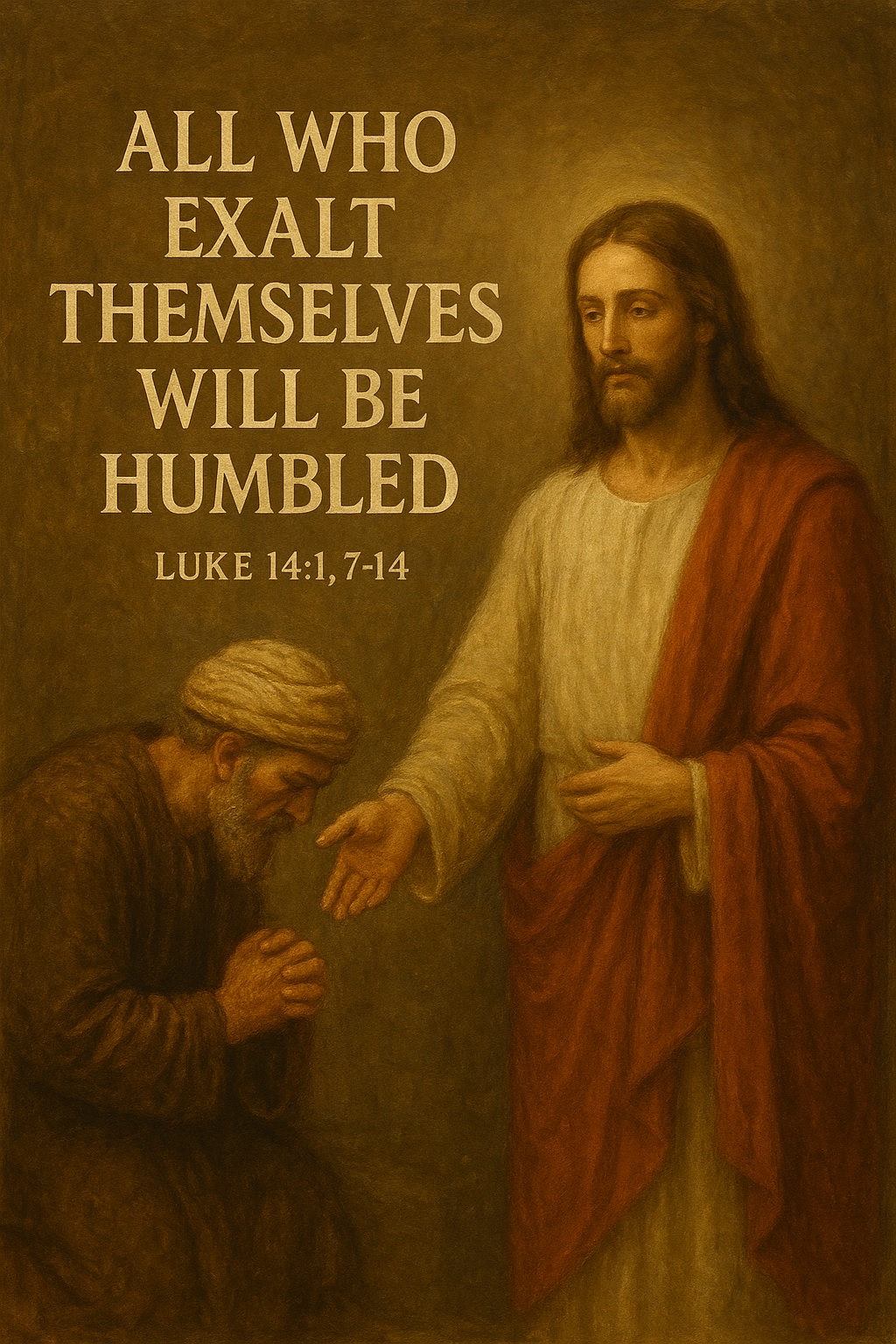
Key verse to meditate: "For everyone who exalts himself shall be humbled, and he who humbles himself shall be exalted" (Lk 14:11).
Dear Brothers and Sisters in Christ,
The Liturgy of the Twenty-Second Sunday in Ordinary Time brings to us a profound and essential Christian virtue—humility—as the foundation of discipleship. Both the first reading from the Book of Sirach and the Gospel focus on this theme, calling us to reflect and act. In today’s Gospel, Jesus uses a parable to teach humility—not simply as a matter of good manners, but as a spiritual attitude before God. The second reading from the Letter to the Hebrews reminds us that in the presence of God—Mount Zion, the city of the living God—holiness is paramount. There, Christ stands as the mediator of a new covenant, and nothing unholy can remain.
First Reading
In the Book of Sirach, the author Ben Sira repeatedly emphasizes the importance of humility as a mark of true wisdom (Sir 1:27; 4:18; 7:16-17; 10:26-28). The Hebrew word anawāh (humility) can also be translated as modesty, meekness, or lowliness. In the Old Testament, humility is often closely linked with the fear of the Lord (Prov 22:4). At other times, humility is presented in parallel with the fear of the Lord as its essential expression (Prov 15:33; cf. Prov 11:2; 18:12).
Today’s first reading from Sirach presents a profound teaching on humility. It combines attitudes and virtues directed both toward oneself and toward others: self-knowledge, patience, modesty, an awareness of one’s limitations, and above all, the wisdom to rely on God (cf. Mt 20:26-28; Phil 2:3-8). In this poetic reflection, Ben Sira reminds us that although God’s power is great (Ps 20:6; 71:18; Sir 15:18), He is not glorified by the proud and powerful, but by the humble of heart. This same spirit of humility shines forth in Mary’s Magnificat in the New Testament (Lk 1:46, 48, 51-52).
Ben Sira also warns against intellectual pride and self-reliance, urging us not to seek what is beyond our understanding or presume to master what is beyond our power (Sir 3:21). True wisdom lies in recognizing our limits and entrusting ourselves to God’s providence.
The reading concludes with a striking image: “As water extinguishes a blazing fire, so almsgiving atones for sin” (Sir 3:30). Almsgiving, generosity, and the repayment of kindness (Sir 3:31) are upheld as expressions of humility before God. This teaching foreshadows Christ’s message in today’s Gospel, where He invites us to give without expecting repayment, especially to those who cannot repay us (Lk 14:14). For it is God Himself who will repay with the reward of eternal life.
The Second Reading
The passage from Hebrews 12:18-19, 22-24 contrasts two mountains to reveal the transformation brought by the New Covenant in Christ. This reading reminds us that as Christians, we no longer approach God in fear and trembling as under the Old Covenant. Rather, we come into a sacred communion with God through Jesus, the mediator who brings peace and holiness
The first part (Heb 12:18-19) of the passage recalls Mount Sinai, where Moses received the Law. It was a terrifying experience for the people of Israel. The mountain was enveloped in fire, darkness, gloom, and a storm. The voice of God was so overwhelming that the people begged no further word be spoken to them. This mountain represents the Old Covenant, marked by fear, awe, and distance from God. Holiness here was so intense that even touching the mountain could lead to death (cf. Ex 19:12-13). The second part (Heb 12:22-24) In contrast, the author of Hebrews says Christians have now come to Mount Zion, the heavenly Jerusalem — the city of the living God. This mountain is symbolic of the New Covenant brought by Jesus Christ. It is a place not of fear, but of celebration, worship, and communion.
This reading reminds us that as Christians, we no longer approach God in fear and trembling as under the Old Covenant. Rather, we come into a sacred communion with God through Jesus, the mediator who brings peace and holiness. It is a call to live holy lives worthy of this heavenly citizenship — not out of fear, but out of love and gratitude, as we are now part of the divine family, destined for eternal joy in the presence of God.
The Gospel Reading
In today’s Gospel, Jesus uses a parable to teach humility—not simply as a matter of good manners, but as a spiritual attitude before God. Jesus had just healed a man on the Sabbath—a bold and compassionate act that upset the religious elite. Yet, undeterred by their criticism, Jesus turns their attention to another matter: the pride and self-seeking behaviour of those who seek the places of honour at a supper in a Pharisee’s house.
So, as Jesus observed how guests scrambled for the best seats, He spoke a parable urging them to choose the lowest place instead. Why? Because if you presume to take a seat of honour, the host may come and ask you to give up your place to someone more distinguished, causing embarrassment and shame (Lk 14:9). On the other hand, if you humbly take the lowest place, the host may say, "Friend, move up higher"—and then you will be honoured in the presence of all (Lk 14:10). He warns them of the embarrassment that comes when someone assumes a place of honour, only to be displaced.
This teaching is echoed in the Book of Proverbs: “Do not put yourself forward in the king’s presence or stand in the place of the great; for it is better to be told, ‘Come up here,’ than to be put lower in the presence of a noble” (Prov 25:6–7).
Jesus was not merely giving social advice; He was offering a spiritual principle rooted in God's vision of the human heart. Humility, in the Kingdom of God, is not weakness—it is strength. It is not denial of our worth—but the honest recognition that all we have is a gift from God. True humility places God at the center and allows us to see ourselves as we truly are: children of grace.
What Jesus proposes to the Pharisees is a radical call to true humility—a humility that acknowledges one's proper place before God, rather than seeking recognition before others. The message is further supported by the first reading from Sirach: “My child, conduct your affairs with humility, and you will be loved more than a giver of gifts... Humble yourself the more, the greater you are, and you will find favour with God” (Sir 3:19–20).
From Personal Honour to Hospitality
Jesus then shifts the focus from personal honour to hospitality. He challenges the host—and us—to rethink who we invite into our lives. Normally, we invite those who can repay us: our family, friends, or those from whom we expect return invitations. Jesus then goes a step further—teaching not only how to behave as guests, but also how to host. He tells the Pharisee: “When you give a banquet, invite the poor, the crippled, the lame, and the blind... they cannot repay you, but you will be repaid at the resurrection of the righteous” (Lk 14:13–14).
The Essence of Gospel humility: This teaching reveals the heart of Christian generosity. True humility seeks no reward. It is content with quiet service, hidden generosity, and loving attention to the marginalized. This is the essence of Gospel humility—to give without expecting anything in return, to serve those who cannot serve us back, and to love simply because it is what Christ Himself did. The heart of this teaching is summed up in one of Jesus' most memorable sayings: “For all who exalt themselves will be humbled, and those who humble themselves will be exalted” (Lk 14:11).
Points for Personal Reflection
1. What is true humility?
Humility is not thinking less of ourselves, but thinking of ourselves less. Humility is the ability to see ourselves as God sees us—not inflated by pride nor diminished by insecurity. It is not weakness, but spiritual strength rooted in truth. It liberates us from the need to impress others or to measure our worth by worldly standards.
“Though he was in the form of God, he did not regard equality with God as something to be grasped... but emptied himself... humbled himself and became obedient to the point of death—even death on a cross. Therefore, God highly exalted him.”
Christ, though divine, lowered Himself to lift us up. In doing so, God exalted Him above all creation. His humility became the path of redemption.
Conclusion
Humility means seeing ourselves as God sees us—not as the world ranks us. It liberates us from pride and insecurity. The Book of Sirach says: “The greater you are, the more you must humble yourself, and you will find favor with God” (Sir 3:18). Jesus is our model: though equal to God, He emptied Himself, taking the form of a slave… becoming obedient to death on a cross. Therefore, God highly exalted Him (Phil 2:7–9). When we embrace humility, we walk the path of Christ—and it is this path that leads to sainthood.
Humility is the queen of all virtues. It is the soil in which faith, love, and service grow. In a world that encourages self-promotion and personal glory, Jesus invites us to walk a different path—the path of self-forgetfulness, generosity, and trust in God’s exaltation.
Let us pray for the grace to be humble—not merely in our words, but in our thoughts, our service, and our love. When we walk humbly with our God, we reflect Christ Himself and become lights of hope and healing in the world: “Learn from me,” says Jesus, “for I am gentle and humble of heart, and you will find rest for your souls” (Mt 11:29).
Let us then strive to clothe ourselves in humility, for it is the doorway to grace, the seed of holiness, and the soul of true discipleship - Amen.
© 2026 CATHOLIC CONNECT POWERED BY ATCONLINE LLP