
English
Mass Readings: Wis 18:6-9 Ps 33 Heb 11:1-2.8-19 Lk 12:32-48
Key Verse to Meditate: "Be dressed in readiness, and keep your lamps alight (Lk 12:35).
My dear Brothers and Sisters in Christ,
The Liturgy of this Nineteenth Sunday invites us to live as watchful servants, prepared at all times for the Lord’s coming. Each reading emphasizes a key Christian virtue—faith, which expresses itself in obedience, hope, and readiness.
In the first reading, from the Book of Wisdom, we hear a hymn of liberation—a song of faith sung by the Israelites as they recalled God’s fidelity in delivering them from slavery in Egypt. They believed with all their hearts that God would set them free—and He did.
In the second reading, Abraham shows us what it means to walk by faith. He trusted God even when the path ahead was unclear and difficult. His journey became a model for all believers. Without faith, even hope becomes difficult. Our ability to hope is rooted in our trust in God. This connection between faith and hope is beautifully reflected in today’s second reading.
In the Gospel, Jesus urges us to be vigilant, faithful servants—always ready, always trusting, and always obedient.
1. The First Reading: A Night of Deliverance and Divine Favor
The author of the Book of Wisdom reflects on the miraculous night of Israel’s deliverance from Egypt—the first Passover. While Egypt, the land of oppression, was struck with the death of its firstborn, Israel was spared by the mercy of God. The sign of blood smeared on the doorposts (Ex 12:7) became a mark of salvation and protection. But beyond its historical meaning, this act was also a foreshadowing of Christ, the true Paschal Lamb, whose blood takes away the sin of the world (cf. Jn 1:29).
The reading also emphasizes how God treated the Israelites not merely as survivors, but as “holy children”—invited into intimacy with Him through worship, sacrifice, and communion. Despite the dangers of the desert and opposition from enemies, God glorified them, calling them into a covenant relationship. This is our story too: God continues to redeem us from sin and slavery, marks us with the blood of His Son in Baptism, and calls us His beloved children.
2. The Second Reading: A Journey of Faith and Obedience
The second reading gives us a rich and beautiful catechesis on faith. Faith, says the author, is “the assurance of things hoped for, the conviction of things not seen” (Heb 11:1). It’s not wishful thinking—it is trust in the promises of God, even when we don’t see the full picture.
Abraham is lifted up as a model of faith. He left his homeland (Gen 12:1. 4), journeyed through foreign lands, lived in tents, faced threats, and waited for a promised land that he would never fully possess in his lifetime. He believed—not because everything was clear, but because he trusted the One who called him. Even more strikingly, Abraham obeyed God’s command to offer his son Isaac, trusting that God could raise the dead (Heb 11:19; Gen 22:1-3). This is radical faith: faith that walks even when the road is unclear, and faith that obeys even when the cost is great.
We are heirs of this same promise. Faith demands a response—not only in belief but in action. Just as Abraham moved, trusted, and surrendered, so too are we called to live not by sight, but by trust in the Word and will of God. True faith is not blind but rooted in trust. It is a journey into the unknown, anchored in God’s promises.
3. The Gospel Reading
Today’s Gospel continues the theme from last Sunday. In the first part (Lk 12:32–34), Jesus teaches us to be free from anxiety over material possessions. In the second part (Lk 12:35–48), He instructs us on how to be spiritually prepared for the coming of the Son of Man.
Jesus begins by affectionately calling His disciples the “little flock,” urging them to trust in the Father who desires to give them the Kingdom (cf. Dan 7:14, 27). In prophetic literature, the term flock symbolizes both vulnerability and divine care (Jer 13:17; Ezek 34; Zech 10:3). By calling them this, Jesus assures them of God's loving protection and the nearness of salvation.
He urges them: “Sell your possessions and give to charity. Make purses that do not wear out, an unfailing treasure in heaven” (Lk 12:33). Disciples must be detached from earthly concerns and preoccupied with the Kingdom of God. A heart freed from worry is a heart available for mission.
4. Waiting with Girded Loins and Burning Lamps
Jesus then continues His teaching on discipleship with a powerful message about readiness and stewardship. “Let your loins be girded and your lamps burning,” He tells His disciples, “And be like men waiting for their master to return” (Lk 12:35–36). In ancient times, servants waited to open the door for the master. If the master returned and found them awake, he would honour them, even serving them at the table—a powerful image of divine reward.
This is a call to active vigilance. In ancient times, servants wore long garments and had to gird their loins—tie up their robes—to move quickly and serve. The servants should be dressed and keep their lamps lit so that there is no delay in lighting the master's path into the house. The burning lamp symbolizes a heart fuelled by grace and alert to the Lord’s presence. The faithful servant watches with longing, not out of fear but out of love.
5. Being Served servants
What is truly remarkable is what Jesus says next: If the master finds the servant awake, he will serve the servant—a radical reversal of roles (Lk 12:37). The fidelity of the servants earns them the astonishing reward of being served rather than serving. This striking image echoes the scene at the Last Supper, where Jesus, the Master, girded Himself with a towel and washed the feet of His disciples (Jn 13:4–5). Such is the reward of the faithful: deep intimacy with the Lord and a share in the joy of His Kingdom.
Jesus also issues a sobering warning against complacency. Just as a homeowner remains vigilant, fearing a thief in the night, so must the disciple be watchful and prepared. Through this parable, Christ teaches that those who are negligent and unprepared will face serious consequences at the coming of the Son of Man (Lk 12:39–40).
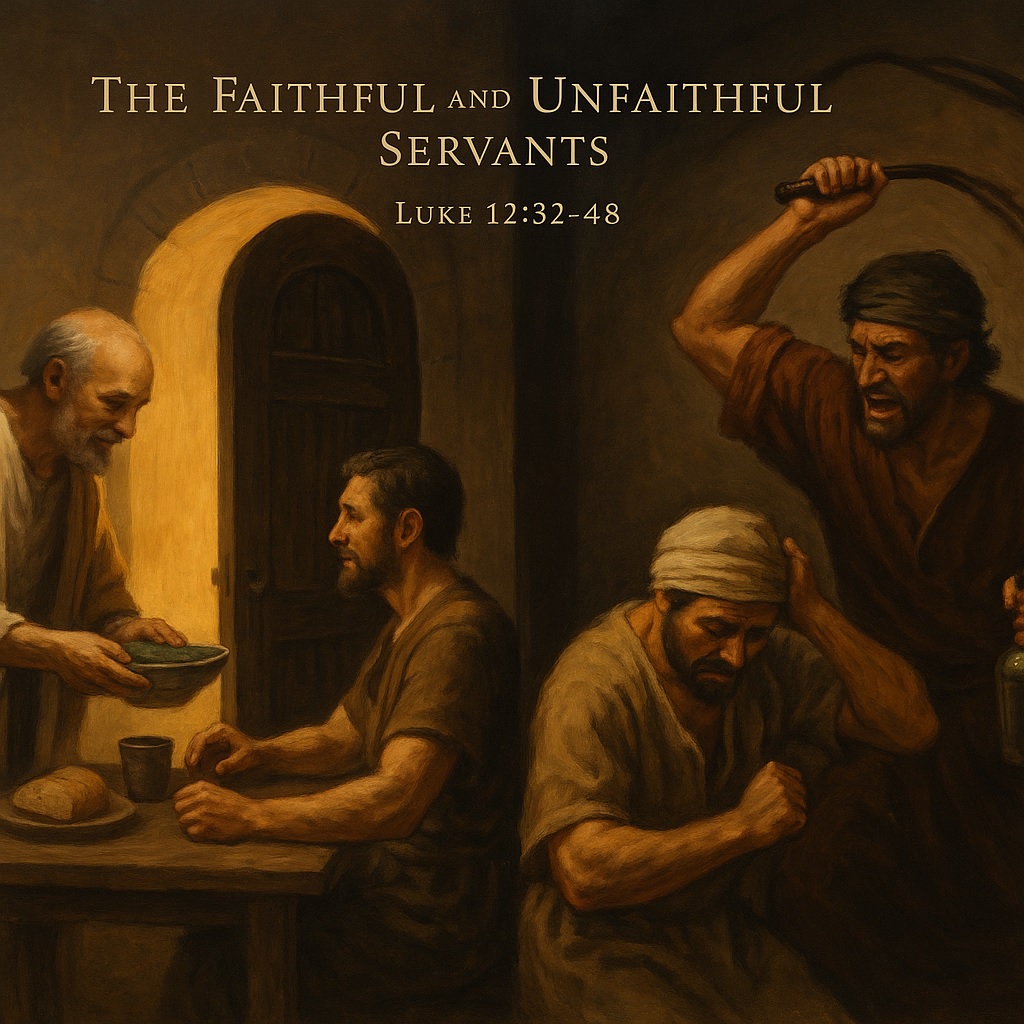
6. The Faithful and Unfaithful Servant
Jesus then contrasts the faithful and unfaithful servant. The faithful one, entrusted with responsibility, manages it wisely. The unfaithful one abuses his role and is severely punished. The wise and faithful servant steadily carries out his master’s wishes and is promoted while the servant who takes advantage for the master’s delay pays the ultimate penalty for his folly. The key message is: we are stewards, not owners. Everything we have—talents, responsibilities, time—is given by God. “To whom much is given, much will be required” (Lk 12:48).
Jesus also reminds us: “Where your treasure is, there will your heart be also” (Lk 12:34). This radical phrase means that the heart aligned with God will have the Kingdom of God as its constant point of reference. What do we truly treasure—Heaven or earth? Faith invites us to invest our hearts in eternal things. This is a solemn reminder for each of us—whether in ministry, family, or society—we are stewards, not owners, of the gifts entrusted to us.
7. Points for Personal Reflection
The First Reading shows us God’s faithfulness to His people. The Second Reading challenges us to respond in obedient faith like Abraham. And the Gospel shows us how this faith expresses itself in vigilance, responsibility, and hope. Together, they form a single message: the Christian life is a pilgrimage of trust, and we must walk it with eyes fixed on the Lord.
The disciple should be equipped and alert at all times, ready to meet the Master at the moment of His arrival. The Evangelist Luke, who identifies Jesus as the coming Son of Man, places greater emphasis in today’s parables on the coming of the Son of Man rather than on the return of the Master. It is this coming for which the disciple is called to be prepared. The servants in the Gospel parables this Sunday also represent the leadership roles of the disciples and their pastoral responsibilities. As Scripture reminds us: “From everyone who has been given much, much will be required; and from the one who has been entrusted with much, even more will be demanded” (Lk 12:48).
Our Life of Faith
In the life of Jesus, we witness a profound sense of urgency to do the will of the Heavenly Father. He once said to His disciples, “My food is to do the will of Him who sent Me and to accomplish His work” (Jn 4:34). Even in His hour of agony in the Garden of Gethsemane, He prayed with deep submission: “Father, if You are willing, remove this cup from Me; yet not My will, but Yours be done” (Lk 22:42).
Living a life of faith is often like leaping into the unknown. When someone decides to follow the will of God, they will inevitably face countless moments of uncertainty, temptation, and doubt. Yet, Jesus assures us, “The one who endures to the end will be saved” (Mt 24:13). Just as He remained obedient unto death, so are we called to imitate His steadfastness and fidelity.
Faith implies a total surrender to the will of God—no matter the cost. A life without faith will likely neglect God’s will in daily decisions. But a person transformed by God’s sanctifying grace is able to say “yes” to God continually, just as our Blessed Mother Mary did when she said, “Let it be done to me according to your word” (Lk 1:38).
Even today, we witness many humble, ordinary Catholics living extraordinary lives of faith. Their witness may not make headlines, but their trust in God speaks volumes. We need more than just eyes to see their example—we need the faith to recognize and be inspired by it. Without faith, even hope becomes difficult. Our ability to hope is rooted in our trust in God. This connection between faith and hope is beautifully reflected in today’s readings.
We Ask Ourselves
Conclusion
Faith is not a one-time decision; it’s a daily “yes” to God, even amid doubt or darkness. Like Jesus, who said, “Not my will, but Yours be done” (Lk 22:42), we too are called to a life of obedient love. And like Mary, we are invited to say, “Be it done to me according to Your word.” May we grow in faith, stay vigilant, and live with the joyful expectation of meeting the Lord. Let our lives be a constant echo of readiness: “Speak, Lord, your servant is listening.”
Faith is not just believing in God; it is living in such a way that our whole life speaks of trust in His promises. It is walking like Abraham, trusting like the Israelites, and watching like faithful servants.
May the Lord find us ready—with girded loins, burning lamps, and open hearts—eager to welcome Him when He comes. Amen
© 2026 CATHOLIC CONNECT POWERED BY ATCONLINE LLP