
English
Mass Readings: Mic 5:1-4 Ps 13 Mt 1:1-16. 18-23
Key Verse to Meditate: "Look, the virgin shall conceive and bear a son, and they shall name him Emmanuel," which means, "God is with us" (Mt 1:23; Is 7:14).
Dear Brothers and Sisters in the Lord,
Today the Church celebrates the Feast of the Nativity of the Blessed Virgin Mary. Her birth is a sign that God has prepared salvation for us, for in His divine plan He fashioned the body and soul of the Mother of Jesus—who is also our Mother. After the solemnity of Christmas, the birthday of our Saviour, the Church celebrates only two other birthdays: that of the Blessed Virgin Mary and that of John the Baptist. In the case of Mary, because of her Immaculate Conception, it is most fitting that her nativity is celebrated liturgically.
Birthdays remind us that life itself is God’s greatest gift. Along with life comes our vocation, our calling. What matters is how we respond to these gifts—by offering our lives back to God as an act of thanksgiving. As St. Paul reminds the Christians in Rome: “For the gifts and the call of God are irrevocable” (Rom 11:29).
Our Lady of Good Health
In India, especially in Tamil Nadu, this feast coincides with the celebration of ‘Our Lady of Good Health,’ affectionately known as ‘Our Lady of Velankanni.’ The Basilica of Our Lady of Good Health, located in the Diocese of Thanjavur, Nagapattinam District, is often called the “Lourdes of the East.” It is one of the most popular Christian pilgrimage centers in India, drawing thousands of pilgrims each year who come to receive God’s mercy, pardon, and healing through the intercession of Our Lady of Good Health.
Similarly, in Karnataka, St. Mary’s Minor Basilica at Shivajinagar, another important pilgrimage center, also celebrates with great devotion the maternal feast of Our Lady of Good Health, once again attracting thousands of pilgrims from across the state.
The Gospel Reading - Joseph, the “son of David”
On the Nativity of the Blessed Virgin Mary, the Gospel reading from Matthew highlights not only Mary but especially the character of Joseph: “and to Jacob was born Joseph, the husband of Mary, by whom Jesus was born, who is called Christ” (Mt 1:16).
Joseph is addressed as the “son of David” (Mt 1:20), showing that the promise made to Abraham and David is fulfilled through him at the announcement of the Saviour’s birth, whose reign will never end. As a human being, Joseph must have struggled when he discovered that Mary was with child through the Holy Spirit (Mt 1:18, 20). Though he trusted that God’s hand was at work, convincing others—especially the religious authorities—would have been futile. Thus, being a righteous man unwilling to expose her to shame, Joseph planned to dismiss her quietly (Mt 1:19).
The Second Annunciation
But God never leaves His chosen ones in doubt. Through a dream, the angel strengthened Joseph: “Joseph, son of David, do not be afraid to take Mary as your wife, for the child conceived in her is from the Holy Spirit. She will bear a son, and you are to name him Jesus, for he will save his people from their sins” (Mt 1:20-21).
This was almost a “second annunciation.” Joseph was told that Mary’s child was not ordinary, but the Saviour. Though uncertain about the consequences, Joseph chose to embrace God’s plan: “When Joseph awoke from sleep, he did as the angel of the Lord commanded him; he took her as his wife” (Mt 1:24). His faith triumphed over doubt. With courage and trust, he entered into a divine mystery beyond his understanding, strengthened by grace.
Joseph’s greatness lies in his obedience. By naming the child ‘Jesus,’ he shared in the unfolding of God’s promise. Without grace, no one can say “yes” to God’s plan. Joseph was not only courageous but deeply faith-filled. When faith shines, the darkness of doubt is dispelled.
Hail Mary, Full of Grace
Like Joseph, Mary too found favour with God (Lk 1:30). No patriarch, prophet, or saint of the Old Law received this privilege. Mary alone gave life to the Author of all grace, and so she is rightly called the Mother of Grace.
Today, as we celebrate her birth, we remember that the gift of her immaculate life is also God’s gift to us. Through Mary, the Saviour was born to take away our sins (Mt 1:21) and bring us abundant life (Jn 10:10). The real focus of her nativity is God, the giver of life. Every birthday, including Mary’s, should lead us to thank Him as the Author of life: “From birth I have relied on you; you brought me forth from my mother’s womb. I will ever praise you” (Ps 71:6–8).
When we pray the Hail Mary, we remember that grace is also offered to us. St. Louis-Marie de Montfort teaches that Mary is the surest way to receive the grace needed for holiness. Grace is the fuel of the spiritual life; without it, we cannot reach heaven. Mary, the Mediatrix of all grace, shows us how to cooperate with God’s gifts—whether great or small—in order to accomplish His will.
Continual Fidelity to the Call of God
When we think of the Blessed Virgin Mary, the first thing that comes to mind is her total availability and continual fidelity to the call of God (Lk 1:38). Her vocation to be the Mother of the only-begotten Son of God was indeed an unmerited gift, yet she was found worthy in the eyes of the Most High to bear His Son: “She will bear a son, and you are to name him Jesus, for he will save his people from their sins” (Mt 1:21). Mary was chosen to carry in her womb Immanuel-“God with us” (Mt 1:23)-the One who would save His people. Her Son was no ordinary child, but the very Son of God: the Saviour, the Ruler who would shepherd Israel. This is the holy event foretold by the prophet Micah in today’s first reading: “But you, O Bethlehem of Ephrathah, who are one of the little clans of Judah, from you shall come forth for me one who is to rule in Israel, whose origin is from of old, from ancient days” (Mic 5:2).
The First “Yes”
From the very moment of her conception, Mary was set apart by God for His saving plan. His grace was always with her, enabling her to utter her first “yes.” Like St. Joseph, Mary too did not fully understand, at the beginning, the depth of her vocation-the call to be the Mother of God. Yet, step by step, God revealed to her that she had been called into a life of grace, filled with both wonders and sufferings. But He assured her of His abiding presence.
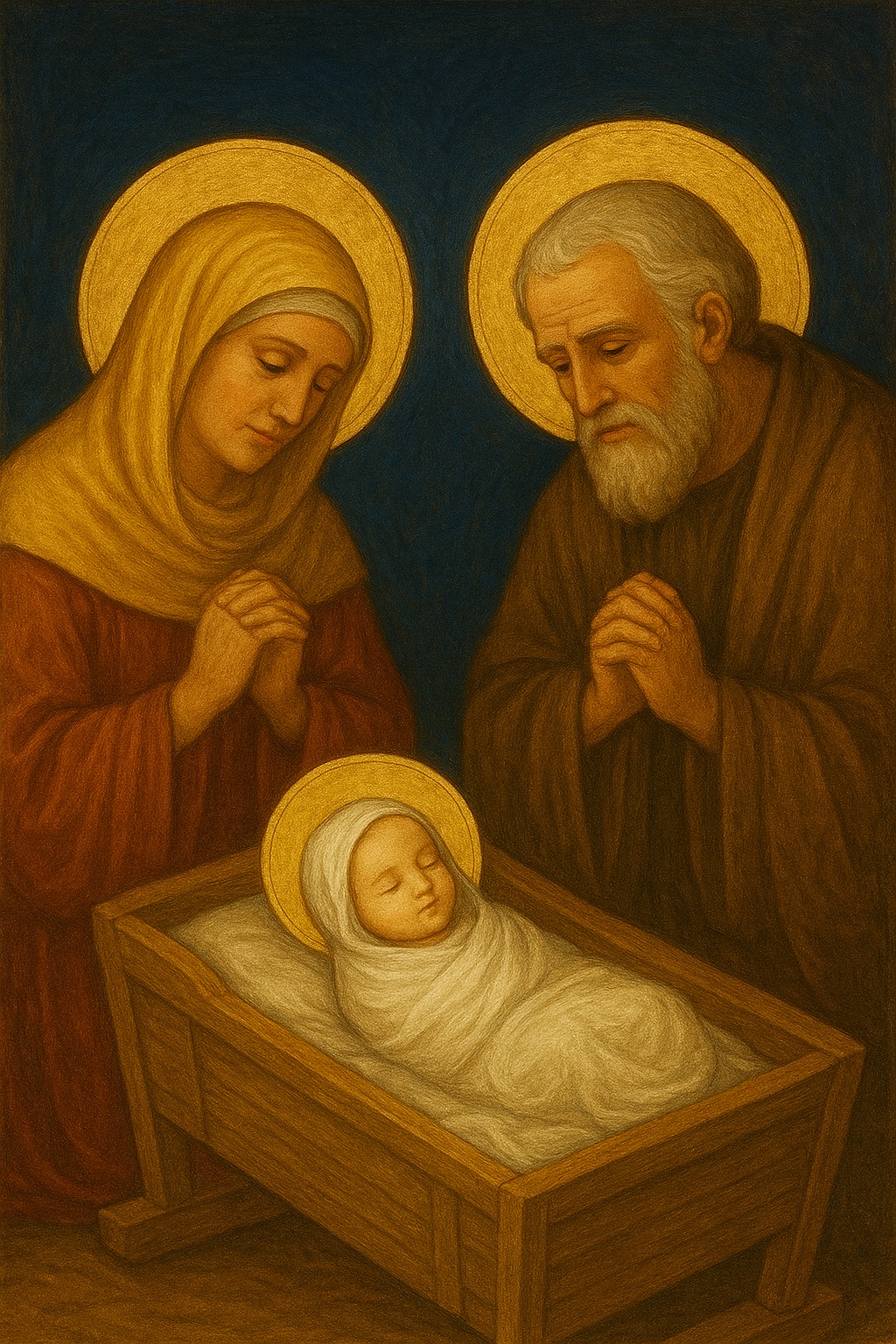
St. Joseph, too, could not see clearly the path God had laid out for him. Yet together, these two holy souls, through faith, endurance, and trust, welcomed the mystery of God made flesh—their Son, Jesus Christ—who became the light of the world. Mary watched her Son, the promised Messiah, grow, all the while treasuring these mysteries in her heart.
Thus, she becomes for us the holy Mother of God, wholly surrendered to His will, faithfully listening to His word, and responding with faith: “Here am I, the servant of the Lord; let it be with me according to your word” (Lk 1:38). She abandoned herself to the divine will, confident that the God who gave her grace to respond would also sustain her until the end. As St. Paul affirms: “The one who began a good work among you will bring it to completion by the day of Jesus Christ” (Phil 1:6).
The Silent Fidelity of St. Joseph
St. Joseph, whose name means “one who adds or supplies,” embodies chastity, innocence, and grace. Once he accepted God’s will, he carried it out silently and prayerfully. Like Mary, he dreamed of God’s plan and surrendered himself to it. He believed, obeyed, and remained faithful, teaching us never to stop dreaming of what God desires for our lives.
Though Joseph had doubts, he trusted in the Lord. When God calls, He provides the grace needed to complete the mission. We too are invited to bring our doubts and fears to God in prayer, following the example of Joseph and Mary. When we trust Him, He grants guidance, consolation, and reward.
Like Joseph, may we receive the grace to be faithful in all situations—favourable or difficult—and like Mary, may we learn the art of living joyfully in every circumstance.
Points for Personal Reflection
The celebration of the Nativity of the Blessed Virgin Mary together with the Feast of Our Lady of Good Health reminds us that devotion to Mary is inseparable from devotion to Christ, for Mary has given us Christ. To love and honour the Mother necessarily leads us to love and honour the Son. The closer our union with Mary, our Blessed Mother, the deeper and more intimate will be our communion with Christ. This theological truth forms the foundation of all Marian devotion. Hence the saying: “He who will not have Mary for his mother cannot have Christ for his brother or sister.”
Mary loves Christ because she is His Mother, and she loves us because she is our Mother. Her union with God was essential for bringing forth Christ the Saviour into our sinful world. She was most intimately united with God, as the angel proclaimed: “Hail, full of grace, the Lord is with you; blessed are you among women” (Lk 1:28). For this reason, St. Gertrude, the German mystic (1256–c. 1302), beautifully said: Christ is Mary’s firstborn according to the flesh, and we are her second-born according to the spirit.
Today’s Gospel reveals that God’s plan is often fulfilled through extraordinary and sometimes disconcerting means—both in the life of our Blessed Mother and in the life of St. Joseph.
Personal Reflection Questions
© 2026 CATHOLIC CONNECT POWERED BY ATCONLINE LLP