English
Mass Readings: Rev 11:19; 12:1-6.10 Ps 45 1 Cor 15:20-26 Lk 1:39-56
Key Verse to Meditate: And Mary said, "My soul magnifies the Lord, and my spirit rejoices in God my Saviour (Lk 1:46-47).
My dear Brothers and Sisters in the Lord,
Today, the Church solemnly celebrates the Assumption of the Blessed Virgin Mary into heaven—body and soul. This profound Marian dogma was solemnly defined by Pope Pius XII on November 1, 1950 : “At the end of her earthly life, Mary, the Mother of the Redeemer, preserved from all stain of sin and corruption, was raised in glory-body and soul-to be united with her Son in heaven.”
The image of Mary’s empty tomb parallels that of Christ’s empty tomb. It points to the total victory of God-the Giver of Life-over death. It prefigures what God will accomplish at the end of time: the bodily resurrection and eternal life of all the faithful who share in Christ’s death and resurrection.
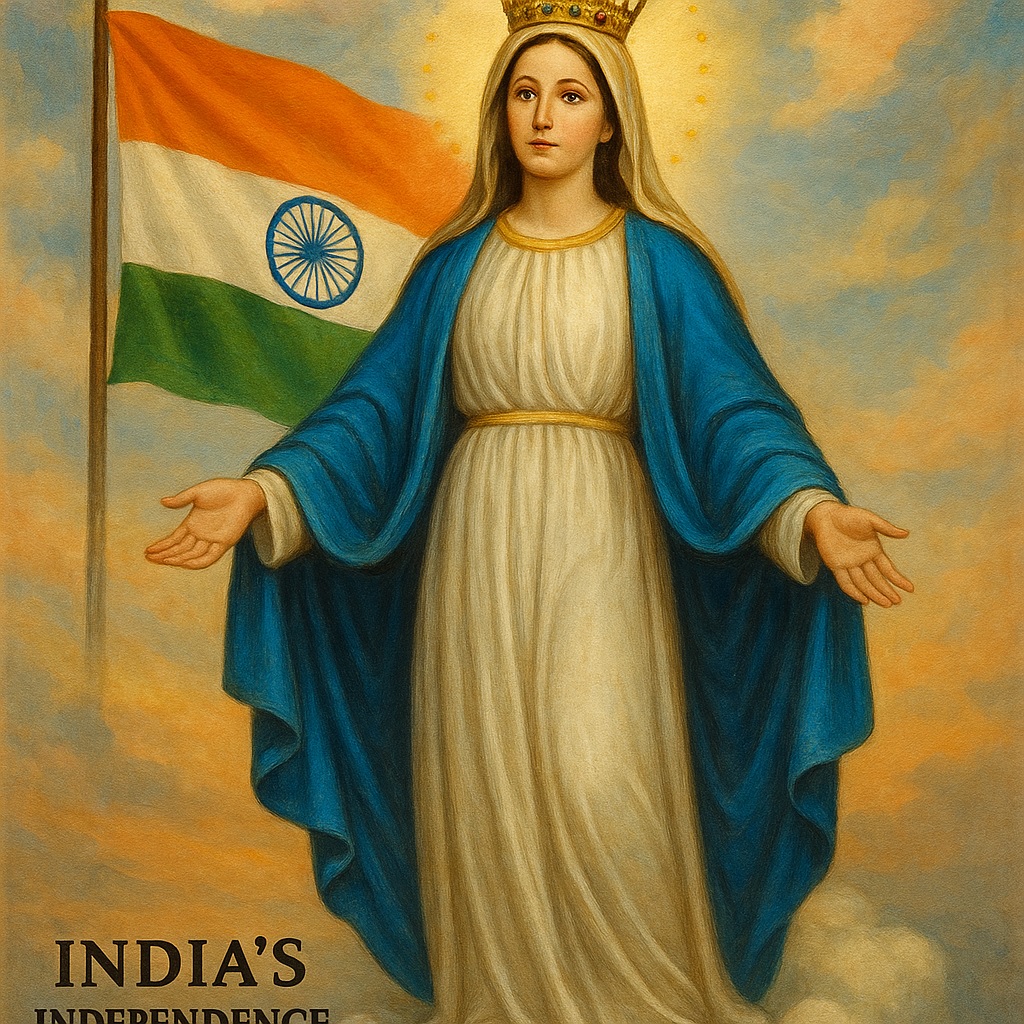
For us Catholics in India, August 15 is also a day of national pride and celebration, as we commemorate the 79th Independence Day of our great nation. Today marks a rare confluence: the Assumption of our Blessed Mother and the Independence of our country—a “double feast” celebrating both freedom in heaven and freedom on earth. In deep gratitude, we lift our hearts to God, praying for our beloved nation and for the holistic growth of every citizen, especially the poor and marginalized.
The First Reading: A Woman Clothed with the Sun
In the First Reading from the Book of Revelation (Rev 12:1), we hear: “A great sign appeared in heaven: a woman clothed with the sun, with the moon under her feet, and on her head a crown of twelve stars.”
This radiant woman is none other than Mary, whose life was marked by grace and whose mission was to bear the Redeemer to the world. She is rightly called the “figure and first fruits of the Church”—the first to believe and to receive the fullness of God's promise.
The Dragons of Today
But the reading also speaks of a second sign: “A great red dragon, with seven heads and ten horns... stood before the woman who was about to give birth, to devour her child.” (Rev 12:3-4)
This dragon represents all forces opposed to God’s saving plan—those that seek to destroy the ongoing birth of Christ in the world through the Church’s mission. Even today, such “dragons” exist:
We must seek protection in the Saviour and live in God’s grace, so that—like Mary—we may one day sing an eternal Magnificat in heaven.
The Second Reading: Mary, First Fruits of the Resurrection
The Second Reading affirms that at the end of her earthly journey, Mary was assumed into glory—body and soul. Her empty tomb mirrors that of Christ, signalling the triumph of life over death.
Mary is the first fruits of redemption, the first to experience the full destiny of those who believe. She suffered the pains of motherhood in service of salvation and now awaits us in heaven, calling us to trust in God's grace.
The Assumption is, therefore, a celebration of her resurrection. As our faith teaches, what God did for Jesus and Mary, He will do for each believer. It is truly a double celebration—on earth and in heaven—of hope and promise.
The Gospel Reading: Mary and Elizabeth – Saints Next Door
Today’s Gospel presents the beautiful encounter between Mary and Elizabeth—two humble and faithful women who were attentive to God's Word. Elizabeth breaks into a song of blessing, while Mary proclaims her Magnificat.
This scene teaches that holiness is lived in ordinary, daily life. These women recognized God’s presence in each other’s lives and responded with joy. Pope Francis, in Gaudete et Exultate, calls such people the “saints next door.”
The encounter moves away from the grandeur of the Temple to the simplicity of a hillside home—reminding us that true holiness blossoms in the ordinary. Mary recognized the subtle movements of God’s Spirit, both in grand events and in the quiet of everyday life.
Mary’s Faith Journey
After the Annunciation, Mary journeyed to the hill country to visit Elizabeth. Having already embraced her role as Mother of the Saviour (Lk 1:38), Mary’s greeting caused the child in Elizabeth’s womb to leap for joy (Lk 1:44).
Elizabeth, filled with the Holy Spirit, exclaimed: “Blessed are you among women, and blessed is the fruit of your womb!” “And why has this happened to me, that the mother of my Lord comes to me?” (Lk 1:42–43).
Elizabeth recognized in Mary not just her young cousin, but the Mother of her Lord—a profound acknowledgment of divine grace at work.
The Magnificat: Mary's Spiritual Testament
Mary responds with her great hymn—the Magnificat—a prayer that reveals her innermost soul: “My soul magnifies the Lord, and my spirit rejoices in God my Saviour.” (Lk 1:46–47)
These inspired words are her spiritual testament to all generations. The Church continues to sing them every evening, praising a God who lifts the lowly, fills the hungry, and makes the impossible possible.
The Hail Mary, one of the most beloved Catholic prayers, originates from this encounter. Mary is shown to us as a woman full of God, a woman who felt God's presence in every fibre of her being. This is the kind of life we, too, are called to live—filled with the Word of God, listening, meditating, and acting upon it.
Mary – The First Believer in Christ
Before conceiving Christ in her womb, Mary conceived Him in her heart. She believed even before she understood. Likewise, we too are called to bring Christ to birth in our own lives—in our thoughts, actions, and desires. This is not always easy. Generating Christ in today’s world is a challenge that requires grace and perseverance.
Points for Personal Reflection
The Marian Way to Bring Joy and Hope:
Mary carried Christ to Elizabeth and brought joy to her and to the unborn John the Baptist. We are invited to do the same—to bring Jesus to others, especially through acts of love, mercy, and faith. Pope Francis says in Evangelii Gaudium: “The joy of the Gospel fills the hearts and lives of all who encounter Jesus… With Christ, joy is constantly born anew.”
Let us become bearers of joy and hope, just like Mary.
Mary and Elizabeth – A Spirit-filled Encounter:
Two Spirit-filled women, bearing two Spirit-filled children, rejoice in God's presence. Mary carries God-With-Us; Elizabeth carries the forerunner of the Lord. One is young, the other old—yet both are filled with divine grace.
Mary – A Woman of Faith:
Mary is the woman of faith whose life foreshadows our future in God. She carried Jesus in her womb and became the living tabernacle. We, too, are called to carry Christ in our hearts and bring His presence to the world.
Do I carry Christ in my daily life?
Do I believe, as Mary did, in God's promises for me?
A Final Word of Gratitude and Hope
Today, we contemplate the great mystery of the Assumption and turn to Mary, our Heavenly Mother. We ask her to guide us to heaven, where she waits as the Mother of God and our mother.
May Mary, Queen of Heaven and Earth, help us keep our gaze fixed on her Son, Jesus Christ. As we celebrate our Nation’s 79th Independence Day, let us reflect on the freedom God offers us—a freedom that comes from grace, not just from governance.
Let us ask ourselves:
Where there is no grace, there can be no true freedom. A life of faith is a life of grace—and it is that grace that makes us truly free.
May our Blessed Mother, assumed into heaven, remain our beacon of hope, leading us always toward her Son, our Saviour -Amen.
© 2026 CATHOLIC CONNECT POWERED BY ATCONLINE LLP