
English
Mass Readings -
Daniel 3:25. 34-43, Psalm 25, Matthew 18:21-35.
Key Verse to Meditate -
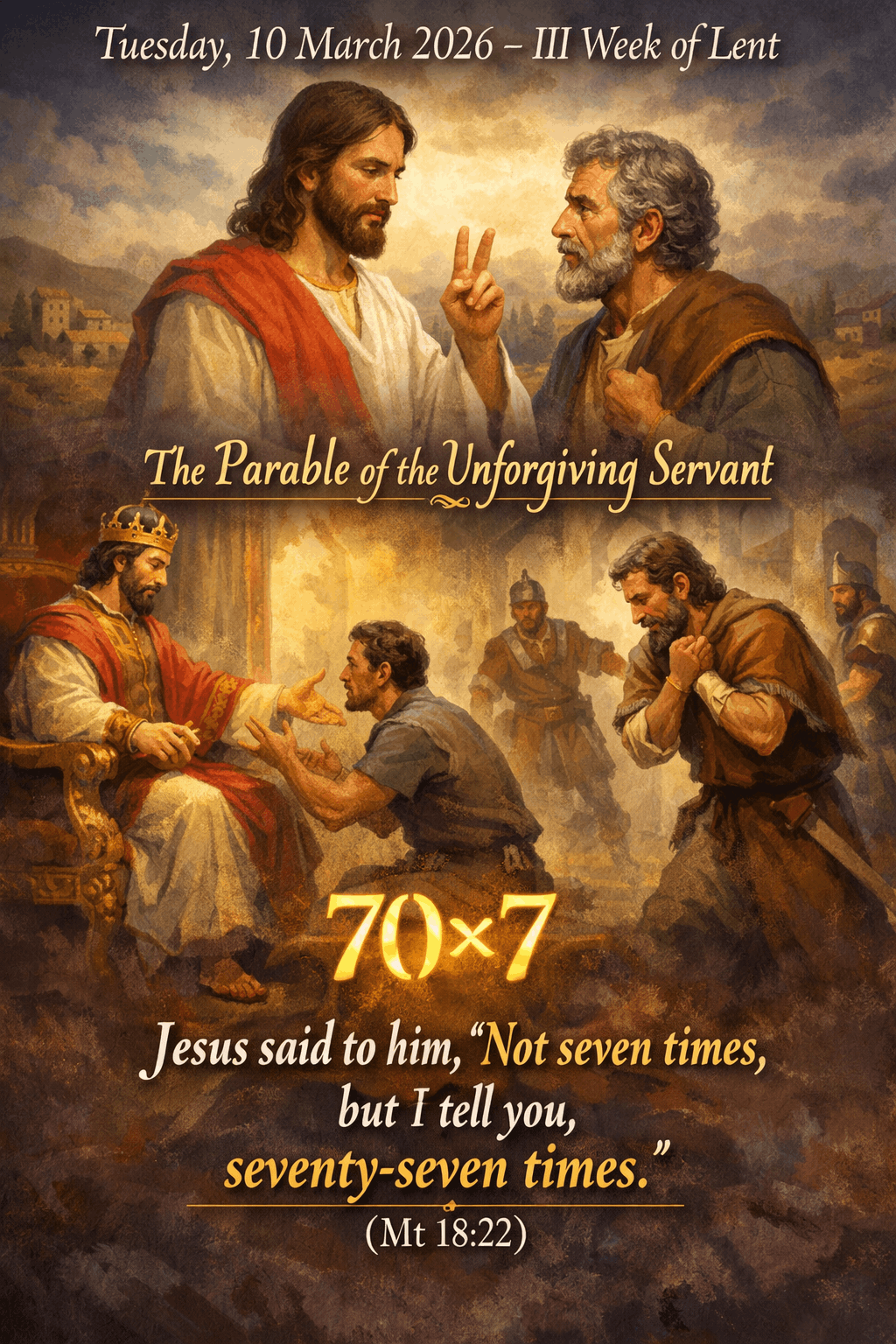
Jesus said to him, "Not seven times, but I tell you, seventy-seven times. (Matthew 18:22)
The Gospel Reading -
In today’s Gospel, once again Jesus insists on the practice of forgiveness, which must characterize the life of His disciples. Our forgiveness must be countless and tireless, and perhaps this is what costs us the most. Very often, we can barely forgive our brother or sister, and even when we do, we tend to attach conditions—making it clear that the same mistake must never be repeated. We find it extremely difficult to forgive repeatedly, as if it were the first time. It is not easy for us to have enough patience and love to continue trusting a person who may offend us again—twice, ten times, or even a thousand times. Such is human nature, and such is the condition of our hearts: we tend to place limits on our love.
We do not know whether Peter had his own brother Andrew in mind when he asked Jesus this question. Nor do we know whether Andrew might have repeatedly annoyed Peter by committing the same fault again and again. Yet Jesus’ answer is unmistakably clear:
“I do not say to you, up to seven times, but up to seventy-seven times” (Matthew 18:22).
Through these words, Jesus teaches us the difficult but necessary lesson that forgiveness cannot be calculated or negotiated. Whenever a brother or sister sincerely asks for forgiveness, it must be granted. This is precisely the lesson that Jesus illustrates through the parable of the unforgiving servant.
The love of the Father, on the other hand, is infinite and unconditional. God our Father continually forgives us, and we know that He has countless opportunities to do so. His ardent desire is that we, who constantly receive His mercy, may in turn become merciful toward our brothers and sisters. The offenses we are called to forgive will always be insignificant when compared to the countless sins that God forgives in our lives without keeping account.
The First Reading -
Today’s first reading presents to us the prayer of Azariah in the fiery furnace (Daniel 3). Standing in the midst of the fire, Azariah remembers God’s mercy and faithfulness. It is an unimaginable sign of God’s favor that these three men were protected by the angel of the Lord and saved from the flames. Their faith stands as a powerful example of fidelity and trust in God.
When we remain faithful, God never abandons us—even in the most difficult moments of life. More than the three young men asking Yahweh to remember His covenant and promises, it is actually the Lord who faithfully remembers the covenant He made with the Patriarchs. They pray with humility:
“For your name’s sake do not give us up utterly, and do not break your covenant. Do not withdraw your mercy from us, for the sake of Abraham your beloved, and for the sake of your servant Isaac and Israel your holy one” (Daniel 3:34–35)
Their prayer for life and mercy was accepted because it came from a humble and contrite heart. They recognized their nothingness before God’s greatness and mercy. They asked the Lord to accept their contrite spirit as a sacrifice, since there was no possibility of offering burnt offerings, sacrifices, oblations, or incense (Daniel 3:38–40). They promised to follow God’s commandments faithfully and to seek His presence alone. In response, God answered their prayer and delivered them from the fiery furnace.
The Gospel reading from Matthew comes from the final section of chapter eighteen, a passage that has no exact parallel in the other Gospels. It begins with Peter’s question:
“Lord, how often shall my brother sin against me and I forgive him? Up to seven times?” (Matthew 18:21).
Rabbinic teaching at the time suggested a limited forgiveness—usually up to three times—which was already considered reasonable. Peter therefore thought he was being generous by suggesting seven times. However, Jesus reveals the merciful heart of the Father by teaching that forgiveness must be without limits. He replies:
“I do not say to you, up to seven times, but up to seventy-seven times” (Matthew 18:22)
This phrase reminds us of an Old Testament passage in which Lamech boasts of unlimited vengeance, saying:
“If Cain is avenged sevenfold, truly Lamech seventy-sevenfold” (Genesis 4:24)
In that ancient context, revenge had no limits. Jesus completely overturns this mentality. Instead of unlimited vengeance, His disciples are called to practice unlimited forgiveness. Just as the Old Testament world often justified endless hatred and retaliation, Jesus now establishes a new rule for His followers: there must be no limit to forgiveness and mercy. The disciple of Christ is not commanded to count offenses but to forgive without counting. Our forgiveness should not be merely quantitative, as if measured by numbers, but qualitative, flowing from the heart. In short, there must be no limit to forgiveness.
In the parable of the unforgiving servant, we encounter a servant who owes his master ten thousand talents (Matthew 18:24), an unimaginably large sum. Unable to repay the debt, he begs for mercy. The master, moved with compassion, generously cancels the entire debt rather than selling the servant and his family.
However, the same servant soon encounters a fellow servant who owes him only a hundred denarii—a very small amount in comparison. Instead of showing mercy, he demands immediate repayment and throws the man into prison. When the master hears about this injustice, he revokes his mercy and punishes the wicked servant.
Through this parable, Jesus delivers a powerful message, especially fitting for the season of Lent:
“So my heavenly Father will also do to every one of you, if you do not forgive your brother or sister from your heart” (Mathew 18:35).
This teaching echoes Jesus’ earlier words:
“But if you do not forgive others, neither will your Father forgive your trespasses” (Matthew 6:15)
Forgiveness must come from the heart. As the Letter of James reminds us:
“For judgment will be without mercy to anyone who has shown no mercy; mercy triumphs over judgment” (James 2:13)
“Forgiveness from the heart” stands in complete contrast to “hatred from the heart” (cf. Leviticus 19:17; Proverbs 26:24). God expects His children to imitate His mercy. The limitless mercy God shows toward us becomes the model for our own relationships with others.
Forgiveness as the Response to God’s Mercy
The central message of the parable is clear: we are able to forgive because God has first forgiven us. God continually forgives our sins, failures, and weaknesses. Our response to this immense mercy should be a heart that is also ready to forgive others.
This truth is reflected in the prayer that Jesus taught us in the Our Father:
“Forgive us our debts, as we also forgive our debtors.”
Every time we pray these words, we remind ourselves that our forgiveness from God is closely linked to our willingness to forgive others. God delights in a humble and simple heart that is ready to forgive.
Points for Personal Reflection
The prayer of Azariah can also become the prayer of our own hearts:
“And now with all our heart we follow you; we fear you and seek your presence” (Daniel 3:41)
During this season of Lent, we must ask ourselves:
Do we truly seek the Lord with all our hearts?
Forgiveness is learned only by forgiving others. When forgiveness seems difficult, we must look to the Cross of Christ, where Jesus forgave even those who crucified Him. From the Cross we receive the strength and grace to forgive.
Will the world ever fully follow the teaching of Christ? That question remains open. But a more important question concerns each one of us:
Are we, as disciples of the Lord, ready to practice this teaching in our families and communities?
“I do not say to you, up to seven times, but up to seventy-seven times” (Matthew 18:22)
Let the world do what it will. But are you and I ready to forgive from the heart?
© 2026 CATHOLIC CONNECT POWERED BY ATCONLINE LLP