
English
Mass Readings -
2 Kings 5:1-15, Psalm 42, Luke 4:24-30.
Key Verse to Meditate -
There were also many lepers in Israel in the time of the prophet Elisha, and none of them was cleansed except Naaman the Syrian." (Luke 4:27)
The First Reading -
The narrative of Naaman’s healing in the first reading of today (2 Kings 5:1–15) offers a profound theological insight into the nature of God’s grace and the human response of faith. Naaman, though a powerful commander, respected and successful, suffers from leprosy, symbolizing the deeper human condition of weakness and dependence on God.
The path to his healing unfolds through humble instruments—a captive servant girl, the prophet Elisha, and the simple waters of the Jordan—revealing that God often works through ordinary means to accomplish extraordinary grace. Initially, the turning point in the story of healing begins with the words of an unnamed servant girl, a captive from Israel, who points Naaman toward the prophet Elisha (2 Kings 5:2-3). God often chooses simple and unexpected instruments to communicate His will. We must learn to listen even to the smallest voices through whom God may be speaking. Once Naaman reaches the residence of prophet Elisha, he asks him to go and dip seven times in the Jordan. Naaman initially refuses the prophet’s instruction because it seems too simple and undignified (2 Kings 5:11-12). Initially hindered by pride, Naaman must learn humility and obedience before receiving healing. What we learn from the refusal of Naaman is that Pride Is the Greatest Obstacle to Grace. Pride blinds us to God’s ways. Often, we expect dramatic miracles, but God invites us to humble acts of faith and obedience.
But When Naaman finally humbles himself and washes in the Jordan seven times, he is healed (2 Kings 5:13–14). His immersion in the Jordan becomes not only a physical cleansing but also a moment of spiritual conversion, leading him to confess that there is no God except the Lord. The obedient act of Naaman and his consequent healing shows that God’s grace becomes effective when we trust and obey His word. Sometimes the path to healing and transformation begins with simple acts of faith. Yes, our obedience to God’s word, opens the Door to God’s Healing. The healing of Naaman the Syrian highlights a central biblical truth that divine grace is offered freely, but it is received through humility, trust, and obedience.
The Gospel Reading -
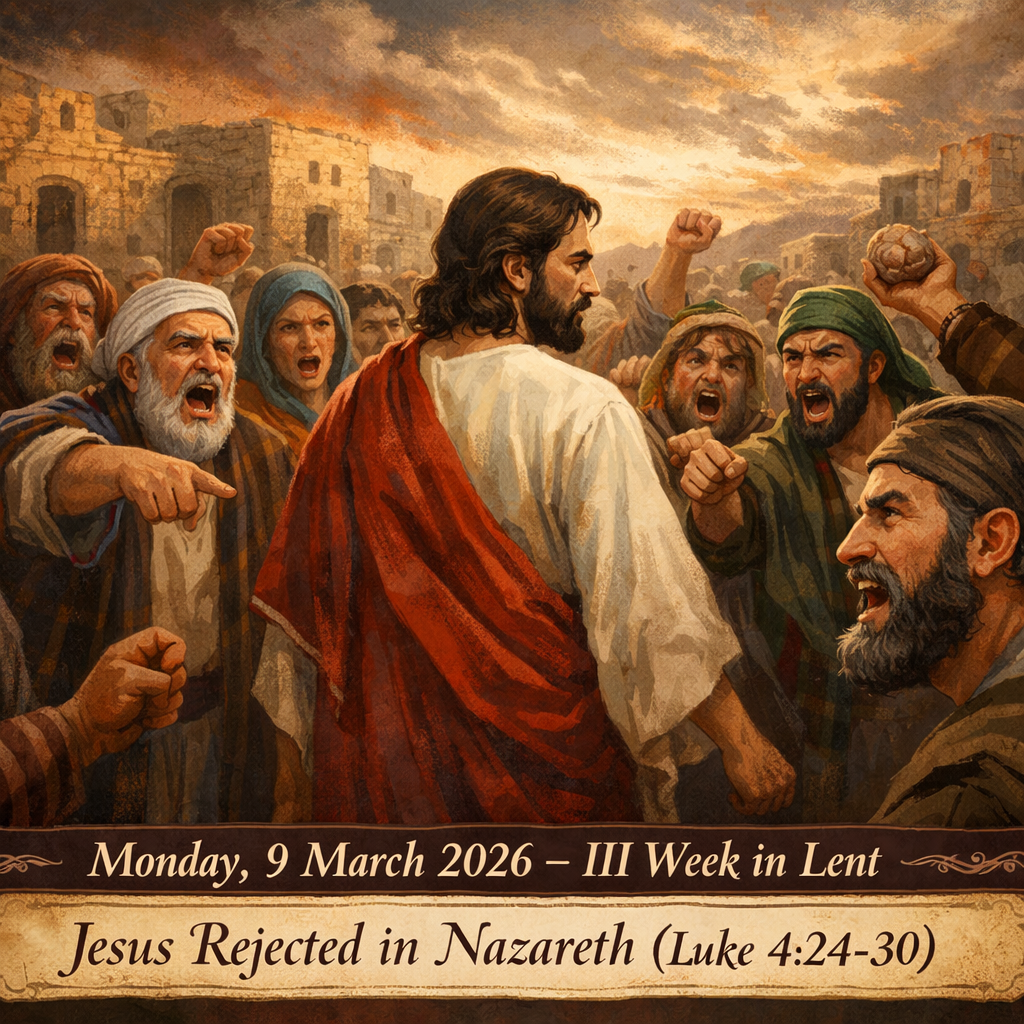
The Gospel reading begins with the solemn admonition of Jesus: “No prophet is accepted in his own hometown.” Jesus then illustrates this truth with two examples to show how often strangers accept God’s prophets and their message, while their own people reject them. These examples correspond to the themes found in today’s first reading.
This teaching takes place in the synagogue of Nazareth after Jesus reads from the prophet Isaiah: “The Spirit of the Lord is upon me…” (Luke 4:18–19). After reading the passage, Jesus declares that the Scripture has been fulfilled in their hearing. The text from Isaiah is a Messianic proclamation, announcing the mission of the anointed one who would bring good news to the poor, freedom to captives, sight to the blind, and liberation to the oppressed.
The difficulty for the people of Nazareth was not the message itself but the identity of the messenger. The problem could have been resolved had the people believed that Jesus was truly the Messiah. However, their familiarity with Him became an obstacle. They knew Him as one of their own—a man who grew up among them. Now He stands before them proclaiming that the promises of Scripture are fulfilled in Him. Although they were amazed at the gracious words that fell from His lips (Luke 4:22), they failed to recognize in their townsman a prophet, let alone the Messiah.
Those gathered in the synagogue expected Jesus to confirm His words with spectacular signs and miracles. They did not see prisoners being released, the blind receiving sight, or the oppressed being set free. Everything seemed to remain the same. Their reaction reveals a deeper issue—a lack of faith. Before the reading of the prophecy and after it, nothing appeared to change in their eyes. The blind seemed still blind, and the oppressed still oppressed.
Perceiving their thoughts and doubts, Jesus reminds them that the mission of a prophet is not merely to perform miracles but to proclaim the Word of God. Furthermore, because of their unbelief, He reminds them that God’s grace often reaches beyond those who presume to possess it. Though there were many widows and lepers in Israel, God’s saving power was manifested elsewhere. Jesus recalls how the prophet Elijah was sent to a widow in Zarephath in Sidon, a pagan land. Likewise, the prophet Elisha healed Naaman the Syrian, as we heard in today’s first reading (2 Kings 5:1–15).
Through these examples, Jesus reveals a broader vision of God’s mercy—a mercy that extends even to those considered outsiders. This revelation provoked anger among His listeners, for they could not accept a God whose grace transcended their narrow expectations.
This Gospel invites us to reflect deeply on our own attitudes. Do we accept the prophets and spiritual guides God places in our lives, despite their human limitations? Jesus reminds us that familiarity can breed contempt. Often we fail to recognize God’s presence because it comes through ordinary people and situations.
Spiritual Lessons for Lent from this Gospel
1. Lent Calls Us to Overcome Spiritual Blindness
The people of Nazareth heard the Word of God but failed to recognize its fulfillment in Jesus. Lent invites us to open our eyes of faith and recognize Christ present in our lives.
2. Familiarity Can Make Us Spiritually Indifferent
Often we take the Gospel, the sacraments, and our spiritual guides for granted. Lent challenges us to rediscover the freshness and power of God’s Word.
3. True Faith Does Not Demand Signs
The Nazarenes wanted miracles before they would believe. Lent teaches us to trust God even when we do not see visible signs.
© 2026 CATHOLIC CONNECT POWERED BY ATCONLINE LLP