English
Mass Readings: Heb 5:7-9 Ps 31 Jn 19:25-27
Key Verse to meditate: Then he said to the disciple, "Here is your mother." And from that hour the disciple took her into his own home. (Jn 19:27).
My dear Brothers and Sisters in the Lord,
After the Feast of the Exaltation of the Holy Cross, the Church celebrates, on the following day, the Feast of Our Lady of Sorrows. These two feasts are intimately connected, giving meaning and depth to one another. The Cross is the sign of redemption, the symbol of victory. Standing beneath the Cross, the Blessed Mother represents all humanity, gathered under her maternal guidance for two profound reasons.
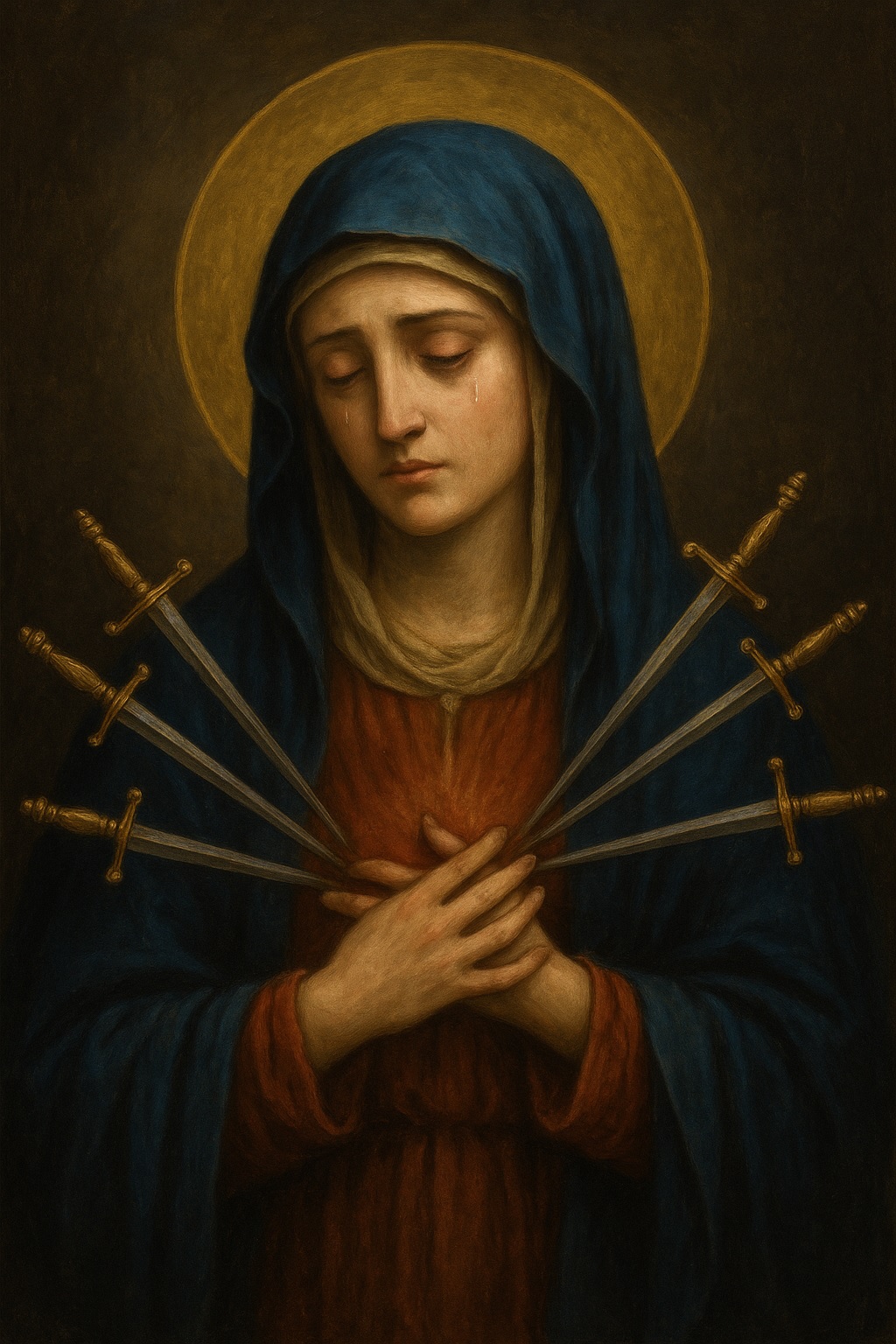
First, she is the true disciple who carried her cross and followed her Master and Lord, her own Son, Jesus Christ. As Jesus Himself declared: “If any want to become my followers, let them deny themselves and take up their cross and follow me” (Mk 8:34). Mary understood that her vocation would be a path marked with sorrow. Tradition recognizes her seven sorrows: the prophecy of Simeon; the flight into Egypt; the loss of the Child Jesus for three days; meeting Jesus on His way to Calvary; the crucifixion; the taking down of His body from the Cross; and His burial. When she stood beneath the Cross, she must have recalled Simeon’s prophecy: “And a sword will pierce your own soul too” (Lk 2:35).
Mary’s Silent Standing at the Foot of the Cross
Mary’s quiet, steadfast presence beneath the Cross reveals two profound dimensions of her sorrowful heart.
1. Suffering Love
Her presence was an expression of a love that suffers with those who suffer. It must have been an indescribable agony for Mary to behold her beloved Son hanging on the Cross, bruised and bloodied. True love suffers in union with the beloved. This is the love that overcomes every disaster and pain. St. Paul reminds us: “Love bears all things, believes all things, hopes all things, endures all things” (1 Cor 13:7).
Mary endured these sufferings out of love for God, meditating deeply upon this unfathomable mystery. As St. Luke notes, she “treasured all these words and pondered them in her heart” (Lk 2:19, 51). Her silent presence at the Cross was not an absence of words but the fullness of contemplation—gazing upon God’s face of compassion and mercy revealed in her Son. Her participation in Christ’s suffering was the truest expression of her love for God and for all humanity.
2. Perfect Submission to the Will of God
Her silent endurance at Calvary also manifests her perfect submission to God’s will—a will that is always rooted in love. From the Annunciation to the Cross, her fidelity remained unbroken: “Here am I, the servant of the Lord; let it be with me according to your word” (Lk 1:38). That “yes” spoken in Nazareth sustained her through the agony of Golgotha.
Her infinite, silent love united her to God’s infinite will, enabling her to bear the unbearable sight of her Son crucified. As St. Paul asks: “Who will separate us from the love of Christ? Will hardship, or distress, or persecution, or famine, or nakedness, or peril, or sword?” (Rom 8:35). Nothing could separate Mary from her Son—not even the horror of His Passion. Unlike the apostles who fled, Mary remained firm, rooted in love.
St. Bernard of Clairvaux beautifully observes: “Jesus died in body through a love greater than anyone had known. Mary died in spirit through a love unlike any other since His.”
“Let It Be”
Mary’s life was marked by sorrow, yet her constant response was always: “Let it be” (Lk 1:38). Her obedience mirrored that of her Son, who submitted Himself to the Father’s will. Standing beneath the Cross, Mary accepted, with unshakable love, the mysterious plan of God—even when it meant unimaginable pain.
Her seven sorrows reveal not only her maternal suffering but also her unwavering love. She bore all because she loved greatly. Simeon’s prophecy echoed in her heart as she watched her Son die: “This child is destined for the falling and rising of many in Israel… and a sword will pierce your own soul too” (Lk 2:34-35).
Yet through it all, Mary shows us that love endures, suffers, and triumphs. Truly, St. Paul’s words find their perfect embodiment in her: “Love bears all things, believes all things, hopes all things, endures all things” (1 Cor 13:7).
The Gospel Reading
Today’s Gospel presents the moving scene of Mother Mary standing at the foot of the Cross, gazing upon her suffering Son and Lord. It is a profound mystery that in His final moments, Jesus entrusts His Mother to someone else. Having completed His salvific mission, He did not wish to leave His widowed Mother alone. He entrusted her to the beloved disciple: “Then He said to the disciple, ‘Here is your mother.’ And from that hour the disciple took her into his own home” (Jn 19:27).
Even in His grief and agony, Jesus did not forget His Immaculate Mother. He gave her into John’s care. Mary, standing silently beneath the Cross, would have pondered all these things in her heart. When we are confused or cannot understand God’s ways, we are invited to be like Mary under the Cross—totally abandoned to the Father’s will. Though she did not fully comprehend the mystery unfolding, she remained faithful, accompanying her Son on His journey back to the Father. As Scripture tells us: “But Mary treasured all these words and pondered them in her heart” (Lk 2:19).
Mary stood beneath the Cross for love
Mary stood beneath the Cross for love—the love of God. She endured all suffering because her heart was filled with divine love. St. Paul says: “Love bears all things, believes all things, hopes all things, endures all things” (1 Cor 13:7). These words perfectly describe our Blessed Mother. Her love for Christ and her submission to God’s infinite will gave her strength to endure the unbearable sight of her Son’s suffering and death. Truly, as St. Paul asks: “Who will separate us from the love of Christ? Will hardship, or distress, or persecution, or famine, or nakedness, or peril, or sword?” (Rom 8:35). Nothing separated Mary from the love of God revealed in her Son.
In St. John, all of us have received Mary as our Mother. There can be no greater gift than this—to be her children. The question is: do we imitate her faith, her obedience to God’s will, and her endurance in the face of suffering and pain? May she always remain our consolation and support.
Points for Personal Reflection
O thou Mother, font of love! Touch my spirit from above; make my heart with thine accord.
© 2026 CATHOLIC CONNECT POWERED BY ATCONLINE LLP