
English
Mass Readings -
Exodus 17:3-7, Psalm 95, Romans 5:1-2.5-8, John 4:5-42.
Key Verse to Meditate -
"Sir, give me this water, so that I may never be thirsty or have to keep coming here to draw water" (John 4:15)
My dear Brothers and Sisters in the Lord,
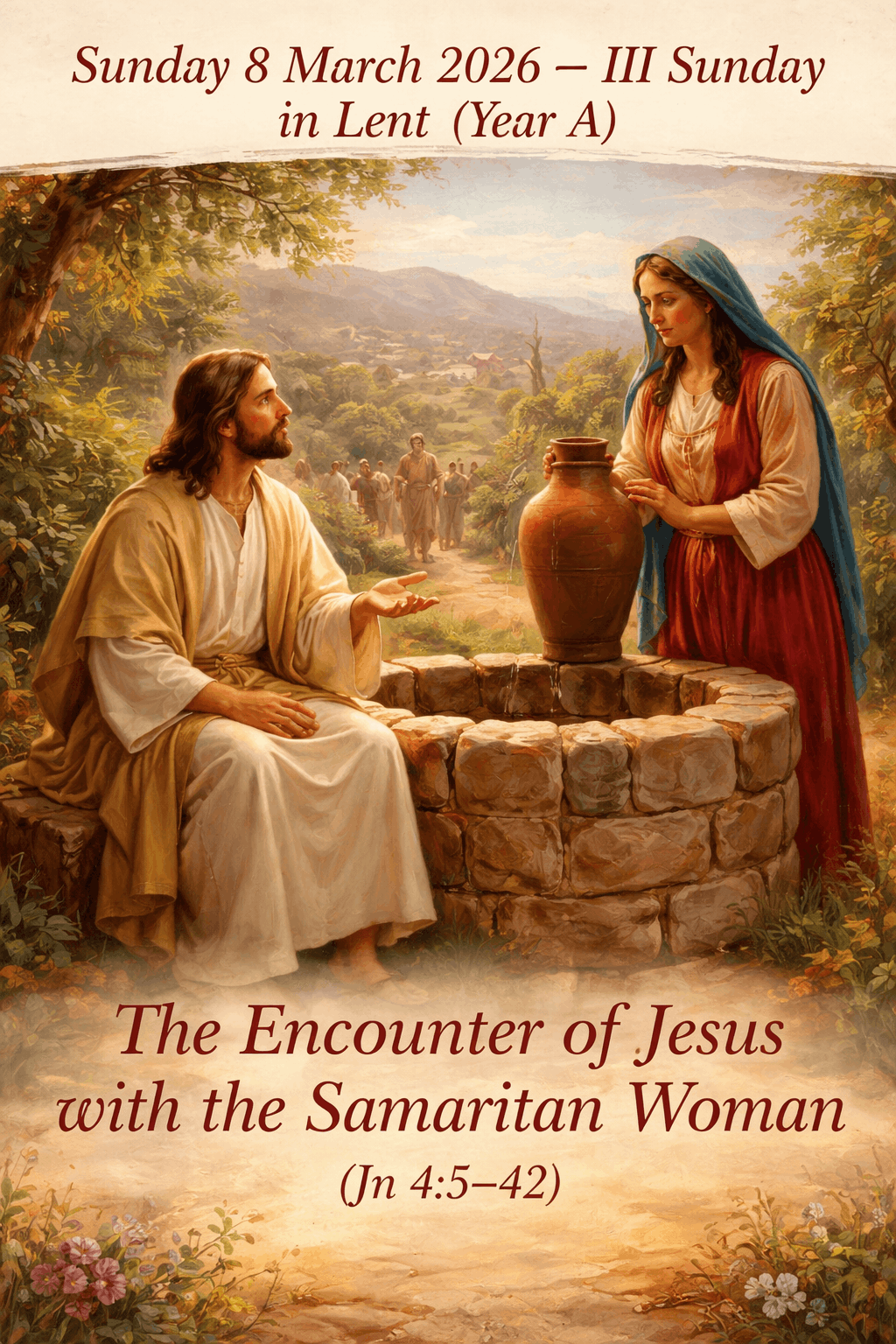
The Liturgy of the Third Sunday of Lent (Year A) presents to us the beautiful encounter between Jesus and the Samaritan woman at the well. It contains one of the most profound and moving conversations recorded in the Gospels. This passage is among the richest Lenten texts for meditation and renewal. The way Christ the Lord gently leads the Samaritan woman to conversion reveals a spiritual journey — from thirst to fulfilment, from sin to grace, from isolation to mission. This episode in the Gospel of John reminds us that true life and salvation can be received only when we open our hearts to welcome the gift of God.
The First Reading: The Water Symbol in the Old Testament.
The symbol of water also appears in today’s first reading from the Book of Exodus. In the wilderness, the people cry out to Moses, “Give us water to drink.” They complain bitterly:
“Why did you bring us out of Egypt, to kill us and our children and livestock with thirst?” (Exodus 17:3)
Moses provided water for the Israelites through miraculous interventions of God. There were two principal occasions when water flowed from a rock: first at Horeb/Rephidim (Exodus 17:1–7), which we hear today, and later at Kadesh/Meribah (Numbers 20:1–13). Earlier still, there was the incident at Marah (Exodus 15:22–25), where bitter water was made sweet.
In today’s reading, the people are ready to revolt against Moses. When Moses cries out to the Lord, God commands him: “Go on ahead of the people… Strike the rock, and water will come out of it, so that the people may drink” (Exodus 17:5–6). Moses obeys, and water gushes forth. Yet the place is called Massah and Meribah because the people doubted the Lord’s presence, asking:
“Is the Lord among us or not?” (Exodus 17:7).
Later, at Kadesh (Numbers 20), near the end of the forty-year journey, a similar crisis arises. This time, God commands Moses to speak to the rock. However, in anger, Moses strikes the rock twice. Because he fails to uphold the holiness of God before the people, he is not permitted to enter the Promised Land.
The water that flowed from the rock at Horeb prefigures Christ. The rock symbolizes Jesus Himself, and the water that gushes forth anticipates the water and blood that flowed from His pierced side on Mount Calvary. The striking of the rock foreshadows the sacrifice of Christ. This “living water” signifies the Holy Spirit, who purifies, sanctifies, and gives life.
The Second Reading: The Self-Giving Love of Christ.
This self-giving of Christ, prefigured in the water from the rock, is beautifully expressed by St. Paul in today’s second reading from the Letter to the Romans:
“While we were still weak, at the right time Christ died for the ungodly… God proves His love for us in that while we still were sinners Christ died for us” (Romans 5:6–8)
Christ did not wait for us to become righteous. He loved us in our weakness and sin. This immense love is echoed in the First Letter of John: “In this is love, not that we loved God but that He loved us and sent His Son to be the atoning sacrifice for our sins” (1 John 4:10). Lent, therefore, is not merely about our effort to seek God; it is about recognizing the love with which God first loved us.
The Gospel: The Stages of Conversion.
In the Gospel, Jesus arrives at Jacob’s well in Sychar, in Samaria — a region despised by the Jews and religiously separated from them. A Samaritan woman comes to draw water. Jesus asks her for a drink. The recognition of who Jesus unfolds gradually. First, she sees Him as a Jewish stranger. Then she addresses Him respectfully as “Sir.” Finally, she acknowledges Him as a prophet: “Sir, I see that you are a prophet” (John 4:19). Eventually, she comes to recognize Him as the Messiah.
The Thirsty Woman and the Divine Initiative
The Gospel begins by saying that Jesus “had to pass through Samaria” (John 4:4). Theologically, this “had to” is not merely geographical necessity but divine necessity. In every call narrative, the initiative belongs to God. Lent reminds us that God always takes the first step. The Gospel tells us that Jesus, wearied from His journey, was sitting by the well (John 4:6). He is thirsty. He asks for water. Yet, as the Church Fathers remind us, His thirst is deeper than physical need.
The Samaritan woman comes at noon, likely to avoid the other women of the town because of her irregular life. She is socially marginalized and spiritually restless. Little does she realize that the Savior is waiting for her. Her life is about to take a decisive turn. It appears that Jesus waits intentionally for her. Conversion begins not with our search for God but with God’s search for us. Even in our brokenness, Christ sits at the well of our lives and waits. St. John Chrysostom beautifully remarks that Christ “sat by the well, not by chance, but to catch this woman.” Christ waits patiently. Lent is the season to recognize where He is already waiting for us.
When Jesus asks her for a drink, she is surprised: “How is it that You, being a Jew, ask me for a drink since I am a Samaritan woman?” (John 4:9). By doing so, Jesus breaks social, ethnic, and religious barriers. Most Jews would not have asked a Samaritan — especially a woman — for anything. St. Augustine interprets this profoundly: “He who asked for a drink was thirsting for the faith of that woman.” Jesus’ thirst is a thirst for souls.
When she hesitates, Jesus awakens her curiosity: “If you knew the gift of God, and who it is who says to you, ‘Give Me a drink,’ you would have asked Him, and He would have given you living water” (John 4:10). Sensing something extraordinary, she now addresses Him as “Sir” and says:
“You have nothing to draw with and the well is deep; where then do You get that living water?” (John 4:11).
St. Ambrose of Milan comments, “The well is deep; draw from Christ, for He is the fountain of life.” Lent invites us to draw deeply from Christ through prayer, Scripture, and the Sacraments.
From Earthly Thirst to Living Water
Jesus gradually leads the Samaritan woman from concern about ordinary, material water to the mystery of “living water” — the gift of the Holy Spirit. We often seek satisfaction in relationships, achievements, status, and possessions. Yet none of these can quench the deepest thirst of the human heart. Only Christ can do that.
St. Cyril of Alexandria explains: “The Savior calls the grace of the Spirit ‘living water,’ because through Him the soul is quickened and refreshed.” Thus, the “living water” symbolizes the Holy Spirit poured into our hearts — the divine life that renews, strengthens, and sanctifies us.
Jesus, the Living Water
A new theme now emerges in the dialogue: “living water.” Water is essential for physical life; without it, life cannot exist. In this conversation, water becomes a powerful symbol — first of natural life, and then of salvation itself. At this point, Jesus not only awakens desire in the woman (Jphn 4:13–14), but He also speaks of lasting satisfaction and interior rest — realities every human being longs for: “Everyone who drinks of this water will thirst again; but whoever drinks of the water that I shall give him will never thirst. The water that I shall give him will become in him a spring of water welling up to eternal life” (John 4:13–14).
The Psalms beautifully express this imagery of God as the source of life: “For with you is the fountain of life” (Psalm 36:10). Another Psalm cries out: “As the deer longs for flowing streams, so my soul longs for you, O God” (Psalm 42:1).
The prophet Ezekiel describes salvation through the image of water flowing from the Temple, becoming a mighty river that transforms the desert into a garden and brings life even to the Dead Sea (Ezekiel 47:1–12).
Through His conversation with the Samaritan woman, Jesus reveals that He Himself is the fulfillment of all these promises. He offers life — life in abundance: “I have come that they may have life, and have it abundantly” (John 10:10).
Honest Confrontation with Sin
Amazed by this promise, the woman responds: “Sir, give me this water, so that I may never be thirsty or have to keep coming here to draw water.”
We too must learn to ask Christ for this living water. However, before granting her deeper understanding, Jesus gently exposes the broken reality of her personal life. When He reveals her marital history, she recognizes that He is no ordinary man and declares: “Sir, I see that you are a prophet.”
The conversation then moves to a theological discussion about worship. Jesus teaches her that true worship is not confined to a mountain or a temple, but must be offered “in Spirit and in truth” (John 4:21–24). In doing so, Christ inaugurates a new covenantal worship centered in Himself.
When Jesus uncovers her painful past, He does not condemn her; He liberates her. True repentance requires honesty. Christ reveals sin not to humiliate us, but to heal us. Confession becomes a wellspring of grace. St. Augustine beautifully observes: “She came to draw water; she found instead the grace of Christ.”
She came seeking ordinary water, but she encountered extraordinary mercy.
Leaving the Water Jar – Detachment and Mission
When the woman speaks of the coming Messiah who will reveal all things, Jesus openly declares: “I who speak to you am He” (John 4:26). Upon hearing this revelation, she leaves her water jar, returns to the town, and proclaims: “Come and see a man who told me everything I have ever done. Could this be the Christ?” (John 4:28–29).
The water jar symbolizes her former preoccupations and attachments. After encountering Christ, she leaves it behind. We too must examine ourselves: What are the “water jars” we cling to — habits, attachments, resentments, securities — that prevent us from fully following Christ? St. Augustine reflects profoundly: “She left her water pot; for having tasted Christ, she despised the earthly.”
Lent calls us to leave behind whatever binds us and to become courageous witnesses. One powerful lesson from this Gospel is that God is never scandalized by our past.
Evangelization Begins with a Personal Encounter
A simple encounter with Christ transforms the Samaritan woman from sinner to missionary. Evangelization begins with a personal meeting with the Lord.
Pope St. John Paul II frequently referred to this passage when speaking about mission, saying: “The woman of Samaria becomes a missionary the moment she discovers Christ.”
The townspeople come to Jesus and, after listening to Him, confess: “It is no longer because of what you said that we believe, for we have heard for ourselves, and we know that this is truly the Savior of the world” (John 4:42).
Faith deepens from second-hand testimony to personal experience.
Points for Personal Reflection
Reflecting on this Gospel, Pope Benedict XVI once said in a Lenten Angelus message: “The Samaritan woman represents the existential dissatisfaction of one who has not found what she seeks.”
Christ alone answers the deep restlessness of the human heart. This passage reveals a dialogue of salvation, where Jesus patiently leads a searching soul to faith.
Very often, we attempt to satisfy spiritual needs with material substitutes. We seek affection and turn to food; we seek peace and turn to unhealthy habits; we seek fulfilment and cling to temporary pleasures. These may satisfy us briefly, but they leave us thirsty again.
We must seek the Savior who gives living water and satisfies the innermost depths of our being. St. Augustine expressed this truth in his famous prayer: “Our hearts are restless until they rest in You, O Lord.”
Like the Samaritan woman, we sometimes search for fulfilment in the wrong places, in the wrong people, and in the wrong ways. Lent invites us to recognize this misdirection and to return to the true source of life.
Finally, we must admit that we often resemble the Samaritan woman more than we realize — still learning who God truly is. We need to sit quietly at the well, listen attentively to the Master, and allow Him to transform our thirst into eternal life.
© 2026 CATHOLIC CONNECT POWERED BY ATCONLINE LLP