
English
Mass Readings: Gen 12:1-4 Ps 33 2 Tim 1:8-10 Mt 17:1-9
Key Verse to Meditate: And he was transfigured before them, and his face shone like the sun, and his clothes became dazzling white (Mt 17:2).
My dear Brothers and Sisters in the Lord,
The liturgy of the Second Sunday of Lent comes to us with a clear and compelling call: to listen to Jesus, the beloved Son of God. Lent is essentially a season of listening — listening attentively to the Word of God. It is through listening to God’s voice and responding with faith and obedience that we grow in holiness and deepen our relationship with Him.
The First Reading presents before us the exemplary obedience of Abraham to God’s call. Whenever God calls a person for His mission, He often invites them to leave behind familiar surroundings, securities, and known circumstances. Abraham was asked to step into the unknown. Without hesitation and without knowing the final destination, he obeyed God and journeyed toward the land of Canaan, leaving behind Ur of the Chaldeans.
The Second Reading highlights the salvific plan of God fulfilled through the obedient suffering and death of Jesus Christ on the Cross. The Gospel today presents the mystery of the Transfiguration, inviting us to listen to Jesus — the suffering Messiah who will die on the Cross and rise again in glory.
Each year, on the Second Sunday of Lent, the Church places the Transfiguration before us in all three liturgical cycles. This is not accidental. Before accompanying Jesus to Calvary, we are first allowed to glimpse His glory, so that our faith may remain firm during moments of suffering.
The First Reading: Abraham — Journey into the Unknown
God’s covenant with Abraham becomes a shining example of hope and faith for all believers. In the Book of Genesis, God calls Abraham to undertake a journey into an unknown land. The command is simple yet demanding: “Go from your country” (Gen 12:1). Abraham trusted God’s promise: “I will bless you and make your name great; and you shall be a blessing” (Gen 12:2).
Abraham’s journey begins solely with God’s Word. There was no map, no assurance, only a promise. His hope rested not on visible security but on divine fidelity. In sheer faith, Abraham left his familiar homeland and walked toward an unseen future (Gen 12:4).
The Word of God preceded Abraham’s path. Trusting in God’s promises, St. Paul later describes Abraham as one who “hoped against hope” (Rom 4:18) amid life’s uncertainties. Strengthened by God’s promise, the patriarch embarked upon God’s divine plan. His obedience gave space for God’s promise to unfold into reality.
The Second Reading: Called According to God’s Purpose
Abraham was called by God.
Jesus was called by God.
And we too are called according to God’s purpose and grace.
St. Paul, writing to Timothy, reminds us that salvation is part of God’s eternal plan fulfilled through Christ: “This grace was given to us in Christ Jesus before the ages began, but it has now been revealed through the appearing of our Saviour Christ Jesus, who abolished death and brought life and immortality to light through the Gospel” (2 Tim 1:9–10). The obedience of Christ unto death reveals that suffering, when united with God’s will, becomes the path to salvation.
The Gospel: The Magnificence of Divine Revelation
Jesus is now journeying toward Jerusalem — the place of His suffering, death, and resurrection. Shortly before the Transfiguration, He had already foretold His Passion to the disciples (Mt 16:21; 17:22–23; 20:17–19). Yet the idea of a suffering Messiah was difficult for them to accept.
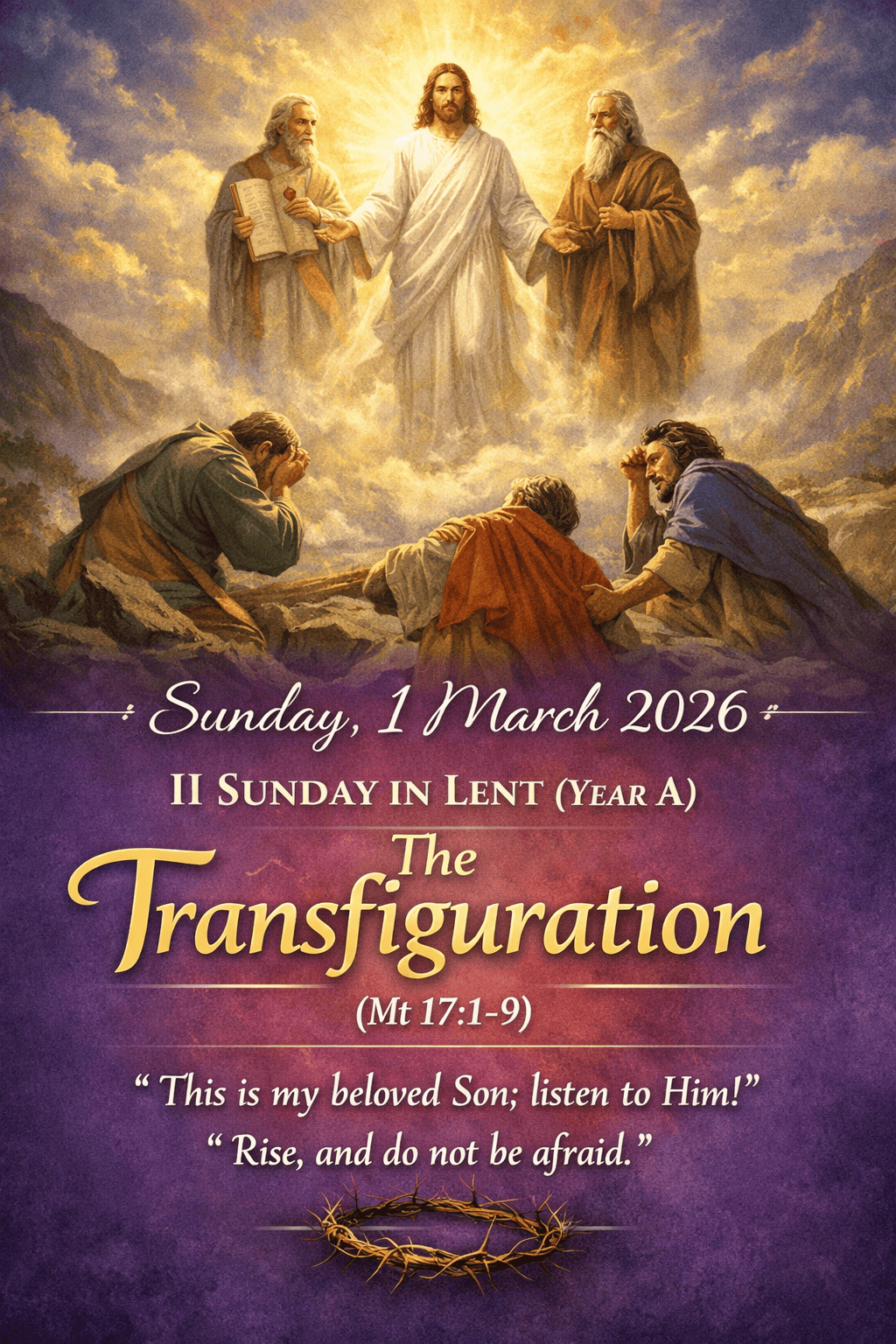
Six days after announcing His Passion, Jesus takes Peter, James, and John up a high mountain. In Scripture, the mountain is always the place of divine revelation. God encountered Moses on Mount Sinai and Elijah on Mount Horeb. Likewise, Jesus reveals His divine glory on the mountain of Transfiguration.
Just as Moses’ face became radiant after speaking with God (Ex 34:29), Jesus now shines with divine splendour before His disciples. Moses and Elijah appear beside Him, representing the Law and the Prophets, both finding fulfilment in Christ. Overwhelmed by this glorious vision, Peter exclaims: “Lord, it is good for us to be here.”
Peter wishes to remain in glory and avoid the suffering that lies ahead. But Jesus teaches them that glory cannot be separated from the Cross. Immediately after descending the mountain, He again speaks of His Passion. The message is unmistakable: the mountain of glory leads to Calvary.
We often desire blessings without sacrifice and resurrection without the Cross. But Lent reminds us that suffering accepted in faith becomes redemptive. There is no Easter without Good Friday.
Jesus and the Circle of Three Disciples
Jesus chooses His closest disciples — Peter, James, and John — to witness this revelation. They experience a profound theophany: they see Christ in His divine glory. This vision prepares them to face the scandal of the Cross (cf. 1 Cor 1:23). The One who will hang on the Cross in humiliation is the very Son of God revealed in glory on the mountain.
A Messiah of Glory
The disciples are invited to accept Jesus not merely as a triumphant Messiah, but as the Messiah of glory who passes through suffering. Moses and Elijah’s presence confirms that Jesus fulfills the Law and the Prophets and surpasses them all. They must learn that the path to glory passes through sacrifice, and that the risen Lord is the same Jesus who will suffer and die.
To Listen to Jesus
Moses and Elijah represent the Law and the Prophets, that is, the entire divine revelation that preceded Jesus. In the Transfiguration, Jesus is revealed as the full and final manifestation of God’s revelation. This truth is symbolized by the luminous cloud — the biblical sign of God’s presence, as seen on Mount Sinai (Ex 19). From this cloud comes the voice of the Father, proclaiming Jesus as the royal and chosen Servant of God, combining the messianic affirmation of Psalm 2:7 and the suffering servant imagery of Isaiah 42:1. To this declaration is added an important exhortation, echoing Deuteronomy 18:15:
“Listen to Him.”
Thus, Jesus is presented as the definitive teacher and revealer of God’s will, whose word surpasses all previous revelation. When the disciples behold the Lord in His glory and hear the Father’s voice saying, This is my Son, the Beloved; with Him I am well pleased; listen to Him!” (Mt 17:5), they fall to the ground overcome with fear.
Falling to the ground is the natural reaction of those who encounter the divine presence. In such moments, human beings become deeply aware of the distance between the holy God and human frailty. Yet, when the disciples lie in fear, Jesus approaches, touches them, and says: “Rise, and do not be afraid.” This tender gesture already anticipates the hope of the Resurrection.
From Fear to Trust — The Lenten Journey
Reflecting on the experience of the disciples, we understand that Lent is not a season of fear or guilt, but a journey:
1. from fear to trust,
2. from sin to mercy,
3. from darkness to light.
The touch of Jesus reveals an important spiritual truth: Christ touches our weakness before calling us to conversion.
When the disciples raise their eyes, “they saw no one except Jesus alone.” Moses disappears. Elijah disappears. Only Jesus remains. This signifies that at the culmination of every authentic spiritual experience, Christ alone becomes central.
Just as earlier generations listened to Moses and the prophets, the disciples are now called to listen to and follow Jesus, the only Son of God. Yet Jesus commands them not to reveal this vision until after His Resurrection, because before glory comes rejection, suffering, and the Cross.
The Command of the Father: Listen
It is significant that in this Gospel scene the Father speaks only once, and He gives only one command: Listen.
During Lent, we become aware that many voices compete for our attention. However, salvation begins with attentive listening to Christ.
True fasting, therefore, also includes:
1. fasting from noise,
2. fasting from constant opinions,
3. fasting from digital distractions,
so that we may truly hear the voice of the Lord. May this Lent become a season in which we listen more attentively to Christ.
Points for Personal Reflection
The Transfiguration teaches us that Lent is:
1. a mountain of prayer,
2. a moment of transformation,
3. a school of listening,
4. a preparation for the Cross,
5. and a journey toward Easter glory.
Before facing Calvary, the disciples were allowed to witness Christ’s glory so that their faith would not fail during suffering. Likewise, Lent assures us that the cross we carry today already contains the light of resurrection.
The same Jesus who led the disciples up the mountain also led them down again. They could not remain on the mountain forever. Authentic prayer always sends us back — to our families, our ministries, and wounded humanity.
True spiritual experiences must lead to mission. Prayer is not an escape from life but preparation for loving service. After encountering Christ, we must descend from the mountain with renewed patience, forgiveness, and commitment.
Unlike the disciples who struggled with sleep during the Transfiguration (Lk 9:32), we are called to remain spiritually awake, attentive to the Lord’s word, lest we miss the revelation of His glory.
Those who accompanied Jesus on the mountain were themselves transformed. Hence we must ask ourselves:
1. Am I transformed interiorly through my participation in the Eucharist, the Sacraments, Adoration, and moments of prayer?
2. Am I prepared to recognize God’s glory in my daily life?
3. Am I ready to obey God, as Abraham did and as Jesus perfectly fulfilled?
4. Do I truly listen to Jesus, the Beloved Son of God?
© 2026 CATHOLIC CONNECT POWERED BY ATCONLINE LLP