
English
Mass Readings -
Act 6:1-7, Psalms 33, 1 Peter 2:4-9, John 14:1-12.
Key Verse to Meditate -
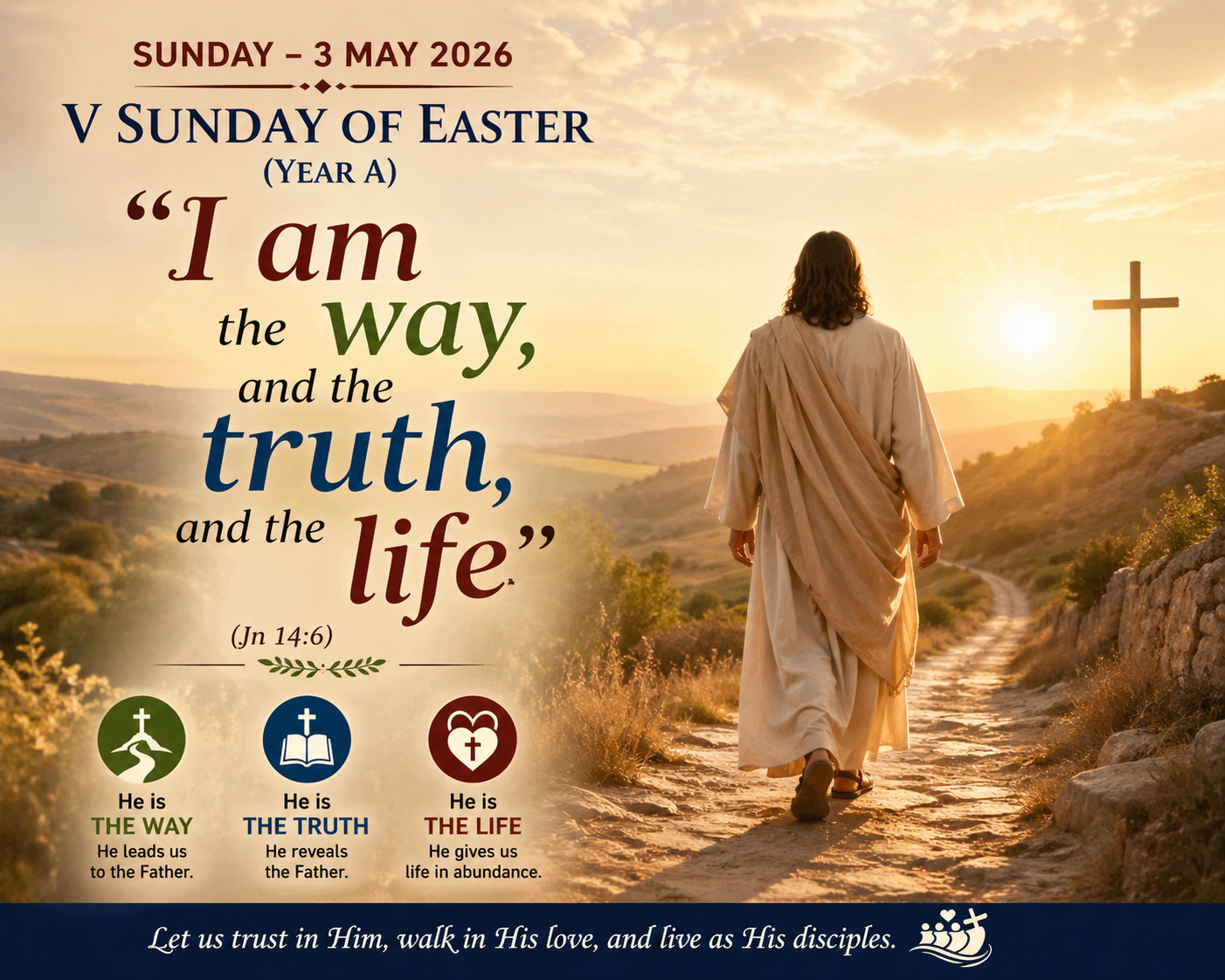
Jesus said to him, I am the way, and the truth, and the life. No one comes to the Father except through me. (John 14:6).
Dear Brothers and Sisters in the Lord,
The Liturgy of the Word on this Fifth Sunday of Easter offers us three beautiful readings centered on the relationship of Jesus with His Heavenly Father.
In the first reading from the Acts of the Apostles, we are given a clear vision of the importance of prayer and the ministry of the Word in the life of the Church.
The apostles remind us that the Church must remain rooted in prayer and in the proclamation of the Gospel. A synodal Church is one that listens, understands, walks together, and actively shares in the mission of Christ.
In the second reading, St. Peter reiterates that Jesus stands at the very center of the wonderful edifice of the Church, for Christ is the “living stone” (1 Peter 2:4), rejected by human beings but chosen and precious in the sight of God. Jesus Himself was rejected—misunderstood, opposed, and ultimately crucified—yet He became the cornerstone of our faith and salvation.
In the Gospel, Christ invites us to trust in Him at all times, even amidst betrayal, fear, uncertainty, and anxiety, for He is “the way, and the truth, and the life” (John 14:6). In Him, we find our path, our hope, and our eternal destiny.
The First Reading
In the First Reading today (Acts 6:1-7), we see a dispute arise within the early Church. The Hellenistic Jews complained against the native Hebrews because their widows were being neglected in the daily distribution of food. Amidst this confusion, the Twelve Apostles addressed the congregation of disciples, explaining that they could not neglect the ministry of the Word of God to serve at tables. Consequently, they suggested choosing seven men—the first deacons—who were full of the Spirit and wisdom to oversee this practical service. By delegating these duties, the Apostles were able to devote themselves fully to prayer and the ministry of the Word: "But we will devote ourselves to prayer, and to the ministry of the word" (Act 6:4).
This passage from the Acts reminds us that every member of the Church has a unique and essential role to play in the body of Christ. Just as the Apostles prioritized spiritual nourishment, the deacons ensured that no one was left behind in their physical needs, showing that true ministry requires both action and contemplation. May we seek the guidance of the Holy Spirit to recognize our own specific calling, serving the community with a heart that is always rooted in prayer.
The Second Reading: “Called to Be Living Stones”
The second reading from the first letter of St. Peter presents to us a beautiful and powerful image: we are living stones being built into a spiritual house. At the center of this house is Jesus Christ, the “living stone,” (1 Peter 2:4) rejected by human beings but chosen and precious in the sight of God. Jesus Himself was rejected—misunderstood, opposed, and finally crucified. Yet, in God’s plan, He became the cornerstone, the very foundation of our faith. What the world rejected, God exalted. St. Peter goes further and says that we are not just stones, but also a royal priesthood (1 Peter 2:9). This means that our whole life becomes an offering to God. We may not stand at the altar as ordained priests, but through our daily lives—our work, our sacrifices, our prayers, our acts of love—we offer “spiritual sacrifices” pleasing to God. Finally, we are reminded of our mission: “to proclaim the mighty works of Him who called us out of darkness into His marvellous light.” We are not meant to keep our faith to ourselves. We are called to witness—to bring light into the darkness of the world through our words and our lives.
The Gospel Reading
The Gospel of this Sunday presents the Last Supper discourse, where Jesus prepares His disciples for His departure. During the Last Supper discourse, as presented by St. John, Jesus speaks clearly to His disciples about His imminent departure. He knows that the betrayal, suffering, and passion that await Him will deeply disturb their hearts. Therefore, before anything else, He prepares them spiritually.
Jesus assures them that He is going to the Father to prepare a place for them and will return to take them into eternal communion with Him. In response to Thomas’ question, Jesus reveals a profound truth: “I am the way, the truth, and the life,” (John 14:6) showing that He alone leads us to the Father and is the living presence of God among His people.
Jesus invites them not to be overcome by fear or anxiety: “Do not let your hearts be troubled. Believe in God, believe also in me” (John 14:1). He asks them to remain strong by trusting in the closeness and faithfulness of God. Faith becomes their anchor in the midst of uncertainty.
Jesus also explains the purpose of His departure. He is returning to the Father in order to prepare a place for them. His going away is not abandonment, but preparation. Those who have walked with Him on earth are also called to dwell with Him in the eternal presence of the Father. He assures them that He will return and take them to the Father’s house.
This is a beautiful revelation of God’s heart: in the Father’s house, there is room for everyone. In the heart of God, there is always a place for every human person. This intimate communion with the Father is what Jesus Himself lived throughout His earthly life and ministry. His mission was always rooted in His union with the Father.
The Spirituality of the Father
The Gospel of this Sunday reveals to us the profound mystery of the union between the Father and the Son in Jesus Christ. Jesus often spoke to His disciples about the Father. His entire life was a reflection of the Father’s love and will. Therefore, the disciples too must learn to follow Jesus in His relationship with the Father. Yet, they still struggle to understand the depth of His message. Thomas, speaking with honesty and confusion, asks: “Lord, we do not know where you are going. How can we know the way?” (John 14:5). Jesus responds with one of the most powerful declarations in the Gospel: “I am the way, and the truth, and the life. No one comes to the Father except through me” (John 14:6).
This is not merely a teaching; it is a revelation of His identity. Jesus does not say that He knows the way—He says, I am the way. He does not simply teach the truth—He is the truth. He does not merely give life—He is life itself. In this declaration, Jesus reveals Himself as the living presence of God among His people, echoing the divine revelation of God in Exodus: “I AM WHO I AM” (Exodus 3:14). God is life, and it is He alone who gives life.
Life in Abundance
Jesus came into the world so that we may have life in abundance (John 10:10)—not merely physical existence, but fullness of life in God. He is the source of eternal life. The Psalmist beautifully prays: “You show me the path of life” (Psalms 16:11). Jesus is that path. He leads us not only through the struggles of this earthly life but also into eternal communion with the Father.
He is also the truth—the only truth worth seeking. In a world filled with confusion, half-truths, and false promises, Christ remains the unchanging truth. Before Pilate, Jesus declared: “For this I was born, and for this I came into the world, to testify to the truth” (John 18:37). He also assures His disciples: “If you continue in my word… you will know the truth, and the truth will make you free” (John 8:31–32). True freedom is found only in Christ. Truth is not an idea; it is a person—Jesus Himself.
And He is the way. There are many roads offered by the world, but only one leads to the Father. Christ alone reveals the Father and leads us safely to Him.
Therefore, like the Psalmist, we must pray: “Make me to know your ways, O Lord; teach me your paths” (Psalms 25:4). And again: “Teach me your way, O Lord, that I may walk in your truth; give me an undivided heart to revere your name” (Psalms 86:11).
Jesus Means Knowing the Father Personally
Jesus continues by teaching the disciples that to know Him is to know the Father personally. Jesus lived in deep intimacy with the Father—through prayer, preaching, healing, and every act of His ministry. He constantly experienced the Father’s presence and acted according to His will.
Then Philip asks: “Lord, show us the Father, and we will be satisfied” (John 14:8). This is a deeply human request. Every human heart longs for God. Only God can fully satisfy the human soul.
Jesus answers Philip with gentle firmness: “Whoever has seen me has seen the Father” (John 14:9). To see Jesus is to see God. To hear Jesus is to hear God. To walk with Jesus is to walk with the Father. This is the heart of Christian faith: God is not distant. In Christ, God has become visible, touchable, and approachable.
That is why Jesus asks Philip: “Do you not believe that I am in the Father and the Father is in me?” (John 14:10). Faith begins here—believing in the inseparable union of the Father and the Son. This same faith led St. Peter to proclaim Christ as the cornerstone of life: “To you who believe, He is precious” (1 Peter 2:7). For the believer, Jesus is not simply important—He is everything.
Faith in Jesus and Miracles
Jesus finally assures His disciples that their faith in Him will empower them to continue His mission: “The one who believes in me will also do the works that I do and, in fact, will do greater works than these” (John 14:12). This is an astonishing promise. Faith is never passive. True faith makes us participants in the mission of Christ. Through preaching, healing, forgiveness, and service, believers continue the saving work of Jesus in the world.
Wherever we go carrying the presence of Christ, we can be certain that His power accompanies us. His grace works through ordinary people who trust Him with extraordinary faith. It takes courage to believe. It takes simplicity of heart to surrender. But when we trust in Him, His mighty presence sustains us. Therefore, let us not allow our hearts to be troubled. Let us remember always: Jesus is the way, the truth, and the life.
Points for Personal Reflection
Do I trust in the Lord’s powerful presence during moments of crisis, suffering, and uncertainty?
Do I truly know Jesus as my life, my truth, and my only way to reach the Father?
Do I ask the Lord each day to reveal the father more deeply to me?
Do I live with the awareness that God is present in my life and walks with me always?
© 2026 CATHOLIC CONNECT POWERED BY ATCONLINE LLP