
English
Mass Readings -
Act 2:14.36-41, Ps 23:1-3a. 3b-. 4. 5. 6(1), 1 Peter 2:20-25, John 10:1-10.
Key Verse to Meditate -
Again, Jesus said to them, "Very truly, I tell you, I am the gate for the sheep". (John 10:7).
My dear brothers and sisters in the Lord,
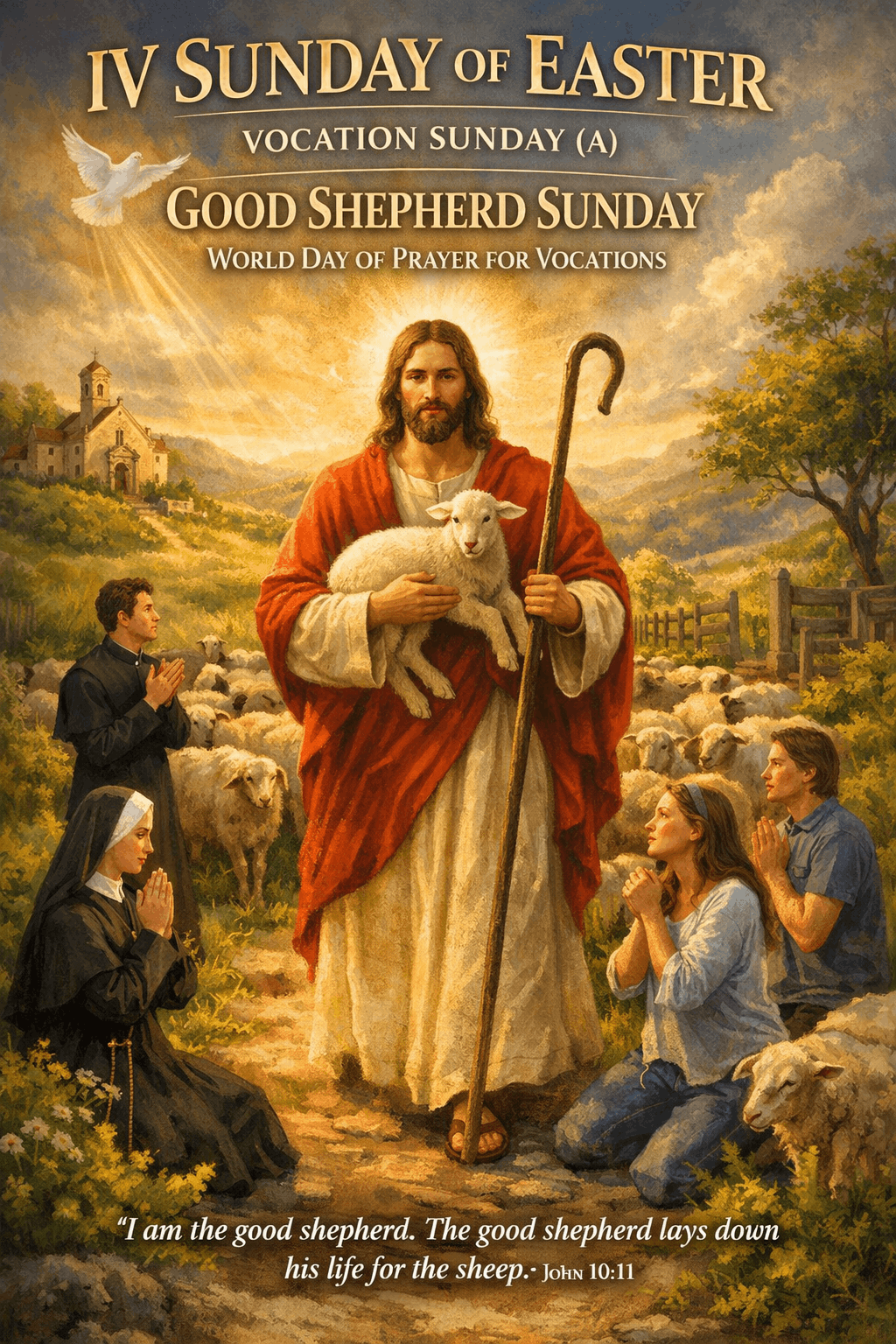
The Fourth Sunday of Easter is traditionally known as Good Shepherd Sunday, because every year the liturgy invites us to reflect on the image of Jesus as the Good Shepherd, presented in the tenth chapter of the Gospel of John. This beautiful image reminds us not only of Christ’s loving care for His people but also of the need for shepherds in the Church who guide and care for the faithful.
For this reason, this Sunday is also observed as the World Day of Prayer for Vocations, instituted by Pope Paul VI in 1964. On this day, the Church invites all believers to pray earnestly that many young men and women may respond generously to God’s call to serve His people as priests, religious, and committed lay leaders, following the example of the Good Shepherd.
The First Reading
The first reading is taken from the Acts of the Apostles. This passage follows the event of Pentecost, where the disciples, filled with the Holy Spirit, spoke in tongues and were understood by people of different languages. As the crowd wondered about this event, Peter stood up and addressed the people of Jerusalem:
“Men of Judea and all who live in Jerusalem, let this be known to you, and give heed to my words” (Acts 2:14).
Peter, who had once been saddened and fear-stricken, is now filled with the power of the Holy Spirit and boldly gives witness before the crowd. He proclaims that Jesus Christ, whom they crucified, is the one whom God has made both Lord and Christ. On hearing this powerful message and accusation, the Scriptures say that they were “pierced to the heart,” and they asked Peter and the other apostles, “Brethren, what shall we do?” (Acts 2:37). This expression, “pierced to the heart,” reveals the power of God’s Word, as described in the Letter to the Hebrews:
“For the word of God is living and active, sharper than any two-edged sword, piercing to the division of soul and spirit, of joints and marrow, and able to judge the thoughts and intentions of the heart” (Hebrews 4:12).
Similarly, in the Bread of Life discourse, when people sought Jesus the next day for material food, He challenged them not to seek the food that perishes but the food that endures for eternal life, which the Son of Man will give. In response, they asked, “What must we do, to be doing the works of God?” (John 6:28). In the same spirit, Peter clearly invites the people:
“Repent, and be baptized every one of you in the name of Jesus Christ for the forgiveness of your sins; and you will receive the gift of the Holy Spirit” (Acts 2:38).
The Word of God has the power to transform the life of the community. It pierces the human heart, leading people to repentance and opening them to receive forgiveness in Christ. When we allow the Spirit of God, present in the Scriptures, to work within us, our lives too will be transformed, and we will become true witnesses to Christ.
When we truly listen to God’s Word with an open heart, it does not leave us unchanged; it calls us to conversion and renewal. Like the early believers, may we respond with sincerity, allowing the Holy Spirit to shape our lives and make us courageous witnesses of Christ.
The Second Reading
In the second reading, St. Peter reminds the community of believers that enduring suffering requires discernment. When we sin and are punished, there is no merit in simply enduring it. But when we do what is right and suffer for it, and patiently endure, we find Favor with God. This, Peter teaches, is the very path that Christ Himself walked for our sake.
In such moments of unjust suffering, we are called to look to the crucified Saviour as our model. Though Christ committed no sin and no deceit was found in His mouth, He willingly accepted suffering and death, entrusting everything to God. As Peter writes:
“For to this you have been called, because Christ also suffered for you, leaving you an example, that you should follow in His steps. He committed no sin, and no deceit was found in His mouth. When He was reviled, He did not revile in return; when He suffered, He did not threaten, but entrusted Himself to Him who judges justly” (1 Peter 2:21–23).
Referring to the prophecy of Isaiah, Peter further affirms that Jesus bore our sins in His body on the cross, so that we might die to sin and live for righteousness. “By His wounds you have been healed” (cf. Isaiah 53:4, 11; 1 Corinthians 15:3). The purpose of Christ embracing such a humiliating and painful death was to lead us away from sin and guide us into a life of righteousness. Through His sacrifice, we who were once wandering and straying far from God have now found our way back to Him. Christ is the Good Shepherd, the true guardian of our souls (1 Peter 2:25), who lovingly leads us into the fullness of life.
Christian discipleship is not merely about avoiding suffering, but about enduring it with faith when it comes as a result of doing what is right. When we unite our struggles with Christ’s suffering, they become a path of grace, drawing us closer to the Good Shepherd who heals, guides, and strengthens our souls.
The Gospel Reading: The Good Shepherd and His Sheep
In the Gospel passage, Jesus uses rich imagery drawn from the pastoral world to reveal His identity. He presents Himself not only as the Good Shepherd but also as the gate (door) of the sheepfold. “I am the gate for the sheep… Whoever enters by me will be saved, and will come in and go out and find pasture” (John 10:7, 9). Unlike hired workers or mercenaries, who work only for wages and abandon the sheep in times of danger, the true shepherd knows his sheep personally and loves them deeply. There is a profound bond between the shepherd and the sheep—he calls them by name, and they recognize his voice. Jesus, the Good Shepherd, is not a mere caretaker; He is the owner of the flock. He protects, guides, and even lays down His life for His sheep.
The Call to Repentance and New Life
Both the First and Second Readings echo this message of salvation and belonging. In the First Reading (Acts 2:38), St. Peter calls the people to repentance:
“Repent, and be baptized… so that your sins may be forgiven; and you will receive the gift of the Holy Spirit.”
This invitation is a call to enter through Christ, the true gate, and to become part of His flock. In the Second Reading, St. Peter reminds us that we were once like sheep going astray, but now we have returned to the Shepherd and Guardian of our souls:
“By his wounds you have been healed” (1 Peter 2:24–25).
Jesus, the Good Shepherd, laid down His life for us on the Cross, taking upon Himself the burden of our sins and opening for us the path to righteousness and new life.
Jesus the Gate: The Way to Salvation
A key word in today’s Gospel is “gate” or “door.” Jesus says: “I am the gate.” The gate serves as the point of entry and exit. Through Christ, we find salvation, freedom, and nourishment. Entering through Him means accepting His teachings, trusting in His love, and living according to His will. This “entering and going out” signifies a dynamic relationship—one of freedom and trust. In Christ, we find not restriction, but true freedom that leads to abundant life.
True Shepherd vs False Shepherds
Jesus clearly distinguishes Himself from false shepherds—thieves, robbers, and mercenaries—who exploit the sheep for their own benefit. They neither love nor protect the flock:
“All who came before me are thieves and bandits… but the sheep did not listen to them” (John 10:8).
False leaders mislead, manipulate, and ultimately destroy. But Jesus, the true Shepherd, leads with love, humility, and sacrifice. He invites us:
“Learn from me; for I am gentle and humble in heart” (Matthew 11:29).
He also warns us to be vigilant:
“Enter through the narrow gate… Beware of false prophets… you will know them by their fruits” (Matthew 7:13–16).
The Role of Pastors and the Christian Community
In the Church, pastors are called to reflect the image of the Good Shepherd. They are to guide, protect, and walk closely with the faithful. The Christian community becomes the sheepfold, and Christ remains the true gate through whom all must enter. The freedom Christ offers invites each person to make a choice—to enter through Him and receive life, or to remain outside. Choosing Christ is choosing life in abundance.
The Good Shepherd Who Leads Us
Jesus is not only the gate but also the Shepherd who walks ahead of us. He knows each one of us by name, loves us personally, and offers His life for us. He continues to guide us through His Word, the Sacraments, and the teachings of the Church. As His sheep, we are called to listen to His voice, trust in His guidance, and follow Him faithfully without hesitation.
Spiritual Conclusion: Listening to the Voice of the Shepherd
Dear brothers and sisters, Jesus is our Good Shepherd—loving, caring, and ever faithful. He calls each one of us by name and invites us into a deep and personal relationship with Him.
Today, let us ask ourselves:
• Am I listening to the voice of the Good Shepherd?
• Do I allow Him to guide my life?
• Am I willing to follow Him, even when the path is narrow and challenging?
Let us also pray for vocations, that many may respond generously to God’s call to shepherd His people. May we learn to trust the Good Shepherd, walk in His ways, and find in Him true peace, security, and abundant life.
Let us remember the beautiful words of Psalm 23:
“The Lord is my shepherd; there is nothing I shall want.”
© 2026 CATHOLIC CONNECT POWERED BY ATCONLINE LLP