
English
Mass Readings -
Act 2:14.22-33, Psalm 16, 1 Peter 1:17-21, Luke 24:13-35.
Key Verse to Meditate -
"Oh, how foolish you are, and how slow of heart to believe all that the prophets have declared (Luke 24:25).
My dear brothers and sisters in the Lord,
The liturgy of this Sunday beautifully invites us to reflect on a profound truth: the Risen Lord walks with His people, transforms their despair into hope, and reveals Himself through the Scriptures and the Eucharist. The three readings together present a journey of faith—from proclamation, to redemption, to personal encounter.
In the First Reading, St. Peter boldly proclaims the mystery of Christ’s death and Resurrection. In the Second Reading, he reminds us that we are redeemed not by earthly wealth, but by the precious Blood of Christ. And in the Gospel, we witness the moving encounter of the Emmaus disciples with the Risen Lord—an encounter that transforms their sorrow into mission.
The First Reading: The Bold Proclamation of the Resurrection
In the first reading (Acts 2:14, 22–33), we see St. Peter addressing the people after the outpouring of the Holy Spirit. The once fearful disciple now speaks with courage and conviction, proclaiming God’s plan in the death and Resurrection of Jesus:
“This man… you crucified and killed… but God raised Him up, having freed Him from death” (Acts 2:22–24).
Peter emphasizes that this was not an accident, but part of God’s divine plan. He further strengthens his message by referring to King David, who had already prophesied about the Resurrection:
“You will not abandon my soul to Hades, or let your Holy One experience corruption” (Acts 2:27).
Thus, the Resurrection is not a fabricated story, but the fulfilment of God’s promises in Scripture. The apostles stand as witnesses to this truth.
The Second Reading: Redeemed by the Precious Blood of Christ
In the second reading (1 Peter 1:17–21), St. Peter reminds us of the cost of our salvation. We were not redeemed with perishable things like silver or gold, but with the precious Blood of Christ.
Through His death and Resurrection, Jesus becomes the bridge that reconnects humanity with God. As St. Peter says: “Through Him you have come to trust in God… so that your faith and hope are set on God” (1 Peter 1:21). This truth calls us to live a life of holiness, reverence, and gratitude, knowing the immense love with which we have been redeemed.
The Gospel: The Emmaus Encounter
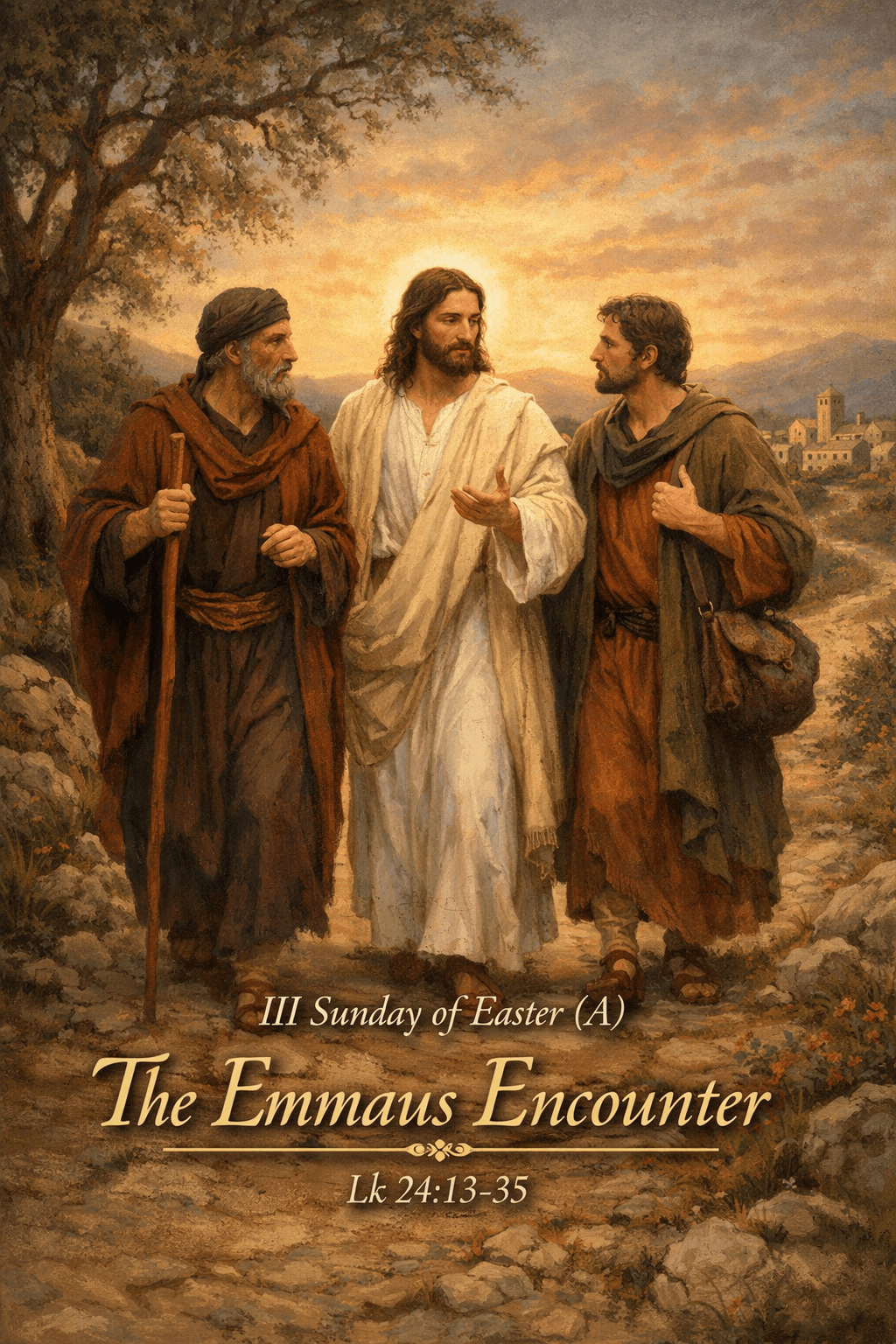
The Gospel presents the beautiful and deeply symbolic encounter of the Emmaus disciples with the Risen Lord (Luke 24:13–35). This passage is truly a masterpiece of both liturgical and missionary catechesis. Two disciples, disheartened and confused after the crucifixion, leave Jerusalem and walk toward Emmaus. One is named Cleopas; the other remains unnamed—perhaps representing each one of us.
The Painful Journey from Despair
Their journey is not just geographical; it is spiritual. They move away from Jerusalem—the place of hope—and descend into disappointment and confusion. Their dreams seem shattered by the Cross. Yet, in their moment of despair, Jesus draws near. He walks with them, listens patiently to their fears, and gently begins to guide them. This reminds us that the Risen Lord never abandons us, especially in moments of doubt, crisis, and confusion. When our struggles reach their peak, His presence is often closest to us.
The Lord Opens the Scriptures
Just as in the Old Testament, where God walked with man in the Garden of Eden, so too Jesus walks alongside the Emmaus disciples, though as a stranger. We are not sure why they could not recognize Him. The point is that they had forgotten His teachings regarding His death and resurrection.
The disciples fail to recognize Jesus, not because He is absent, but because their hearts are slow to believe. Jesus rebukes them for their lack of faith and understanding:
“Oh, how foolish you are, and how slow of heart to believe all that the prophets have declared!” Then, beginning with Moses and all the prophets, He interpreted to them everything concerning Himself in the Scriptures (Luke 24:27).
This teaches us a profound truth: only Christ can fully open the meaning of Scripture, for He is the Word made flesh. Later, the disciples would recall:
“Were not our hearts burning within us while He was talking to us on the road?” (Luke 24:32).
Whenever we listen attentively to the Word of God, our hearts too can be set on fire. To recognize the Risen Lord, one needs the proper understanding of the Scriptures. There is no better interpreter than Jesus Himself, for He is the Word made flesh who dwelt among us.
Recognition in the Breaking of the Bread
As they reach Emmaus, the disciples invite Jesus:
“Stay with us, for it is nearly evening” (Luke 24:29).
In this simple invitation lies a deep spiritual truth—we must welcome the Lord into our lives.
At the table, in the breaking of the bread, their eyes are opened, and they recognize Him. Immediately, Jesus vanishes from their sight. His physical presence is no longer necessary; they now recognize Him in faith.
This moment reflects the Eucharist. Even today, though we do not see Him physically, we encounter the Risen Lord in the breaking of the bread. The Church continues to experience His living presence in every Eucharistic celebration.
From Encounter to Mission
The encounter with the Risen Lord transforms the disciples completely. From despair, they move to hope; from fear, to courage. Without delay, they return to Jerusalem—even in the darkness of night—to proclaim the Good News. An authentic encounter with Christ always leads to mission.
Conclusion: Our Emmaus Experience Today
Dear brothers and sisters, The Emmaus event remains a masterpiece of comforting dialogue. It assures us that when we listen to the Scriptures in the Liturgy of the Word and participate in the breaking of the bread in the Eucharistic celebration, we truly encounter the Risen Lord Jesus Christ and receive faith, hope, and consolation.
The Emmaus story is not just an event of the past—it is our story today. Every Eucharist is an Emmaus experience. In the Liturgy of the Word, Jesus speaks to us. In the breaking of the bread, He reveals Himself to us.
When we come to Mass with faith, we too encounter the Risen Lord who walks with us, strengthens us, and transforms us.
Let us ask ourselves:
1. Do I listen attentively to the Word of God?
2. Do I truly participate in the Eucharist?
3. Do I recognize the Risen Lord in my daily life?
4. Do I trust that He never abandons me, even in moments of doubt?
May our hearts burn with love for the Lord. May we invite Him to stay with us. And may every Eucharistic encounter transform us into joyful witnesses of His Resurrection - Amen.
© 2026 CATHOLIC CONNECT POWERED BY ATCONLINE LLP