- 09 June, 2026

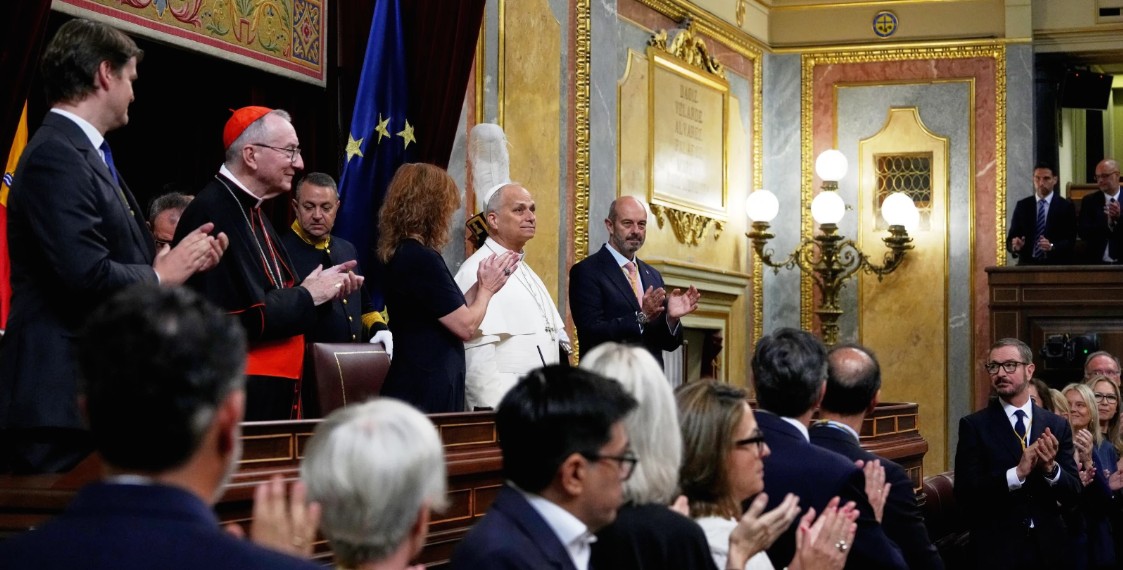
MADRID, Spain, June 9, 2026: – In a moment that will likely be remembered as one of the defining scenes of Pope Leo XIV’s pontificate, Spain’s lawmakers rose to their feet and applauded for more than seven minutes after the Holy Father delivered a historic address to the Spanish Parliament.


The prolonged standing ovation, accompanied by chants of “Viva il Papa!” (“Long live the Pope!”), came after Pope Leo called for greater respect for migrants’ rights, the protection of human dignity, adherence to international law, and a renewed moral vision in public life.
The event marked the first time a Pope has addressed Spain’s national legislature, the Cortes Generales, making the occasion significant not only for the Catholic Church but also for modern Spain, a nation that has become increasingly secular over recent decades. The thunderous response from lawmakers surprised many observers and signalled a remarkable level of respect for the Pope’s moral leadership in a country where religious influence in public life has often been viewed with caution.
For Catholics around the world, the ovation represented more than admiration for a speech. It reflected recognition of the Church’s continuing role as a voice for conscience, justice, peace, and the defence of human dignity in an increasingly divided world.


The extraordinary reception given to Pope Leo XIV carried significance far beyond parliamentary protocol. Spain, once one of Europe’s strongest Catholic nations, has experienced a sharp decline in religious observance over the past several decades. Many younger Spaniards identify as secular, and the Church’s influence in public life has diminished considerably since the democratic transition following the Franco era.
Against this backdrop, the standing ovation was a striking moment. Lawmakers from across the political spectrum rose in appreciation of a speech that appealed not to partisan interests but to universal moral principles.
The applause reflected recognition of the Pope’s ability to speak credibly on issues affecting humanity as a whole. Rather than presenting political solutions, Pope Leo offered a moral framework rooted in human dignity, solidarity, and the common good. In doing so, he demonstrated why the papacy continues to hold influence on the world stage even in increasingly secular societies.
At the heart of Pope Leo’s address was a challenge to political leaders to pursue what he described as a “moral renewal” in public life.
“The moral greatness of a nation is manifested, above all, in its capacity to accompany, protect and love those lives that are most fragile,” the Pope declared.
The Holy Father reminded lawmakers that political leadership is not merely about legislation, economics, or power. It is ultimately about serving people, especially those who are most vulnerable.
Throughout the speech, he stressed that every human person possesses inherent dignity and worth. This dignity, he said, should guide all political decisions and public policies.
His words echoed the Church’s long-standing social teaching that the measure of a society is found in how it treats its weakest members.
One of the most significant themes of the Pope’s address was migration.
Building upon the pastoral priorities of Pope Francis, Pope Leo urged governments to adopt a balanced and compassionate approach towards migrants and refugees. He called for safe and legal pathways for migration while simultaneously addressing the conditions that force people to leave their homes.
The Pope highlighted war, poverty, economic inequality, insecurity, and climate-related challenges as major causes of displacement across the globe.
He stressed that societies have a responsibility to welcome those seeking protection while creating meaningful opportunities for integration. At the same time, he insisted that international efforts should focus on enabling people to remain safely in their own countries whenever possible.
His message reflected the Church’s conviction that migrants are not statistics or political problems but human beings created in the image and likeness of God.
The Pope’s speech came at a time of growing international instability, particularly amid escalating tensions in the Middle East.
Addressing these concerns, Pope Leo renewed his call for dialogue, diplomacy, and respect for international law. He warned against allowing military confrontation to become the preferred solution to global disputes.
The Holy Father expressed concern about increasing military rearmament in various regions of the world and cautioned leaders against accepting conflict as inevitable.
Instead, he urged nations to embrace what he described as “diplomatic courage” and recommit themselves to peaceful methods of resolving disagreements.
His appeal reinforced the Vatican’s consistent message that lasting peace can only be achieved through dialogue, justice, and mutual respect.
Another important section of the speech focused on emerging technologies and artificial intelligence.
Pope Leo repeated his growing concern regarding autonomous weapons systems and the use of artificial intelligence in warfare. He warned that decisions involving life and death must never be surrendered entirely to machines.
The Pope called for rigorous ethical oversight of technological advancements and insisted that moral responsibility must always remain with human beings.
As artificial intelligence continues to transform societies around the world, the Holy Father’s intervention highlighted the Church’s desire to ensure that technological progress remains rooted in ethical principles and respect for human life.
Drawing upon Spain’s rich intellectual heritage, Pope Leo praised the sixteenth-century School of Salamanca, whose theologians and scholars helped shape early concepts of international law and universal human rights.
These thinkers argued that power must always be subject to moral limits and that justice cannot be determined solely by political or military strength.
However, the Pope also acknowledged that neither society nor the Church has always lived up to these principles.
In a moment of honesty and humility, he referred to historical failures connected to colonial expansion and slavery, recognising that Christian ideals were not always faithfully applied in practice.
His comments reflected the Church’s continuing commitment to historical truth, repentance, and reconciliation.
Pope Leo also addressed the growing divisions affecting many democracies today.
Without endorsing any political party or ideology, he warned that political pluralism must not deteriorate into hostility and constant attacks against opponents.
Healthy disagreement, he said, is essential in democratic societies. However, respect for one another must remain intact even amid profound differences.
His remarks resonated strongly in contemporary Spain, where political tensions have become increasingly pronounced in recent years.
The Pope’s message served as a reminder that politics should seek the common good rather than deepen social divisions.
While the seven-minute ovation in Spain was extraordinary, it joins a number of memorable moments in modern papal history.
In 2015, Pope Francis received multiple standing ovations during his historic address to the United States Congress. His reflections on immigration, human dignity, care for creation, and religious freedom resonated across party lines.
Similarly, Pope Benedict XVI was warmly received during his 2011 address to Germany’s Bundestag. His speech on the relationship between law, morality, and reason was praised internationally for its intellectual depth.
Perhaps the most powerful historical parallel remains St John Paul II’s 1979 visit to Poland. Although not delivered before a parliament, his speeches inspired millions and contributed to a spiritual awakening that helped transform Eastern Europe.
Yet Pope Leo’s reception in Spain remains particularly noteworthy because it occurred within one of Europe’s most secularised nations, demonstrating that the moral voice of the papacy continues to command respect far beyond practising Catholic communities.
The Vatican has not focused on the duration of the applause itself, but Church leaders have recognised the deeper significance of the moment.
Many Catholics around the world viewed the standing ovation as an affirmation of the values Pope Leo presented: compassion, justice, peace, human dignity, and responsible leadership.
Across social media and Catholic communities, the event was greeted with enthusiasm and gratitude. For many faithful, it served as a reminder that the Church’s message continues to resonate even in societies where religious practice has declined.
The ovation was not simply a tribute to Pope Leo XIV as an individual. Rather, it reflected appreciation for the enduring moral witness of the Church and the timeless truths of the Gospel.
As chants of “Viva il Papa!” echoed through Spain’s parliament chamber, Catholics around the world witnessed a remarkable moment in the life of the Church.
More than seven minutes of applause became a visible sign that the voice of the Successor of St Peter continues to inspire attention, respect, and hope in an age searching for moral direction.
In a secular Europe often portrayed as distant from its Christian roots, Pope Leo XIV’s historic reception in Madrid offered a powerful reminder that the Church’s mission remains alive: to proclaim the dignity of every person, defend the vulnerable, promote peace, and call nations towards justice and the common good.
The standing ovation was more than a parliamentary gesture. It was a powerful acknowledgment that the values at the heart of the Gospel continue to speak to the deepest aspirations of humanity.
Courtesy SUMAN NAISHADHAM and NICOLE WINFIELD (AP News)
Photo Courtesy Alessandra Tarantino (AP News)
© 2026 CATHOLIC CONNECT POWERED BY ATCONLINE LLP